

Lot n° 13
Estimation :
7000 - 10000
EUR
Result without fees
Result
: 6 500EUR
MASSELOTTE & BACCARAT - Lot 13
MASSELOTTE & BACCARAT
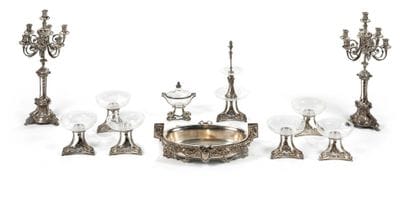
Important tableware of eleven pieces in chased and silvered bronze decorated, partially openwork, with scrolls, scrolls and ribbon races, branches and laurel tori, flowers, acanthus leaves and lines of pearls, including:
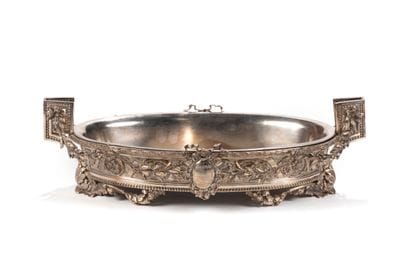
- an oval molded planter, with two Greek-style handles, decorated with two medallions topped with a ribbon bow and highlighted with garlands of fruit, engraved with the coat of arms of the ALIGRE family [dexter] and PREAULX [sinister].
Removable lining in silver plated metal.
18 x 58,5 x 31,4 cm.
- A pair of seven-light candelabra with twisted arms and shafts, with fluted and rudentate sphere punctuated with applied flowers, and resting on a circular base with three projections on three clawed feet.
69 x 32 cm.
Shocks to the wicks.
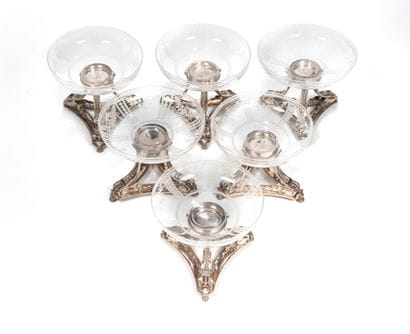
- six cups or compote with circular basins, removable, out of crystal engraved of rectangular cartridges pearled and garlands flowered and with the mounts out of silver plated bronze with hollowed triangular bases, posing on three clawed feet.
H. from 18 to 19,5 cm - Diam. from 20,5 to 21,5 cm.
With two additional basins, one bearing a BACCARAT label.
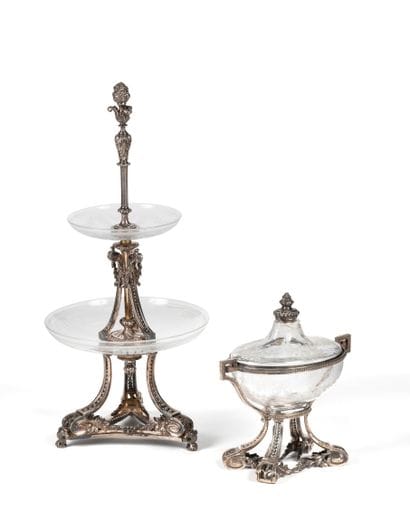
- A dumb waiter with two circular crystal basins engraved in continuation of the cups above and with silvered bronze mountings, with the model of the compotiers.
H. 50 cm - Diameter: 22 or 15 cm.
- a candy box with the body and the lid out of crystal engraved of garlands of leaves and flowers and with mount out of silver plated bronze, decorated in continuation, with two small handles with the Greek and resting on four amounts in rollings joined together by garlands of leaves.
23 x 22 cm.
Body and lid cracked, the lid with the presence of glue.
No goldsmith's mark.
Several pieces marked MASSELOTTE, with model and assembly numbers.
Louis XVI style, Second Empire period, circa 1857-1860.
Some scratches from use; some oxidation.
Set contained in its oak trunk, with two trays, and lined with red tinted skin (some cracks; wear and faded color of the skin).
A MASSELOTTE, metal gilder, is referenced at 1 rue du Foin, under the sign "Au Marais" in the 1842 Almanach-Bottin du Commerce de Paris, by Sébastien BOTTIN (p. 114).
Emile-Jean MASSELOTTE, gilder on metals, is referenced at 2 rue Neuve-Saint-Pierre, with the square punch E.M. with beehive, registered on December 13, 1860.
It would thus be about the gilder on metals, of which we know a mention on his subject in an article dedicated to the engraver-modeller Émile PHILIPPE, on the occasion of the World Fair of 1867, in the part "Industrial Art": "Since the invention of gilding with the battery, a serious disadvantage had occurred. The electric current is very sparing of metal and deposits infinitesimals, which are sufficient to the point, since the whole piece is coated and shines [...]. You rub it in, it's already gone. Manufacturers with a conscience did not know what to do [...]. It was impossible to control the amount of gilding that was applied by the gilder-ruolz.
One had to go back to the old mercury gilding when one wanted a well-made piece [...]. But this gilding kills the workers [...]. However, the consumer wanted it, and we died.
When, seventeen years ago, a young gilder of great talent, Mr. MASSELOTTE, having to operate solidly on very delicate pieces that the old process, too energetic, would have broken, imagined to try to make mercury enter the electric bath".
The same MASSELOTTE is the winner of the 500 Francs prize, created at the end of 1867, by Mr. Goldenberg to reward "the invention of a healthy gilding process which allowed to obtain the matt aspect" without risks for the health of the workers. It is the process known as pyro-electric [Bulletin de la Société d'Encouragement pour l'Industrie Nationale, 69th year, 2nd series, volume XVII, November-December 1870, Report by Mr. Barral, pp. 80-81].
It seems that this gilder also applied his invention to silvering, used here for this particular piece, of which he signed some parts.
In addition to his activity as a gilder, he seems to have been a bronze worker, which would explain the absence of a goldsmith's hallmark on the elements of this surtout.
His signature was found on a Louis XVI style cage clock in marble and gilt bronze, dating from the second half of the 19th century.
The coat of arms corresponds to that of Etienne Marie Charles de POMEREU (1813-1889), Marquis d'ALIGRE and to his two wives bearing the name PREAULX, his cousin Sophie (1842-1873 / marriage in 1857) or the latter's cousin Marie Charlotte (1854-1926 / marriage in 1876).
It is more likely that this piece dates from the first marriage in 1857, especially since it does not yet have the square hallmark inscribed from 1860.
My orders
Sale information
Sales conditions
Return to catalogue