

Lot n° 94
Estimation :
5000 - 7000
EUR
Result without fees
Result
: 2 500EUR
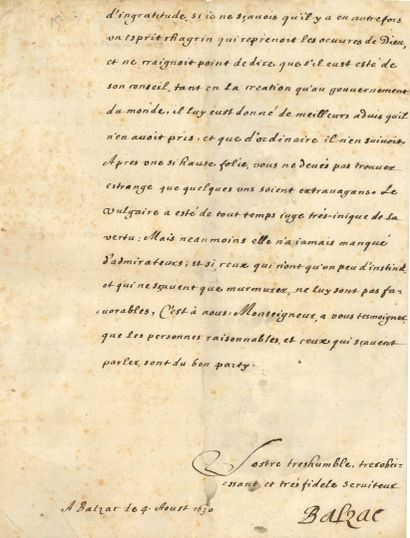
GUEZ DE BALZAC Jean-Louis (1597-1654) literary scholar and e - Lot 94
GUEZ DE BALZAC Jean-Louis (1597-1654) literary scholar and epistolary writer, founding member of the French Academy.
L.A.S. "Balzac", Balzac August 4, 1630, to Cardinal de RICHELIEU; 15 pages in-4.
Magnificent and long letter to Richelieu, superbly calligraphed, where Balzac explains in detail the plan of his work The Prince (1631).
[This letter, which accompanied the homage of a copy of the third book of The Prince devoted particularly to Richelieu, "testifies to Balzac's art of enriching his epistles with the cadence and tricks proper to the oratorical style" (Hélène Carrère d'Encausse); it was published in Les OEuvres, 1665, I, letter xlix.]
"My Lord
Being still arrested here by some business, which I cannot leave without losing them, I suffer with great pain such a hard necessity, and begin to consider myself banished to my country since I am so long away from you. I do not deny that the victorious and triumphant news, which comes to us at all hours from the place where you are, does not give me some emotion of joy, and that I am not appreciably touched by the noise that your name makes on all sides. But my satisfaction cannot be complete, to learn from the reports of others the things to which I should bear witness, and I imagine so much pleasure in considering you in your glory, that there is no soldier beyond the mountains under your command, whose good fortune I do not envy. However, I do not let you, Monseigneur, not being able to serve you with my body and my actions, adore you day and night with my thoughts, and use the noblest part of myself for such a worthy worship. You are the perpetual object of my mind. I almost never turn my mind away from the wonders of your life, and if you have courtiers who are more assiduous than I am, and who do their duties to you with more ostentation and monster, I am certain that you have no more faithful servant, nor one whose affection comes more from the heart, and is more lively and more natural. The cardinal will see in his letter the proof "that a persuaded man has a great disposition to persuade the others, and that the Eloquence animated of the love, and leaned on the truth stirs up well the esprisings with more force, and acquires there much more credibility, than the one which only measures to feign and to declare"...
Balzac then details the plan of his work. "In the first Book it is treated throughout of the virtue and the victories of the King, of the justice of his weapons, of the Royalty, and of the Tyranny, of the Usurpers and of the legitimate Princes, of the chastened Rebellion, and of the maintained Liberty. [] After having considered the King with care, and shown his greatness by itself, I make it see by the comparison of others. [] The whole of the second book is used for these various judgments, and is only concerned with great and illustrious criminals, whose secret faults it uncovers, with a freedom corrected with such discretion, that it does not violate the respect which is due to the quality they have worn. The fourth will contain the principal precepts of civil science, several considerations concerning the State and Religion, and the most necessary rules for governing well, which I have not so much taken from the books I have read, as from your life which I have studied. As for the third, which I forgot, and which concerns you in particular, My Lord, and in which I spoke of the advice of Princes, their servants and their Ministers, it is this that I am sending you, while waiting for me to bring you the rest. Now you know, My Lord, that the kind of writing I have proposed is without comparison the most painful of all, and that it is very difficult to act with perpetual restraint of mind, and to provide an eloquence that lasts. [] As for the Philosophers who have written on Politics, their ratiocination is usually so dry, and so destitute, that it seems that their purpose was rather to instruct than to persuade, and besides their style is so embarrassed, and so sparse, that it seems that they only wanted to teach those who are learned. [] But here, besides the fact that words must be used with more choice, and placed with more accuracy than in simple narrations, which for all the splendor and all the enrichments of expression, want only the clarity and propriety of the terms, I have desired, My Lord, to put into use, and to reduce to action the most subtle ideas of Rhetoric, to raise my reason to the highest point of things, to seek in each matter the less vulgar truths, and less exposed in view, and to make them so familiar, that those who do not perceive them, can touch them. It has been my intention to combine pleasure with utility, to combine delicacy with abundance, to fight not only with good and strong weapons, but also with beautiful and shiny ones, and to civilize the doctrine by despising it.
My orders
Sale information
Sales conditions
Return to catalogue