
Classic
Friday 20 November 2026 at 14:00
Salle 16 - Hôtel Drouot, 9, rue Drouot, 75009 Paris
278 lots
-
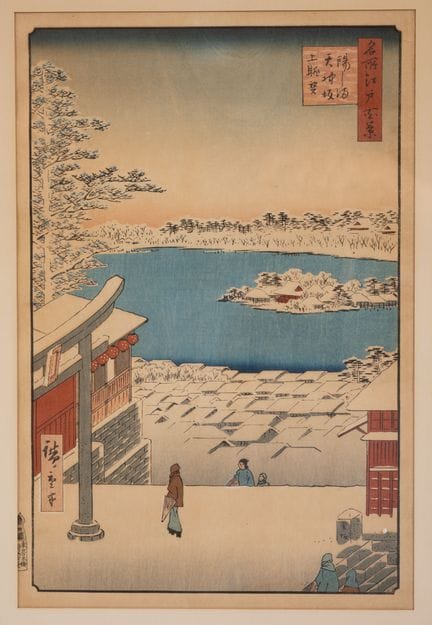
102 - JAPAN, 19th century - CHINA, 20th century * Utagawa HIROSHIGE (1797–1858) - Kanagawa: View from the Ridge, from the series “53 Stations of the Tōkaidō.” Colored woodblock print on paper. Seals. 22 x 34.9 cm (visible when mounted). A few pinholes and stains. - View from the top of the hill, Yushima Tenjin Shrine, No. 117 of the “One Hundred Famous Views of Edo.” Colored woodblock print on paper. Seals. 36 x 24 cm (viewable when mounted). Slightly sun-faded, a few tears. * Utagawa TOYO
Estimate €300 - €500 -
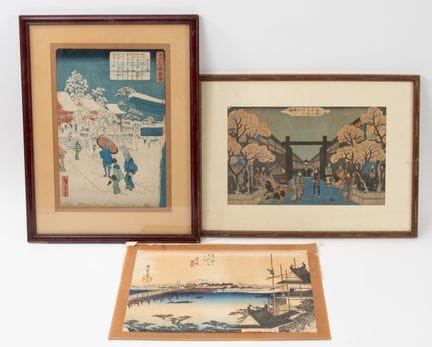
103 - JAPAN, 19th–20th centuries Three prints after Utagawa HIROSHIGE (1797–1858): - The Bridge over the Toyo River 23 x 35 cm. - Fukagawa Hachiman Shrine 34 x 23 cm, framed under glass. - Nakanocho in the Yoshiwara. 21 x 33.5 cm (viewable area), framed, under glass. = Trimmed margins, stains, sun damage, pinholes, small tears.
Estimate €150 - €250 -
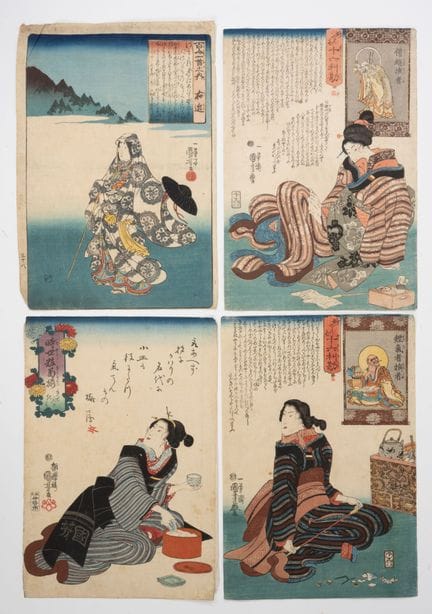
104 - JAPAN, 19th century Set of 4 oban tate-e prints after Utagawa KUNIYOSHI (1797–1861) Actor, woman preparing rice, woman writing, figure wearing a hat. Approx. 36 x 25 cm. Unframed. Signs of wear, soiling, creases, and some trimmed margins.
Estimate €100 - €150 -
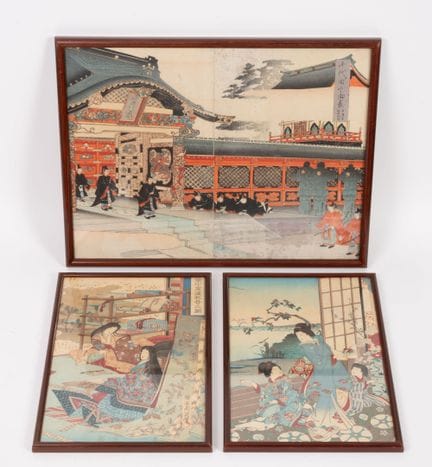
105 - JAPAN, MEIJI period (1868–1912) 3 color prints on paper: - Three women at the entrance to a house, with a landscape in the background. 35 x 23 cm (image size). * Toyohara CHIKANOBU (1838–1912) - Two women indoors, one writing, the other reading. Right panel of the triptych “Reading Poetry with a View of Snow at Court,” originally published in 1886 by Naoyoshi HASHIMOTO. 35 x 23 cm (image size). - Visit by the Tokugawa Shogunate to Zojoji Temple (dedicated to his family) Diptych from the
Estimate €200 - €300 -
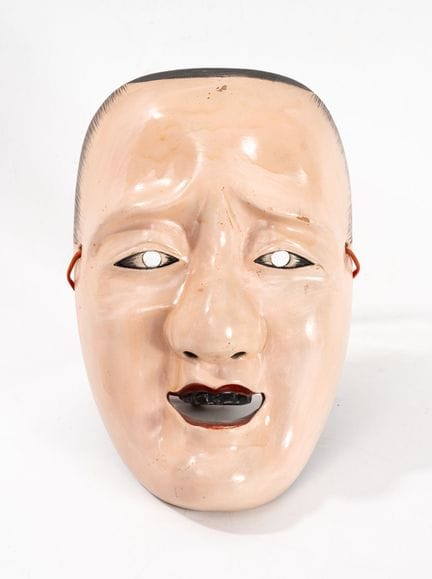
106 - JAPAN, late 19th or early 20th century Noh theater. Chûjô mask. Lacquered wood. Signed NOBUHARA. H. 21 cm. Signs of wear, stains, a few scratches, crazing, chips, and cracks.
Estimate €60 - €80 -
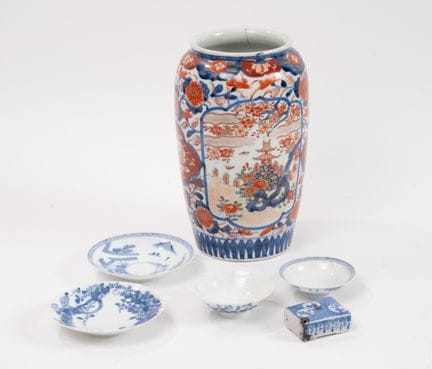
107 - JAPAN, Hirado Kilns—Meiji Period (1868–1912) and 20th century. - Four circular, flared sorbet bowls and two porcelain display stands decorated with underglaze blue designs of thatched roofs or flowers. On the reverse, the mark “Hirado sei Eidamatsu zo.” Diameter of small bowls: 12.6 cm – Bowl: 8.6 cm. Firing defects, cracks, and pitting. - A tubular vase with a round neck, decorated in the Imari style with a pavilion beneath cherry blossoms and chrysanthemum scrolls. 20th century. H. 2
Estimate €70 - €90 -
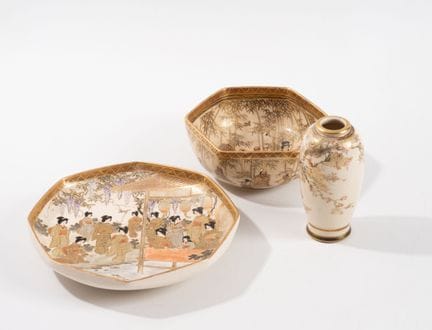
108 - JAPAN, early 20th century. Three pieces of Satsuma earthenware with polychrome and gilded decoration: - A hexagonal bowl decorated with a gathering in a bamboo grove. Diameter: 14 cm - A hexagonal plate decorated with geishas. Diameter: 20 cm - A tapered vase decorated with birds perched on branches. Height: 12 cm.
Estimate €400 - €600 -
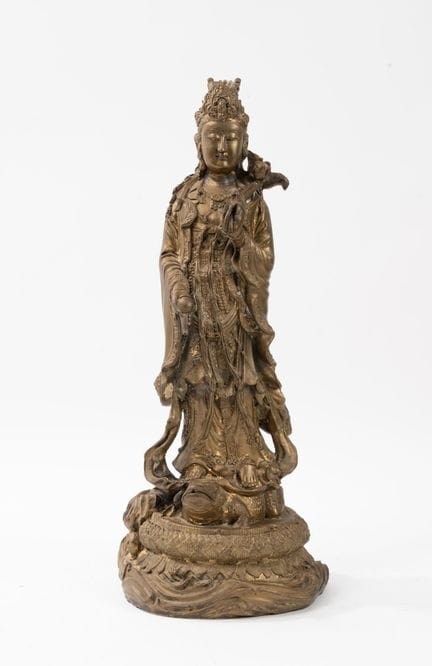
109 - JAPAN, 20th century Kannon Bodhisattva, standing on a frog resting on a lotus flower, holding a lotus flower and pouring ritual water. Bronze figure with a brown patina and traces of gold lacquer. H.: 45 cm. Flaws, wear.
Estimate €200 - €300 -
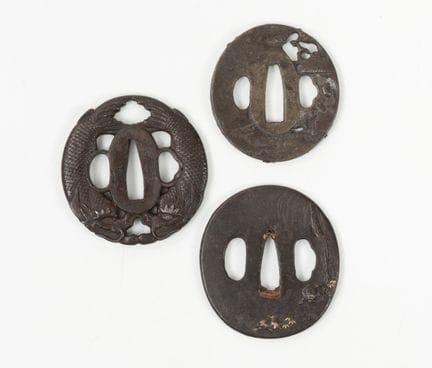
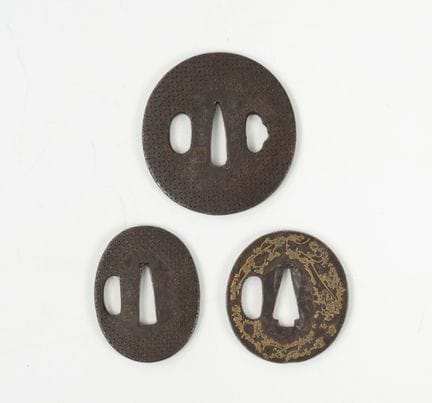
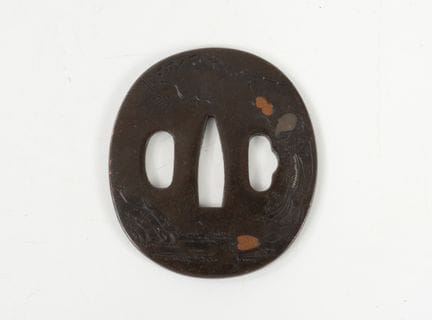
110 - JAPAN, Edo Period (1603–1868) Set of three iron tsubas: - Kawarai-gata shaped like two shachihoko facing each other. Signed Tomohisa. H. 6.8 cm - Nagamaru-gata inlaid with hira zogan depicting shibuichi buffaloes under a weeping willow. H. 6.8 cm - Openwork nagamaru-gata tsuba with a maru-bori design depicting a figure in a thatched cottage. H. 6.1 cm. Patina removed. = Showing signs of use; some wear and scratches.
Estimate €200 - €300 -
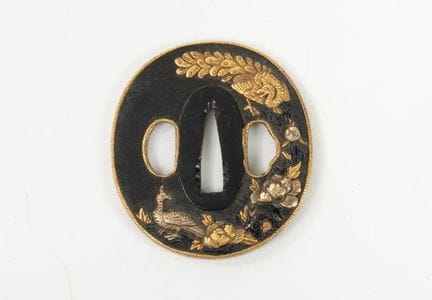
111 - JAPAN, MINO GOTO, EDO PERIOD (1603–1868), 19th century Nagamaru-gata shibuichi inlaid with gilded copper depicting peacocks among peonies on a nanako background. H. 6.5 cm. Shows signs of use, with some wear, particularly on the nanako finish, and scratches.
Estimate €200 - €300 -
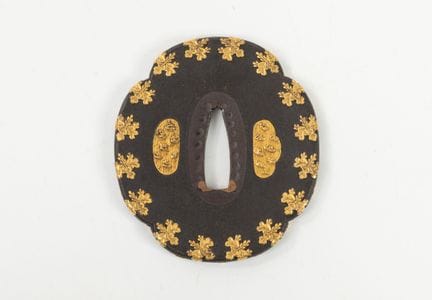
112 - JAPAN, MINO GOTO - Edo Period (1603–1868), 19th century Shibuichi mokko gata with hira zogan inlay of gilded copper featuring paulownia leaves on the mimi against a nanako background. H. 7 cm. Shows signs of use; some wear and scratches.
Estimate €400 - €600 -
113 - JAPAN, Edo Period (1603–1868), 19th century Three nagamaru-gata: - two made of openwork iron with shippo motifs. Signed. H. 5.6 and 6.8 cm. - one inlaid with brass using the gomoku-zogan technique. H. 5.5 cm. Minor oxidation. = Showing signs of use, with some wear and scratches.
Estimate €150 - €200 -
114 - JAPAN, Edo Period (1603–1868), 19th century Shibuichi nagamaru-gata inlayed with nunome zogan using shibuichi and suaka, and engraved with katakiri bori depicting Jurojin and peaches. H. 6.5 cm. Shows signs of use, with some wear, scratches, and minor chips.
Estimate €200 - €300 -
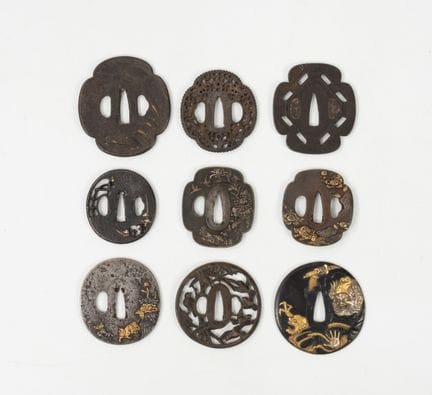
115 - JAPAN, EDO Period (1603–1868) and 20th century Set of 7 iron tsubas (patina removed): - Mokko-gata decorated with a raft (signed) and reeds. H. 8.5 cm. - Mokko-gata iron tsuba with openwork dragons and scrollwork. Nanban. H. 7 cm. - Mokko-gata iron tsuba with geometric motifs. H. 7.5 cm - Openwork nagamaru-gata tsuba in kage-sukashi style featuring a window motif, inlaid with shibuichi depicting cherry blossom branches. H. 6.2 cm. - Mokko-gata tsuba with hira-bori decoration of birds and peoni
Estimate €200 - €300 -
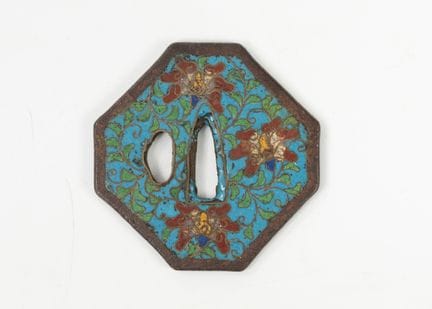
116 - JAPAN, Edo Period (1603–1868), 19th century Iron haku mokko gata inlaid with cloisonné enamel depicting lotuses among their foliage. H. 7.5 cm. Shows signs of use; some wear and scratches.
Estimate €150 - €200 -
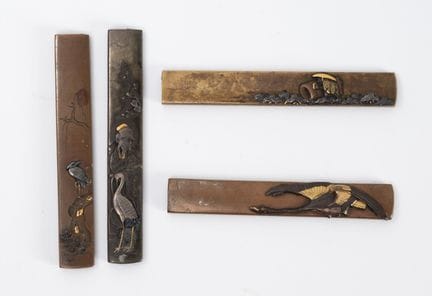
117 - JAPAN, late 19th or early 20th century Four patinated copper kozuka handles with metal inlays: - one decorated with a wading bird perched on a tree trunk. - one decorated with a wading bird in front of an old man holding a fan, beneath a plum tree branch. - one decorated with a man wearing a straw hat on a stony ground. Signed on the edge. - one decorated with a goose in flight. Length: 9.5 to 10 cm Signs of wear, scratches, and a few chips.
Estimate €100 - €120 -
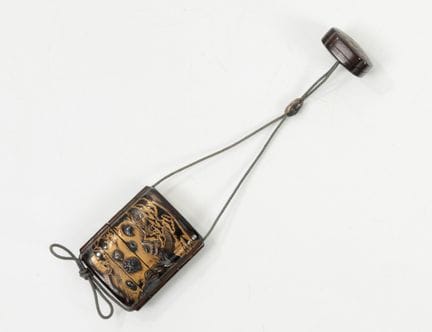
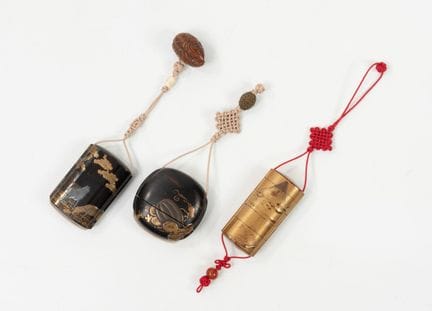
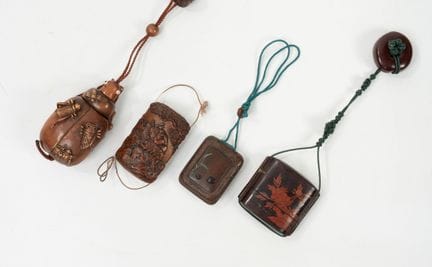
118 - JAPAN, Edo Period (1603–1868), 18th century Four-compartment inro in fundame lacquer, decorated with hira maki-e in gold lacquer and taka zogan inlays of shibuichi and mother-of-pearl depicting pavilions by the water’s edge and seashells. The interior is finished in nashiji. Unsigned. H. 6.2 cm. Wear, scratches, chips, cracks, and a chip on the interior Ojime made of shibuichi, chiseled in taka bori with a chrysanthemum design. Wooden hako netsuke decorated with hira maki-e in gold and sil
Estimate €300 - €400 -
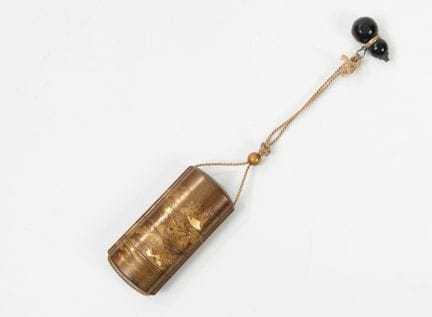
119 - JAPAN, EDO PERIOD (1603–1868), 18th–19th centuries Large four-compartment inro in kimpun lacquer, decorated with hira maki-e, kirigane, and hedatsu in gold lacquer depicting a lakeside and mountainous landscape with pavilions. The interior is finished in nashiji lacquer. Unsigned. H. 10.5 cm. Wear, restorations, cracks, small chips in the lacquer Ojime in gold lacquer. Netsuke made of wood, sentoku, and shibuichi in the shape of a double gourd. H. 4.4 cm. Condition: shows signs of use.
Estimate €200 - €300 -
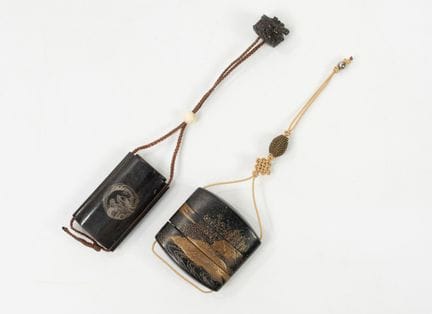
120 - JAPAN, EDO Period (1603–1868), 18th century – MEIJI Period, 19th century Two inro: - A two-compartment inro made of brown lacquer inlaid with mother-of-pearl, decorated with hira maki-e in gold lacquer and kirigane depicting a thatched cottage, Mount Fuji, and pine trees. Interior in nashiji. Unsigned. H. 6.5 cm. Minor chips and missing inlays - Saya netsuke made of buffalo horn, incised with a dragon forming a medallion. H. 7.5 cm. Scratches, some scuffs, and small cracks. Ojime made of pol
Estimate €200 - €300 -
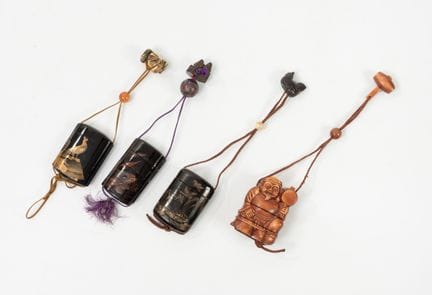
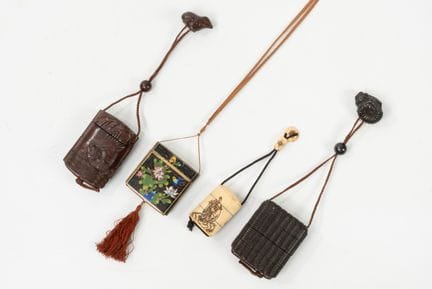
121 - JAPAN, Edo Period (1603–1868), 18th–19th centuries Set of three inro: - one with four compartments in black lacquer, decorated with hira maki-e in gold, brown, and silver lacquer depicting horses grazing under pine trees. The interior is finished in nashiji. H. 7 cm. Chips, scuffs, and small cracks. Netsuke carved from walnut in the shape of a mask. - a four-compartment piece in gold kinji lacquer with a hira maki-e decoration in gold lacquer depicting figures waving banners before Mount F
Estimate €400 - €500 -
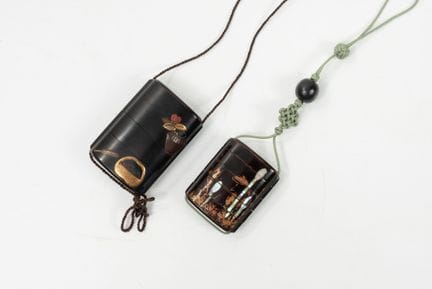
122 - JAPAN, Edo Period (1603–1868), 18th century Two inro: - A four-compartment inro in ro-iro lacquer with hira maki-e decoration in gold lacquer and mother-of-pearl inlays depicting pine shoots. Nashiji interior. Unsigned. H. 5.7 cm. Wear, chips, a few cracks, and losses (especially in the mother-of-pearl). - a three-compartment box in brown lacquer with a taka maki-e design in brown, red, and gold lacquer, and kirigane depicting a mizusashi and kakemono on one side, and a basket of citrus fruits
Estimate €300 - €450 -
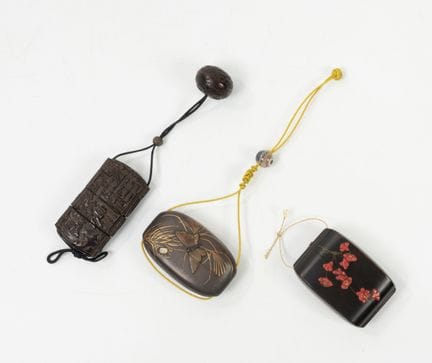
123 - JAPAN, Edo Period (1603–1868), 19th century Set of three inro: - one with a single compartment in brown lacquer, decorated with taka maki-e in red and yellow lacquer depicting bignonia flowers and pine needles scattered on the ground. The interior is lacquered to match, with a lid that opens to reveal a single compartment. W. 8 cm. Some cracks, small splits, and chips. No cord. - a single-compartment brown lacquered inro with a decoration inlaid with mother-of-pearl and hardstone depicting in
Estimate €300 - €400 -
124 - JAPAN, Edo Period (1603–1868) – Meiji Period (1868–1912) and 20th century. Set of four inro: - Four-compartment inro in ro-iro lacquer with hira maki-e decoration in gold lacquer and kirigane depicting a rooster on the roof of a thatched cottage and a tree in bloom. Nashiji interior. Unsigned. H. 7 cm. Some scuffs, small scratches, minor chips, and minor restorations. Ojime made of carnelian. Netsuke made of deer antler, depicting Daikoku. H. 3.3 cm. Small crack. EDO period. - Three-panel
Estimate €200 - €300 -
125 - JAPAN, Edo Period (1603–1868), 19th and 20th centuries Set of four inro: - one with two compartments in brown lacquer, decorated with a hira maki-e design in red and gold lacquer depicting a chimera and peonies among the rocks. H. 6.4 cm. Wear, chips, warping, and damage to the himotoshi; bottom of the central compartment missing; chips. Wooden manju. Chips on the himotoshi. - one with two compartments, carved from bamboo, depicting Shoki watching for an oni hiding in a cave. Ikkei cartouche.
Estimate €300 - €500 -
126 - JAPAN, MEIJI Period (1868–1912) – 20th century Set of three inro: - A three-compartment inro made of carved wood imitating wickerwork. Signed Nissho. H. 7.3 cm. Wooden ojime. Wooden netsuke depicting two coiled snails. W. 3.7 cm. Signs of wear, scratches, and small chips. - A three-compartment set carved from wood, depicting toads fishing. Signed “Nissho” in a mother-of-pearl medallion. Wooden ojime. Wooden netsuke depicting a crouching frog. L. 4 cm. A few scratches and minor chips. - T
Estimate €150 - €200 -
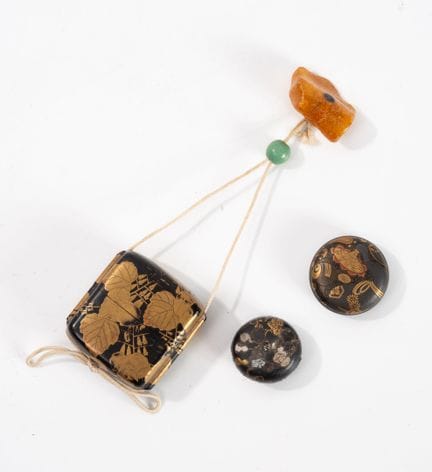
127 - JAPAN, MEIJI period (1868–1912) – 20th century - Single-compartment inro in black lacquer with a hira maki-e decoration of bell-shaped flowers and leaves in gold lacquer H. 5.8 cm. Wear, chips, and cracks, particularly at the himotoshi. Manju made from a piece of amber and an ojimé imitating faded turquoise. - A black lacquer manju decorated with takamaki-e in red, brown, gray, and gold lacquer on a black aventurine background depicting everyday objects. Interior in black lacquer and powder
Estimate €100 - €150 -
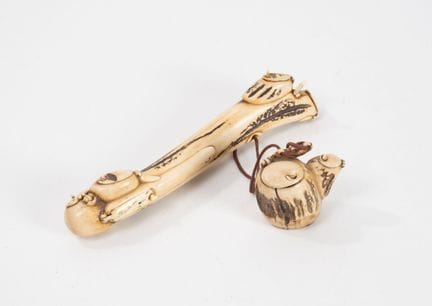
128 - JAPAN - MEIJI PERIOD (1868–1912) Yatate made of deer antler (Cervus nippon), carved with several compartments closed by lids secured with a key. Holds a brush. The inkwell is also made of deer antler. Handle length: 24 cm. Chapped areas, minor imperfections; antler needs to be reattached.
Estimate €400 - €500 -
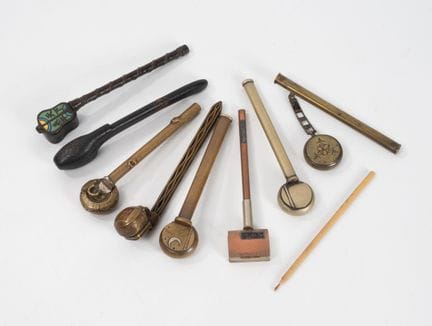
130 - JAPAN - MEIJI period (1868 - 1912) Set of eight yatate : - one in brass and copper, the inkwell in the shape of a gourd in its foliage. The branch-shaped handle holds a brush. Signed Koseki (?). L. 16.5 cm. - one in bronze, the inkwell decorated with an archaistic frieze on the body and a dragon on the lid. The handle, made of wavy bronze wires forming apertures, holds a brush. Signed Natsusetsudo sei. L. 19 cm. - one in copper and white or silver metal, the inkwell forming a book (titled Taihei
Estimate €230 - €300 -
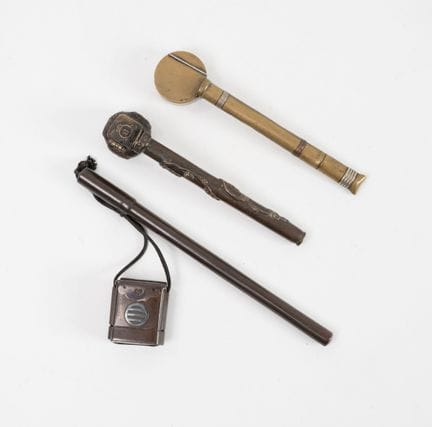
131 - JAPAN - MEIJI period (1868 - 1912) Three yatate : - one in shibuichi. The inkwell bound by a string, with wax reserve, chased with the character "Eternity" and the Kitanokoji môn. The handle containing a calligraphic bamboo brush. L. 21.2 cm. Small tear to the stopper; bottom of the wax reserve damaged. - one in brass with copper or white metal wire rings. Circular inkwell. Illegible stamp. L. 16.9 cm. Soldering to be revised. - one in cast bronze with plant tendrils. The inkwell decorated with
Estimate €200 - €300 -
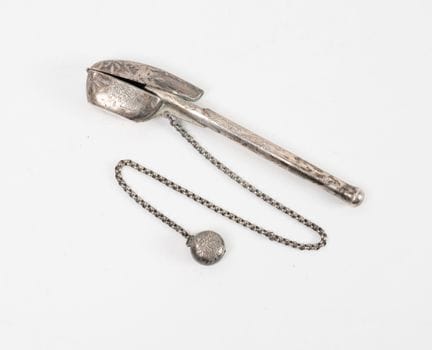
132 - JAPAN - MEIJI PERIOD (1868–1912) Silver plated yatate with chased foliage decoration. Inkwell with a compartment for seal paste. Handle containing a bamboo brush, inscribed with calligraphy. Chain holding a pearl that opens to reveal a compartment containing seal paste. Unsigned. L. 19.5 cm. Signs of wear, scratches, and a few chips.
Estimate €150 - €200 -
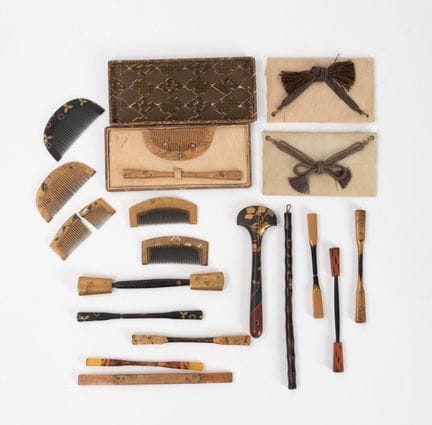
133 - JAPAN - MEIJI period (1868 - 1912) Set of hairdressing ornaments (kanzashi) in lacquer, comprising: - five combs (kushi) in gold or black lacquer with hira maki-e and kirigane decoration of vegetal scrolls. L. from 8.4 to 8.9 cm. One broken, wear to lacquer. - Six horn and black, gold and red lacquer pins (kogai) with hira maki-e and kirigane decoration of plants and bird. L. from 14.5 to 18.2 cm - a lacquer brush, the handle and cap imitating bamboo. L. 21.5 cm - two lacquer and resin elemen
Estimate €130 - €150 -
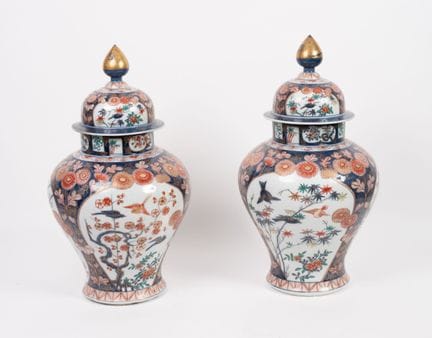
134 - JAPAN or CHINA, 19th century Pair of large lidded porcelain vases with Imari decoration featuring flowers on a midnight blue background, with three white-field cartouches adorned with squirrels or birds among flowering branches. The straight neck is adorned with a frieze of cartouches of various shapes containing plant motifs. Lids with pear-shaped fretwork. H. 51 cm. Glaze defects, particularly on the interiors; wear and scratches; cracks on one lid; a large (through) chip with a significant lo
Estimate €300 - €400 -
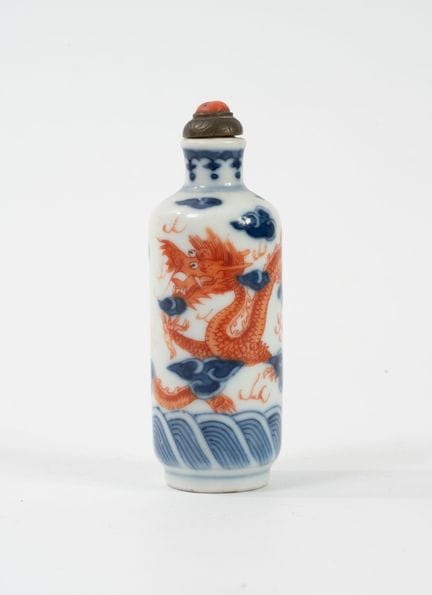
135 - CHINA - 19th century Cylindrical porcelain snuff bottle decorated in underglaze blue and iron-red enamel with two dragons flying through the clouds above the waves; the neck is adorned with pendants. On the reverse, the mark “Yongle tang zhi” (Hall of Everlasting Joy). Very slight cracks. H.: 6.7 cm. Bronze stopper with a coral cabochon (Corallium rubrum).
Estimate €150 - €200 -
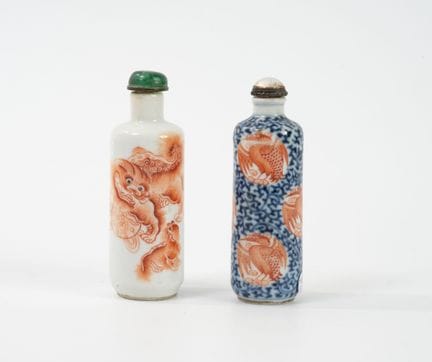
136 - CHINA - 19th century Two cylindrical porcelain snuff bottles decorated with red iron-glaze: - one depicting a Buddhist lion playing with a ball and its cub. (Traces of glue). Height: 7.4 cm. Green resin stopper. - the other featuring medallions of cranes against a background of blue underglaze scrollwork. (Signs of wear). Height: 7.3 cm. Metal stopper with cabochon.
Estimate €200 - €300 -
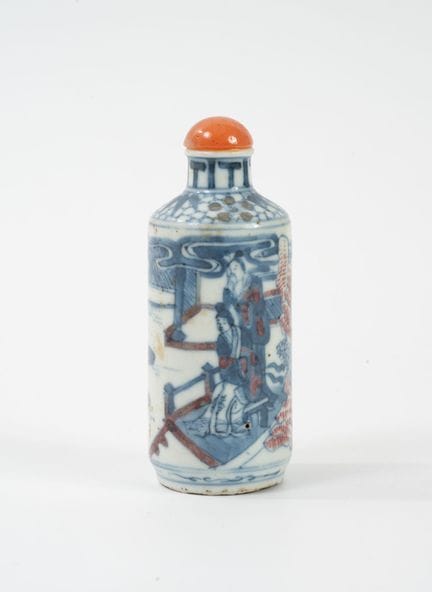
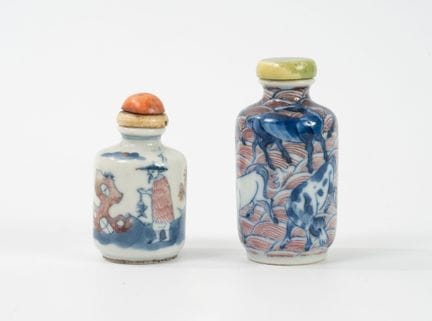
137 - CHINA - 19th century Cylindrical porcelain snuff bottle with an underglaze blue-and-copper-red decoration depicting women and a scholar by a pond, one of them in a boat, her shoulder adorned with plum blossoms and bamboo. On the reverse, an apocryphal Yongzheng mark. (Chips, crack). H.: 8.2 cm. Carnelian stopper (glued).
Estimate €150 - €200 -
138 - CHINA - 19th century Two cylindrical porcelain snuff bottles decorated in blue and copper red underglaze; one depicts a fisherman holding a fish near a rock with a hole in it, the other shows King Mu’s eight horses prancing above the waves. (Firing bubbles, ground bases) H. 4.1 and 5.6 cm. Stopper made of bone and coral (Corallium rubrum).
Estimate €200 - €300 -
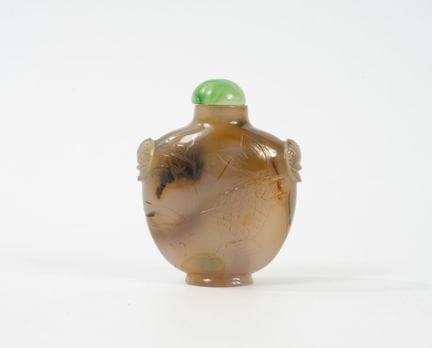
139 - CHINA - Late 19th century Baluster-shaped snuff bottle made of beige agate with brown veins, incised with a carp among lotus flowers on one side and a tiger on the other; the shoulder is flanked by animal masks serving as handles. H.: 6 cm. Green glass stopper. Four-legged wooden base inlaid with coiled gold thread.
Estimate €200 - €300 -
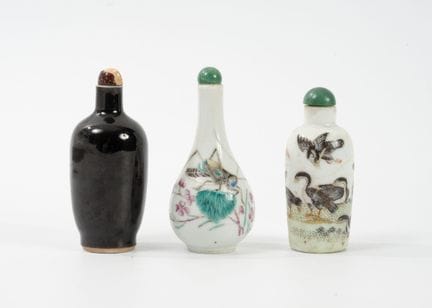
140 - CHINA - GUANGXU Period (1875–1908) Set of 3 snuff bottles: - Cylindrical snuff bottle made of polychrome-glazed porcelain depicting geese among millet. On the reverse, the six-character Guangxu mark in blue underglaze. (Cracks and restorations) H. 6.4 cm. Green stone stopper. And two porcelain snuff bottles: - One with a low body, polychrome-glazed with locusts and flowers. Apocryphal Yongzheng mark. H.: 7.2 cm. Green stone stopper. (glued) - one cylindrical, with a monochrome brown glaze.
Estimate €200 - €300 -
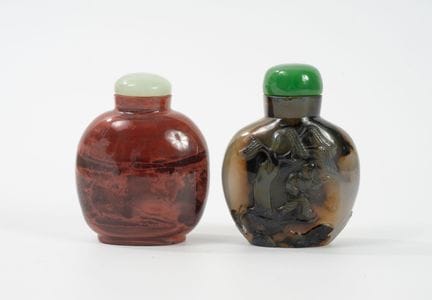
141 - CHINA - 19th–20th centuries Two snuff bottles: - one spherical, made of brick-red glass imitating jasper. (Very fine graining) H.: 6 cm. Jade (nephrite) stopper. - The other is a baluster-shaped bottle made of gray agate with brown veins, depicting a scholar waiting under a pine tree and Liu Hai with his toad. (Grainy texture) Green glass stopper.
Estimate €200 - €300 -
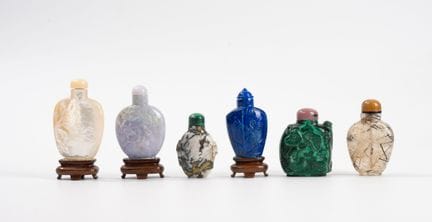
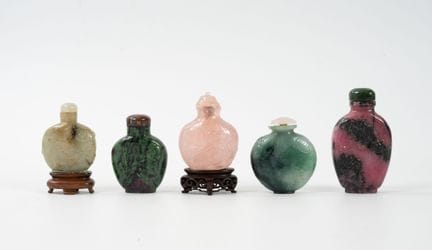
142 - CHINA - 19th and 20th Centuries Set of six snuff bottles, - one made of sodalite, carved with bamboo and flowers, - one made of malachite, carved with a pair of ducks, lotus flowers, and a pine tree, - one in black and white marble with golden veins and two zoomorphic handles, - one in mauve and pale green jadeite carved with birds and pomegranate branches, - one in mother-of-pearl carved with Guanyin and a peony, - one made of rock crystal with rutile inclusions, carved with a scholar in
Estimate €300 - €400 -
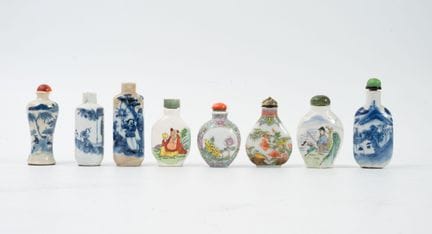
143 - CHINA - 19th–20th century Eight snuff bottles, - seven made of porcelain, including three with polychrome enamel decoration featuring peony medallions on a background of lotus scrolls, a fisherman motif, and a seated Zhongli Quan motif, four with blue underglaze decoration depicting scholars, servants, and landscapes, one of which bears an apocryphal Kangxi mark, and - one made of white glass with polychrome enamel decoration of birds, peonies, and bamboo, bearing an apocryphal Qianlong mar
Estimate €100 - €150 -
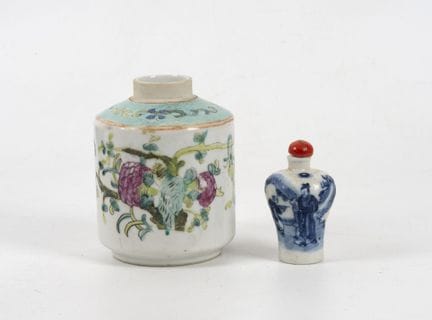
144 - CHINA, 19th–20th centuries Two porcelain pieces: - Porcelain snuff bottle with a blue-and-white design featuring figures in a landscape. H.: 7 cm. - Porcelain jar with polychrome floral decoration. H.: 12 cm. Without lid. = Signs of wear.
Estimate €50 - €60 -
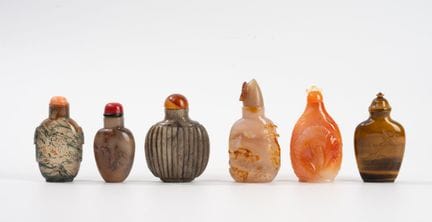
145 - CHINA - 19th–20th centuries Set of six snuff bottles, - one made of tiger’s-eye agate carved with sampans and geese, - one made of beige agate with brown veins, - one made of banded agate with caramel-colored veins, carved with a horseman, - one made of gray nephrite with ribbed brown veins, - one made of moss agate flanked by zoomorphic masks forming handles, - one made of chalcedony carved with foliage. (Scratches, glued stopper, chipping) H.: 0 5.1 to 6.2 cm. One with a wooden base
Estimate €150 - €200 -
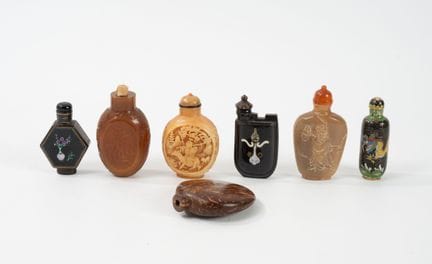
146 - CHINA - 19th–20th Centuries Seven snuff bottles: one made of horn-imitating resin carved with stylized characters and dragons; one made of bronze with cloisonné enamel and dragon decoration; one made of coconut shell incised with a poem; one carved with a scholar, an attendant, and an immortal on a deer; one in burgautée lacquer with a floral vase design and a Qianli mark, one made of blond buffalo horn carved with an attendant holding a lotus, and one made of brown buffalo horn in the shape
Estimate €300 - €400 -
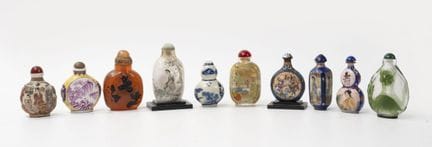
147 - CHINA, 20th century Set of ten snuff bottles: - One in lined glass or overley with green decoration on a white background, (one stopper restored). - Two in glass with printed interior decoration, one enhanced, (one stopper restored). - One in polychrome enameled porcelain with pink monochrome decoration on a yellow background, (stopper restored). - One in enameled porcelain with blue-white decoration of children, (no stopper) - Three in copper with polychrome enamel decoration, (accidents and mi
Estimate €120 - €150 -
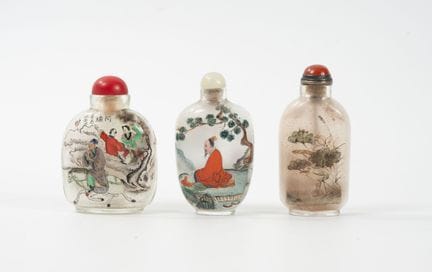
148 - CHINA - 20th century Set of 3 snuff bottles: - Yong Shoutian (China, active 1898–1926) Rectangular snuff bottle made of glass, painted on the inside with scenes from the collection *Extraordinary Tales from the Leisure Pavilion* (*Liaozhai zhiyi*): on one side, a scene from the novel *Axiu*; on the other, a scene from *Silver Fish* (*Suqiu*). Signed “Yong Shoutian zuo.” Dated the year Xinyou (1921). (Scratches) H.: 6 cm. Resin stopper. And two flattened snuff bottles made of glass, pain
Estimate €300 - €400 -
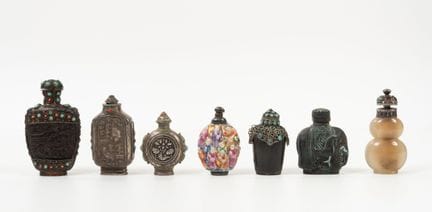
149 - CHINA, 20th century Set of seven snuff bottles: - three made of silver plated or patinated metal, inlaid with turquoise, coral, and so-called “Tibetan” glass cabochons, decorated with water lilies and fish, birds, or figures in applied wooden bas-reliefs. - one made of brown horn with a Silver plated metal mount and blue glass cabochons. - one made of oxidized copper in the shape of an elephant. - one in the shape of a double gourd made of gray agate, with a Silver plated metal mount and mal
Estimate €80 - €100 -
150 - CHINA - 20th century Set of five snuff bottles, - one in the shape of a shield, made of jadeite and incised with a phoenix and peony, - one in pale celadon jade (nephrite) with brown veins, carved with chrysanthemum branches, - one in rose quartz, baluster-shaped, carved with quails and millet, - one made of zoisite, carved with flowers and butterflies, - one made of rhodonite, carved with a bat in flight. H.: 4.6 to 6.7 cm. Two with wooden bases. = as is
Estimate €150 - €200 -
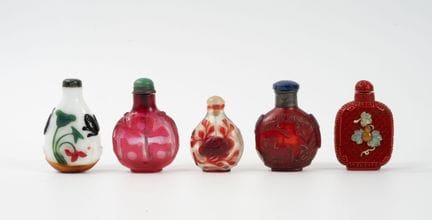
151 - CHINA - 20th century Five snuff bottles, four of which are made of glass, including one - made of red overlay glass on a transparent background depicting a peony branch, - one made of red, green, black, and ochre overlay glass on a white background depicting a toad, a carp, and a lotus, - one made of garnet-colored glass carved with horses and featuring a metal neck, - one made of red glass carved with goats; and - one made of red-lacquered wood carved with Greek fretwork friezes and inlaid
Estimate €150 - €200 -
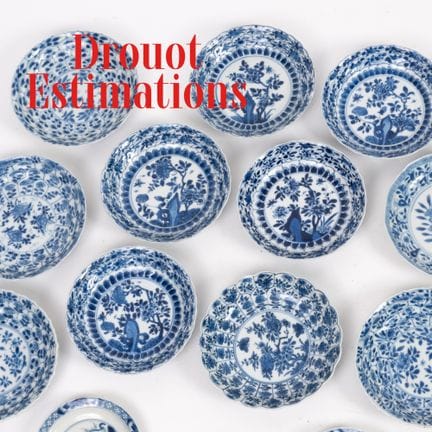
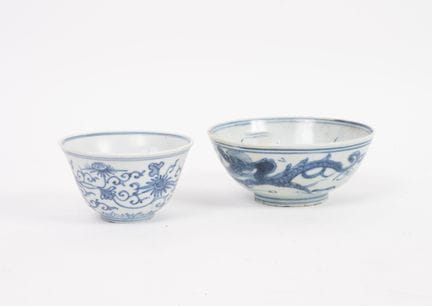
152 - CHINA - JIAJING Period (1522–1566) and 17th century Two porcelain bowls with underglaze blue decoration: - one decorated with chrysanthemum scrolls. On the reverse, the Jiajing mark. Diameter 11.1 cm. Chips and cracks. Provenance: The Hatcher Collection, Axel Vervoordt. - the other decorated with a phoenix and dragon amid clouds. Diameter 14.5 cm. Chips and cracks. Provenance: The Hatcher cargo, Christie’s auction, Amsterdam, June 12–13, 1984 (label).
Estimate €200 - €300
About the sale
Sales Contact
Christine BENOIST-LACAS
Phone: 01 48 01 91 12
Purchase Orders - Telephone Bids
Clémence CLAUDE
Phone: 01 48 01 91 08
Exhibitions
Thursday, November 19, 2026, from 11 a.m. to 8 p.m.
Friday, November 20, 2026, from 11 a.m. to 12 p.m.
Phone: 01 48 00 20 16
Experts:
Mr. Patrice DUBOIS
Phone: 06 85 12 99 91
For lots 6, 8, 9, 12, and 17.
Portier & Associates
Phone: 01 48 00 03 41
For lots 107, 110 through 116, 118 through 126, 128, 130, 131, 132, 133, 135 through 143, 145, 146, 148 through 157, 159, 160, 161, 162, 163, 168, 171, 176 through 183, 191, 193, 212
Laure SOUSTIEL
Phone: 04 42 64 33 45
For Lot 91.
Terms of sale
Show the terms of sale
Conditions de la vente
Les acheteurs paieront en sus de l’adjudication par lot les taxes et frais suivants :
- 23, 21% TTC (pour les livres).
- 26, 40% TTC.
- Frais additionnels DrouotLive : 1,8 % ttc.
Les dimensions sont données à titre indicatif.
Aucune réclamation ne sera possible pour les restaurations d’usage, les petits accidents, l’exposition ayant permis un examen des objets présentés.
Une exposition publique des objets étant spécialement organisée afin d'examen des objets, les enchérisseurs sont réputés avoir examiné ou avoir fait examiner les objets sur lesquels ils portent leurs enchères et aucune réclamation ne serait reçue s'agissant de défauts apparents ou ceux résultant de l'usage ou l'ancienneté de l'objet.
Le fonctionnement des appareils mécaniques, électriques ou électroniques (montres, horloges, appareils photographiques ou autres) n'est en principe pas garanti, sauf précision expresse de son état de fonctionnement dans la fiche le décrivant.
Il est rappelé aux enchérisseurs que toutes les formalités administratives et douanières incombent aux adjudicataires et que les lots ne sont pas délivrés accompagnés d’un certificat d’exportation sauf indication express.
Ordres d'achat - Enchères téléphoniques
Les commissaires-priseurs et les experts se chargent d’exécuter, gracieusement, les ordres d’achat qui leur seront confiés, notamment par les amateurs ne pouvant assister à la vente.
Toute personne souhaitant intervenir téléphoniquement devra en faire la demande par écrit, accompagnée d’un relevé d’identité bancaire, au plus tard la veille de la vente.
L’expérience démontrant qu’à de nombreuses reprises les communications téléphoniques ne sont pas toujours possibles lors du passage des lots, toute demande d’enchère téléphonique présuppose UN ORDRE D’ACHAT A L’ESTIMATION BASSE PLUS UNE ENCHÈRE, au cas où la communication est impossible pour quelque cause que ce soit. Drouot-Estimations ne peut être tenu responsable pour avoir manqué d’exécuter un ordre.
Ordres d’achat : bids@drouot.com
Paiement
Tout achat devra expressément être réglé au comptant durant ou dès la fin de la vente.
A défaut de paiement en espèces ou par chèque, l’objet pourra être remis en vente sur folle enchère immédiatement ou à la première opportunité.
L’adjudicataire pourra s’acquitter par les moyens suivants :
- Par carte bancaire en salle : Visa et Mastercard.
- Par chèque bancaire certifié ou chèque en euros émanant d’un établissement bancaire de droit français, domicilié en France avec présentation obligatoire d’une pièce d’identité en cours de validité. En cas de paiement par chèque non certifié, le retrait des objets pourra être différé jusqu’à l’encaissement du chèque et aucun objet ne sera délivré.
Tout règlement par chèque supérieur ou égal à 1 000 € fera l’objet d’une délivrance différée.
- Par virement bancaire et en euros :
BNP PARIBAS
PARIS LA CENTRALE
(00828)
IBAN : FR76 3000 4008 2800 0106 2854 076
- En espèces (décret du 24 juin 2015) :
Jusqu’à 1 000 € frais et taxes comprises pour les ressortissants français, particuliers et professionnels.
Jusqu’à 15 000 € frais et taxes comprises pour les ressortissants étrangers justifiant de leur domicile fiscal hors de France.
Retrait des lots & Magasinage
Drouot-Estimations ne se chargera pas d’envoyer les objets achetés par les clients.
Il leur appartiendra de prendre leurs dispositions pour l’enlèvement de leur(s) achat(s).
Aucun achat ne sera délivré avant paiement effectif de l’intégralité du bordereau.
Les oeuvres acquises sont sous l’entière responsabilité de l’acheteur et ce, dès l’adjudication prononcée.
Tout lot acheté par Drouot Estimations et non repris le jour de la vente sera stocké au magasinage de l’Hôtel des Ventes, à charge de frais journaliers pour l’acquéreur. (Renseignements : 01 48 00 20 18 - magasinage@drouot.com).
Si l’adjudicataire ne dispose pas de transporteur, toute demande d’envoi par la poste ou coursier peut être adressée directement à Drouot Transport (01 48 00 22 49 ; livraison@drouot.com ). Le règlement du transport est à effectuer directement auprès de Drouot Transport.
Retrait des lots & Magasinage
Drouot-Estimations ne se chargera pas d’envoyer les objets achetés par les clients.
Il leur appartiendra de prendre leurs dispositions pour l’enlèvement de leur(s) achat(s).
Aucun achat ne sera délivré avant paiement effectif de l’intégralité du bordereau.
Les œuvres acquises sont sous l’entière responsabilité de l’acheteur et ce, dès l’adjudication prononcée.
Tout lot acheté par Drouot Estimations et non repris le jour de la vente sera stocké au magasinage de l’Hôtel des Ventes, à charge de frais journaliers pour l’acquéreur. (Renseignements : 01 48 00 20 18 - magasinage@drouot.com).
Si l’adjudicataire ne dispose pas de transporteur, toute demande d’envoi par la poste ou coursier peut être adressée directement à Drouot Transport (01 48 00 22 49 ; livraison@drouot.com .). Le règlement du transport est à effectuer directement auprès de Drouot Transport.
Drouot Magasinage
Profitez du service de stockage de Drouot.
Les lots peuvent être enlevés gratuitement en salle jusqu’à 19h le soir de la vente et entre 8h et 10h le lendemain.
Passé ce délai, les lots ne faisant pas l’objet d’une prise en charge par l’Opérateur de vente sont stockés au service DROUOT MAGASINAGE, aux tarifs suivants*:
Frais de dossier / lot TTC : 5 €
Frais de stockage et d’assurance / lot TTC :
- 1€ / jour, les 4 premiers jours ouvrés
- 1€ / 5 € / 10€ / 20€ / jour, à partir du 5e jour ouvré, selon la nature du lot.
Les lots achetés aux enchères peuvent être enlevés gratuitement jusqu’à 19h le soir de la vente et entre 8h et 10h le lendemain, sans rendez-vous, au 6 rue Rossini 75009 Paris.
Passé ce délai, les lots non repris par l’étude sont stockés au magasinage de l’Hôtel Drouot (contact : magasinage@drouot.com)
Ce service est payant dès le lendemain de la vente. Les frais sont fixes durant les 3 premiers jours ouvrés suivant la vente, puis des frais journaliers s’appliquent à partir du 4ème jour ouvré suivant la vente. La grille des tarifs est disponible sur drouot.com/magasinage, ou en cliquant sur le QR code ci-dessous.
Les frais de magasinage sont offerts pour toute livraison de vos lots par le service Livraisons de Drouot Logistic dans les 3 jours ouvrés suivant la vente (contact : livraison@drouot.com) Une réduction de 50 % sur les frais journaliers est accordée aux clients étrangers et aux professionnels du marché de l’art hors Île-de-France (sur présentation de justificatif).
Le retrait des lots est ouvert du lundi au vendredi, de 12h à 18h, sur rendez-vous, au 9 rue Drouot
75009 Paris et le samedi de 8h à 10h, au 6 rue Rossini 75009 Paris.
La prise de rendez-vous est disponible sur drouot.com/magasinage ou en cliquant sur le QR code ci-dessous.
Les lots sont remis sur présentation d’une pièce d’identité et du bordereau de vente acquitté.
Les transporteurs bénéficient d'un accès réservé au 6 bis rue Rossini, de 9h à 10h et de 13h30 à 17h30.
Au-delà de 6 mois, les lots non retirés seront stockés hors du magasinage de l’Hôtel Drouot.
Drouot Estimations
Maison de ventes aux enchères du groupe Drouot
7, rue Drouot — 75009 Paris
☏ Tél. +33 (0)1 48 01 91 00

Drouot Estimations
Maison de ventes aux enchères
du groupe Drouot
7, rue Drouot — 75009 Paris
☏ Tél. +33 (0)1 48 01 91 00