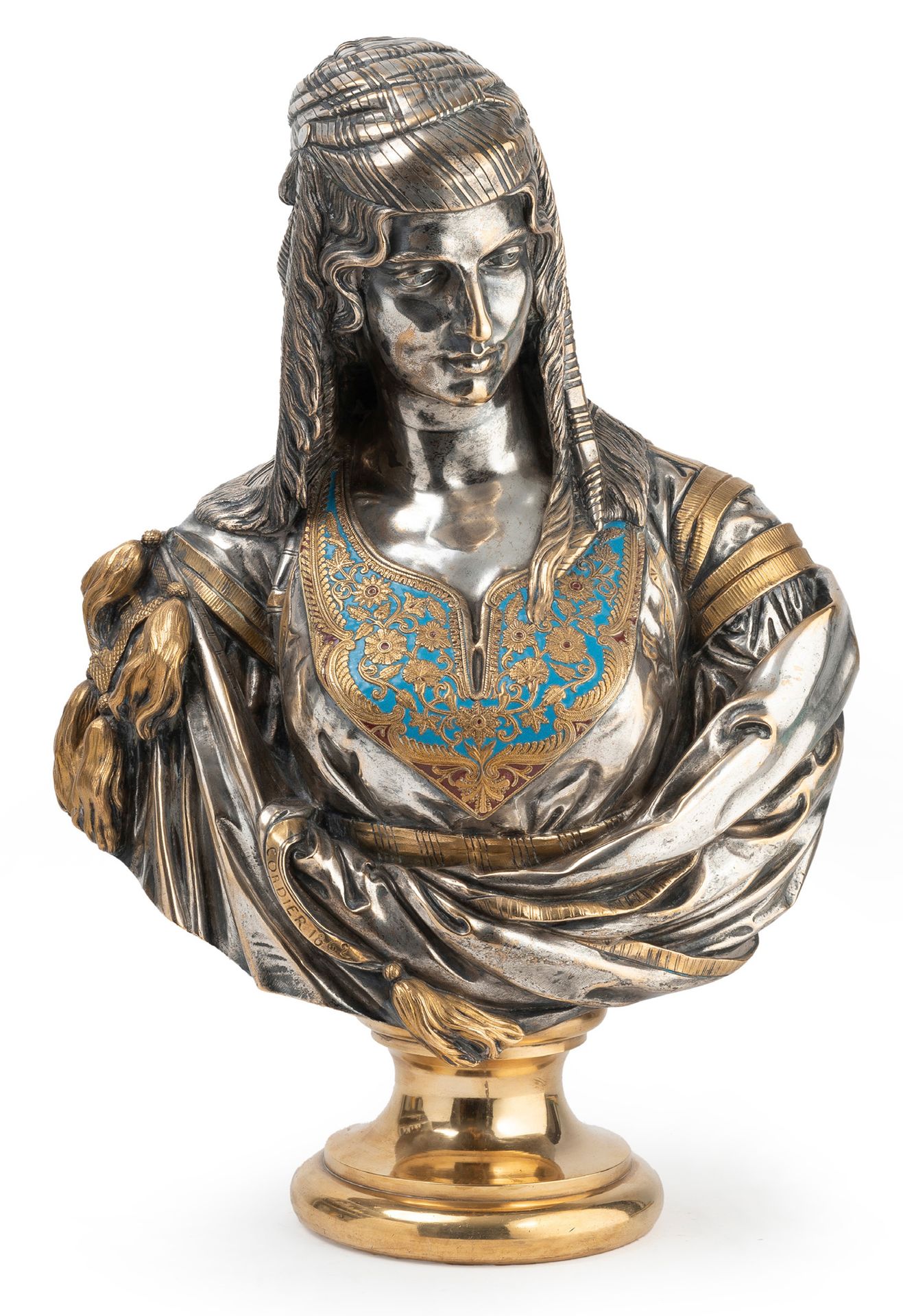
Charles CORDIER (1827-1905) La Juive d'Alger, 1862. Silvered, gilded and enameled bronze proof on a gilded bronze pedestal. Signed and dated on the mantle band. 46 x 34 x 19 cm. Provenance: Sotheby's sale, London, November 29, 1991, n°130. Christie's sale, London, March 17, 1994, no. 242. Bibliography: C. Barthe, L.de Margerie, E.Papet, M.Vigli, "Charles Cordier, l'Autre et l'Ailleurs", Editions de la Martinière, Paris, 2004, illustrated under no. 339, p.18. La juive d'Alger. Jewish women in Algiers were more accessible models for artists than Muslim women at the time of the Conquest. Cordier's ethnographic sculptures are accompanied by another of the artist's innovative proposals: polychromy, which contrasts with the traditional whiteness of the marbles exhibited at the Salon. In France and Germany, archaeologists at the beginning of the 19th century had just rediscovered the almost erased polychromy of ancient architecture and sculpture. The "Juive d'Alger" came in a wide range of rich materials: silver and gilded bronze, marble, onyx, porphyry, enamels and precious stones. The opulent Second Empire, with its sumptuous interiors, adopted Cordier's brilliant and precious art.
Estimate
€18,000 - €20,000
Result
Not communicated
Buyer's premium
25%
Charles CORDIER (1827-1905)
La Juive d'Alger, 1862.
Silvered, gilded and enameled bronze proof on a gilded bronze pedestal.
Signed and dated on the mantle band.
46 x 34 x 19 cm.
Provenance:
Sotheby's sale, London, November 29, 1991, n°130.
Christie's sale, London, March 17, 1994, no. 242.
Bibliography:
C. Barthe, L.de Margerie, E.Papet, M.Vigli, "Charles Cordier, l'Autre et l'Ailleurs", Editions de la Martinière, Paris, 2004, illustrated under no. 339, p.18. La juive d'Alger.
Jewish women in Algiers were more accessible models for artists than Muslim women at the time of the Conquest. Cordier's ethnographic sculptures are accompanied by another of the artist's innovative proposals: polychromy, which contrasts with the traditional whiteness of the marbles exhibited at the Salon. In France and Germany, archaeologists at the beginning of the 19th century had just rediscovered the almost erased polychromy of ancient architecture and sculpture.
The "Juive d'Alger" came in a wide range of rich materials: silver and gilded bronze, marble, onyx, porphyry, enamels and precious stones. The opulent Second Empire, with its sumptuous interiors, adopted Cordier's brilliant and precious art.
Sale
Friday 7 June 2024・14:00 (Europe/Paris)
Salle 6 - Hôtel Drouot
9, rue Drouot
75009 Paris