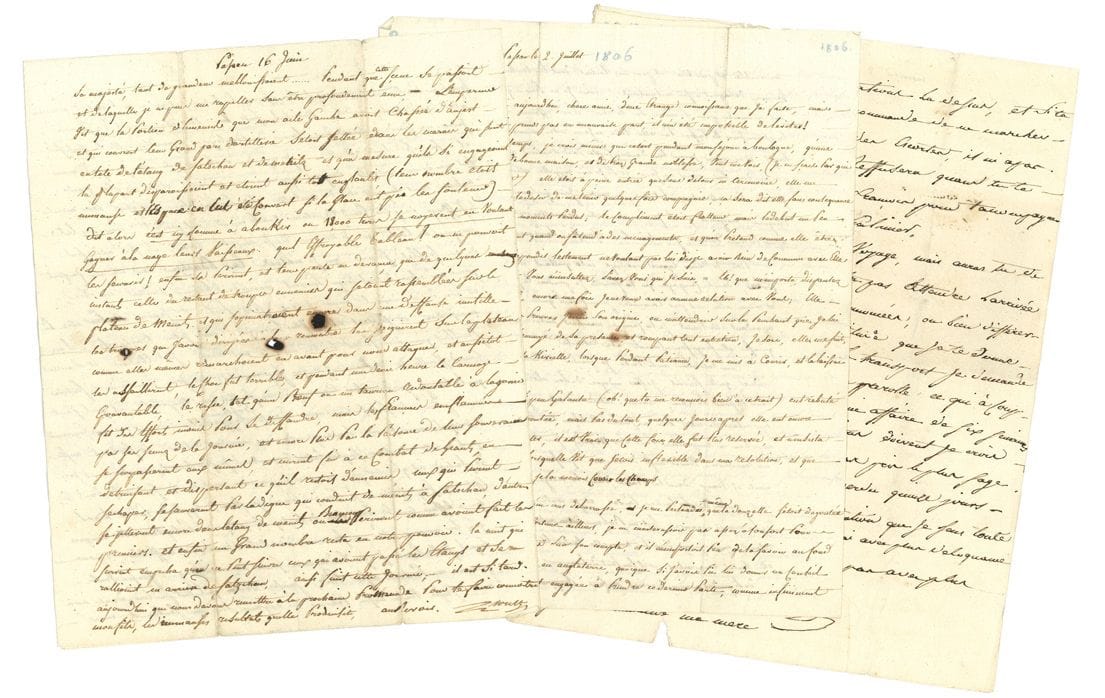
SOULT Nicolas Jean (1769-1851) 223 L.A.S. "Soult", "Mal d. de D.", "Mal S"..., 1800-1850, to HIS WIFE; 511 pages in-4 or in-8, numerous addresses with red wax seals and postal marks of the Grande Armée (notes in blue pencil). Important set of letters from Marshal Soult to his wife, mainly during the campaigns in Poland and Spain. [Soult married in 1796 Jeanne-Louise-Élisabeth BERG (1771-1852), who gave him two children: Napoleon-Hector (1802-1857) and JoséphineLouise-Hortense (1804-1862)]. In these letters, of which we can only give a quick overview here, Soult shows great affection for his wife and children Napoleon and Hortense, whose education interests him greatly, and shows great confidence in Louise, whom he entrusts with numerous commissions from business agents, lawyers and entrepreneurs, as well as with sometimes delicate steps at the Ministry and the Court. Any interruption in their exchanges makes him very unhappy: "I need more courage to bear such pain than to face dangers on a battlefield. Then I run only chances" (Liebstadt May 5, 1807). The letters are written during the campaigns: Alexandria (Italy); Passau (Bavaria); in Poland: Prausnitz, Willenberg, Liebstadt, Rosenau, Morangn, Elbing; Königsberg (East Prussia), Danzig; in Spain: Madrid, Mora, Almagro, Santa Cruz de Mudela, Baylen, Cordoba, Carmona, Seville, Puerto Santa Maria, Ronda, Málaga, Granada, Jerez, Chiclana, Almansa, Piedrahita, Toledo; Dresden in Saxony... 1800. The first letter, dated from Alexandria (Italy), is written after Soult was wounded in the attack on Monte Creto, northeast of Genoa. He finally paid his "tribute to this terrible god of War", who until then had treated him as a "spoiled child". Soult was taken from the battlefield by order of his brother, who claimed guards from the enemy, "and the Lt Gal Prince d'HOHENZOLLERN, made me dress in his presence in his lodging" (2 prairial VIII/22 May 1800)... 1806 sees Soult in Passau (Bavaria), where he makes an account of the battle of Austerlitz for his son. The Emperor, "seeing that the last movement assured him the victory, and that what remained of enemies was going to be destroyed, said to me, Marechal Soult you covered yourself with glory. I had a great confidence in the army of Boulogne today it justified it and surpassed all expectations. - I replied to His Majesty [...] that my greatest ambition had always been to fight his enemies under his eyes in order to deserve the suffrage of the greatest captain that the world had produced"... Transported by happiness, he stammered... Napoleon noted a common point between Austerlitz and Aboukir (June 16)... 1807 saw him take part in the Polish campaign (about 60 letters). His brother is his first aide-de-camp, and M. ANTHOINE, nephew of the King of Naples, is another. He speaks of the death of General d'HAUTPOUL, which he attributes as much to the incurable madness of his wife as to his wounds at Eylau; HEUDELET is recovering from his; Generals LEGRAND, GUDIN and SALME are well... A violent fire has ravaged Liebstadt... At the end of May, he refuses Louise's offer to come to him, because they expect to resume hostilities, since the capture of Danzig; on June 6, they have been fighting for two days, and he is doing well: "Yesterday, in the middle of a very intense fire, I received your letter of May 21. He enters Königsberg on June 16, and rests in this "opulent" city while waiting for the Emperor: "His Majesty has himself pursued his enemies who continue to move away, and to bring him closer to their borders, it is necessary to hope [...] that all the advantages that the Emperor has obtained will produce a happy result, and that peace will perhaps be the consequence" (June 18)... "The Emperor is still pursuing the enemies, but he has not yet reached the point where he is able to do so. The emperor is still pursuing the debris of the Russian army, already he has made them cross their borders again after having suffered immense losses " (June 20)... " It is almost a dream! that in ten days of campaign the emperor could obtain such great advantages and prepare such unexpected results, what a glory! In these ten days he has erased all that he had previously done, what recognition and love such high achievements impose on us! The admiration for his genius was already ineffable, and now he has added to this feeling, which nothing could equal and which cannot be contained. The three sovereigns are gathered at Tilse [Tilsitt] on the Niemen, where their plenipotentiaries are dealing with the peace [...], the army will set out on the march to ensure its execution" (June 28)... The Emperor gives estates in Poland to his marshals and to several generals; information on that of Raciazek which he himself received... Donation in annuities on the State and in money from the Emperor... A terrible epidemic reigns from the Oder to the Vistula; Louise would be frightened to see the misery around her... Arrived in Danzig on December 7, he
Estimate
€8,000 - €10,000
Result
€9,360
Buyer's premium
30%
SOULT Nicolas Jean (1769-1851)
223 L.A.S. "Soult", "Mal d. de D.", "Mal S"..., 1800-1850, to HIS WIFE; 511 pages in-4 or in-8, numerous addresses with red wax seals and postal marks of the Grande Armée (notes in blue pencil).
Important set of letters from Marshal Soult to his wife, mainly during the campaigns in Poland and Spain. [Soult married in 1796 Jeanne-Louise-Élisabeth BERG (1771-1852), who gave him two children: Napoleon-Hector (1802-1857) and JoséphineLouise-Hortense (1804-1862)]. In these letters, of which we can only give a quick overview here, Soult shows great affection for his wife and children Napoleon and Hortense, whose education interests him greatly, and shows great confidence in Louise, whom he entrusts with numerous commissions from business agents, lawyers and entrepreneurs, as well as with sometimes delicate steps at the Ministry and the Court. Any interruption in their exchanges makes him very unhappy: "I need more courage to bear such pain than to face dangers on a battlefield. Then I run only chances" (Liebstadt May 5, 1807). The letters are written during the campaigns: Alexandria (Italy); Passau (Bavaria); in Poland: Prausnitz, Willenberg, Liebstadt, Rosenau, Morangn, Elbing; Königsberg (East Prussia), Danzig; in Spain: Madrid, Mora, Almagro, Santa Cruz de Mudela, Baylen, Cordoba, Carmona, Seville, Puerto Santa Maria, Ronda, Málaga, Granada, Jerez, Chiclana, Almansa, Piedrahita, Toledo; Dresden in Saxony... 1800. The first letter, dated from Alexandria (Italy), is written after Soult was wounded in the attack on Monte Creto, northeast of Genoa. He finally paid his "tribute to this terrible god of War", who until then had treated him as a "spoiled child". Soult was taken from the battlefield by order of his brother, who claimed guards from the enemy, "and the Lt Gal Prince d'HOHENZOLLERN, made me dress in his presence in his lodging" (2 prairial VIII/22 May 1800)... 1806 sees Soult in Passau (Bavaria), where he makes an account of the battle of Austerlitz for his son. The Emperor, "seeing that the last movement assured him the victory, and that what remained of enemies was going to be destroyed, said to me, Marechal Soult you covered yourself with glory. I had a great confidence in the army of Boulogne today it justified it and surpassed all expectations. - I replied to His Majesty [...] that my greatest ambition had always been to fight his enemies under his eyes in order to deserve the suffrage of the greatest captain that the world had produced"... Transported by happiness, he stammered... Napoleon noted a common point between Austerlitz and Aboukir (June 16)... 1807 saw him take part in the Polish campaign (about 60 letters). His brother is his first aide-de-camp, and M. ANTHOINE, nephew of the King of Naples, is another. He speaks of the death of General d'HAUTPOUL, which he attributes as much to the incurable madness of his wife as to his wounds at Eylau; HEUDELET is recovering from his; Generals LEGRAND, GUDIN and SALME are well... A violent fire has ravaged Liebstadt... At the end of May, he refuses Louise's offer to come to him, because they expect to resume hostilities, since the capture of Danzig; on June 6, they have been fighting for two days, and he is doing well: "Yesterday, in the middle of a very intense fire, I received your letter of May 21. He enters Königsberg on June 16, and rests in this "opulent" city while waiting for the Emperor: "His Majesty has himself pursued his enemies who continue to move away, and to bring him closer to their borders, it is necessary to hope [...] that all the advantages that the Emperor has obtained will produce a happy result, and that peace will perhaps be the consequence" (June 18)... "The Emperor is still pursuing the enemies, but he has not yet reached the point where he is able to do so. The emperor is still pursuing the debris of the Russian army, already he has made them cross their borders again after having suffered immense losses " (June 20)... " It is almost a dream! that in ten days of campaign the emperor could obtain such great advantages and prepare such unexpected results, what a glory! In these ten days he has erased all that he had previously done, what recognition and love such high achievements impose on us! The admiration for his genius was already ineffable, and now he has added to this feeling, which nothing could equal and which cannot be contained. The three sovereigns are gathered at Tilse [Tilsitt] on the Niemen, where their plenipotentiaries are dealing with the peace [...], the army will set out on the march to ensure its execution" (June 28)... The Emperor gives estates in Poland to his marshals and to several generals; information on that of Raciazek which he himself received... Donation in annuities on the State and in money from the Emperor... A terrible epidemic reigns from the Oder to the Vistula; Louise would be frightened to see the misery around her... Arrived in Danzig on December 7, he
Sale
Thursday 10 November 2022・14:00 (Europe/Paris)
Salle 4 - Hôtel Drouot
9, rue Drouot
75009 Paris