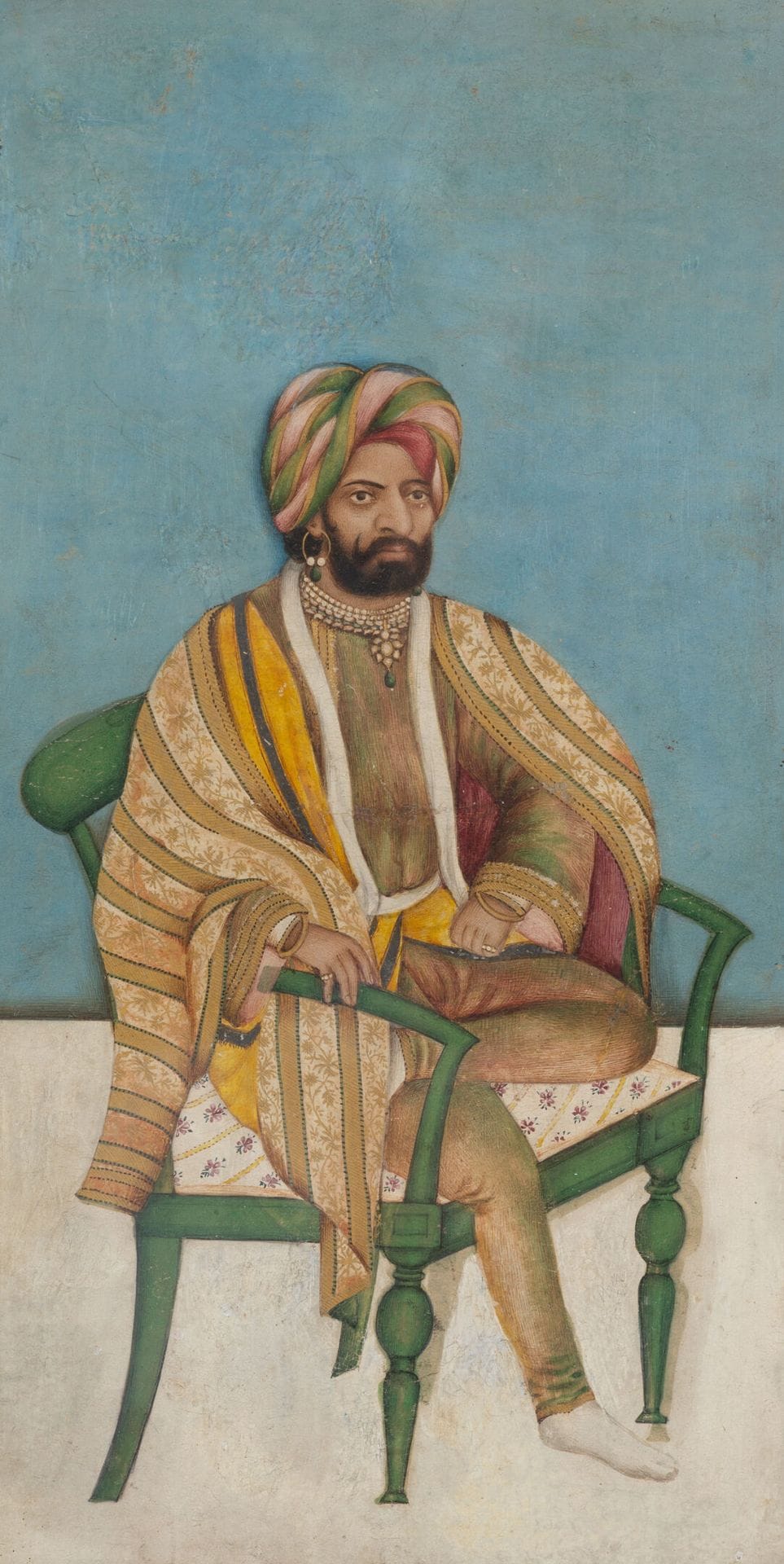
Northern India, Punjab, circa 1850 Portrait of Gulab Singh of Jammu and Kashmir. Gouache and gold on paper. He is depicted seated in a green armchair on a terrace against a plain blue background. Border of floral garlands on a black background. Mounted on an old rose-colored card stock. Original label on the back from the Eyre & Hobhouse gallery: “Sikh School, c. 1847–1857. Maharaja Gulab Singh of Jammu and Kashmir (1792–1857).” Gouache: 28 x 16 cm, with handwritten notes: “cat. no. 45” and “30/1 E+H 2051.” Portrait dimensions: 20 x 10 cm. Dimensions with margins: 22 x 2.5 cm. Mounted under glass. (Unframed; minor imperfections and tears have been restored). Provenance: Eyre & Hobhouse, 39 Duke Street, St. James’s, London Gulab Singh (1792–1957), a member of the Hindu Dogra family, was the first Sikh maharaja of the princely state of Jammu and Kashmir within the British Raj from 1846 to 1857. As early as 1812, control of Jammu passed to the Sikhs. By 1820, Jammu had been incorporated into the ambitious plans of Gulab Singh, who had been appointed raja by Ranjit Singh, the first Sikh ruler of the Punjab (now divided between India and Pakistan). After the First Anglo-Sikh War, in 1846 the Treaty of Amritsar granted him authority over the territory of Kashmir, and Gulab Singh was recognized by the new British forces of the Raj as Maharaja and independent ruler of Jammu and Kashmir (F.S. Aijazuddin, *Pahari Paintings and Sikh Portraits in the Lahore Museum*, 1977, p. 39). He founded the Dogra dynasty. For a portrait of Gulab Singh, Lahore, Punjab, c. 1846, held at the Victoria and Albert Museum, London (inv. IS 194-1951), see Susan Stronge (ed.), *The Arts of the Sikh Kingdoms*, exhibition catalog, V&A, London, 1999, cat. 117, p. 109. Eyre & Hobhouse (later Eyre & Hobhouse Ltd) was a renowned London art gallery, active primarily between 1978 and 1986. Co-directed by the British collector and art dealer Niall Hobhouse, the gallery had built a solid international reputation, particularly in two major areas: “Company School” paintings and botanical art.
Estimate
€800 - €1,200
Buyer's premium
26.4%
Northern India, Punjab, circa 1850
Portrait of Gulab Singh of Jammu and Kashmir.
Gouache and gold on paper. He is depicted seated in a green armchair on a terrace against a plain blue background. Border of floral garlands on a black background. Mounted on an old rose-colored card stock. Original label on the back from the Eyre & Hobhouse gallery: “Sikh School, c. 1847–1857. Maharaja Gulab Singh of Jammu and Kashmir (1792–1857).” Gouache: 28 x 16 cm, with handwritten notes: “cat. no. 45” and “30/1 E+H 2051.”
Portrait dimensions: 20 x 10 cm. Dimensions with margins: 22 x 2.5 cm.
Mounted under glass. (Unframed; minor imperfections and tears have been restored).
Provenance:
Eyre & Hobhouse, 39 Duke Street, St. James’s, London
Gulab Singh (1792–1957), a member of the Hindu Dogra family, was the first Sikh maharaja of the princely state of Jammu and Kashmir within the British Raj from 1846 to 1857. As early as 1812, control of Jammu passed to the Sikhs. By 1820, Jammu had been incorporated into the ambitious plans of Gulab Singh, who had been appointed raja by Ranjit Singh, the first Sikh ruler of the Punjab (now divided between India and Pakistan). After the First Anglo-Sikh War, in 1846 the Treaty of Amritsar granted him authority over the territory of Kashmir, and Gulab Singh was recognized by the new British forces of the Raj as Maharaja and independent ruler of Jammu and Kashmir (F.S. Aijazuddin, *Pahari Paintings and Sikh Portraits in the Lahore Museum*, 1977, p. 39). He founded the Dogra dynasty.
For a portrait of Gulab Singh, Lahore, Punjab, c. 1846, held at the Victoria and Albert Museum, London (inv. IS 194-1951), see Susan Stronge (ed.), *The Arts of the Sikh Kingdoms*, exhibition catalog, V&A, London, 1999, cat. 117, p. 109.
Eyre & Hobhouse (later Eyre & Hobhouse Ltd) was a renowned London art gallery, active primarily between 1978 and 1986. Co-directed by the British collector and art dealer Niall Hobhouse, the gallery had built a solid international reputation, particularly in two major areas: “Company School” paintings and botanical art.
Sale
Friday 4 December・14:00 (Europe/Paris)
Salle 6 - Hôtel Drouot
9, rue Drouot
75009 Paris