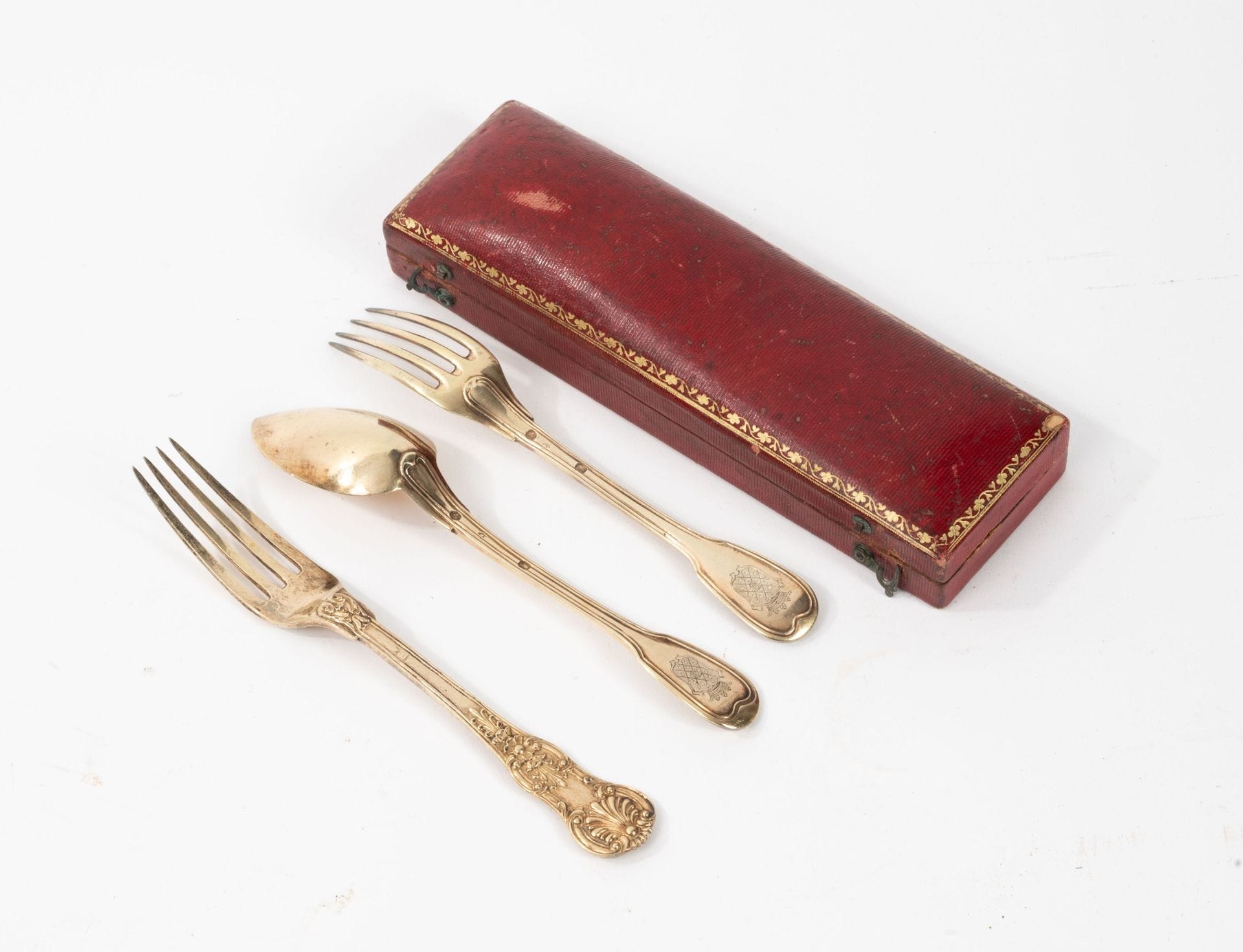
FRANCE, first half of the 19th century Travel dessert spoon in gilded silver (950), net-pattern design, with a spatula engraved with an acanthus leaf on the reverse and a coat of arms on the obverse (gules with crossed lances, adorned with an azure shield bearing a fleur-de-lis) beneath a ducal crown. Silversmith’s hallmark: the first hallmark (1816–1824) of Charles-Salomon MAHLER, active in PARIS between 1816 and 1841. PARIS, 1819–1838. Total weight: 87 g. A few scratches and minor wear to the gilding. In a case lined with red Russian leather, accented with a frieze of floral scrolls gilded with a fine tool (signs of wear). INCLUDED: A silver (950) dessert fork, gilded, with a violin-shaped tine and richly decorated with rocaille motifs of shells, foliage, and small flowers, marked with the monogram “V.B.” surmounted by a count’s crown. Silversmith’s hallmark: likely that of François-Dominique NAUDIN, Place Dauphine, Paris, active between 1805 and 1840. PARIS, 1819–1838. Weight: 63 g. A few scratches and minor wear to the gilding. The coat of arms engraved on the piece corresponds to that of the VILLENEUVE-VENCE family. It could be Clément Louis Hélion (1783–1834), Marquis de Vence, Baron de Villeneuve-Vence and of the Empire, an aide-de-camp to Napoleon, colonel of the Hussars of the Royal Guard during the Restoration, Brigadier General of the King’s armies, and subsequently admitted to the Chamber of Peers in February 1821. He married Aymardine d’Harcourt (1784–1859) in 1801. This marriage could explain the presence of the ducal crown above this coat of arms. For Clément Louis Hélion de Villeneuve-Vence was merely a marquis. However, it was a tolerated custom to display the most prestigious crown (in this case, that of his father-in-law, François, Duke of Harcourt) to signify his social rise. This place setting could be dated to after his father’s death in February 1819, when he officially became the 6th Marquis of that name.
Estimate
€230 - €300
Buyer's premium
26.4%
FRANCE, first half of the 19th century
Travel dessert spoon in gilded silver (950), net-pattern design, with a spatula engraved with an acanthus leaf on the reverse and a coat of arms on the obverse (gules with crossed lances, adorned with an azure shield bearing a fleur-de-lis) beneath a ducal crown.
Silversmith’s hallmark: the first hallmark (1816–1824) of Charles-Salomon MAHLER, active in PARIS between 1816 and 1841.
PARIS, 1819–1838.
Total weight: 87 g.
A few scratches and minor wear to the gilding.
In a case lined with red Russian leather, accented with a frieze of floral scrolls gilded with a fine tool (signs of wear).
INCLUDED:
A silver (950) dessert fork, gilded, with a violin-shaped tine and richly decorated with rocaille motifs of shells, foliage, and small flowers, marked with the monogram “V.B.” surmounted by a count’s crown.
Silversmith’s hallmark: likely that of François-Dominique NAUDIN, Place Dauphine, Paris, active between 1805 and 1840.
PARIS, 1819–1838.
Weight: 63 g.
A few scratches and minor wear to the gilding.
The coat of arms engraved on the piece corresponds to that of the VILLENEUVE-VENCE family.
It could be Clément Louis Hélion (1783–1834), Marquis de Vence, Baron de Villeneuve-Vence and of the Empire, an aide-de-camp to Napoleon, colonel of the Hussars of the Royal Guard during the Restoration, Brigadier General of the King’s armies, and subsequently admitted to the Chamber of Peers in February 1821.
He married Aymardine d’Harcourt (1784–1859) in 1801.
This marriage could explain the presence of the ducal crown above this coat of arms. For Clément Louis Hélion de Villeneuve-Vence was merely a marquis. However, it was a tolerated custom to display the most prestigious crown (in this case, that of his father-in-law, François, Duke of Harcourt) to signify his social rise.
This place setting could be dated to after his father’s death in February 1819, when he officially became the 6th Marquis of that name.
Sale
Friday 4 December・14:00 (Europe/Paris)
Salle 6 - Hôtel Drouot
9, rue Drouot
75009 Paris