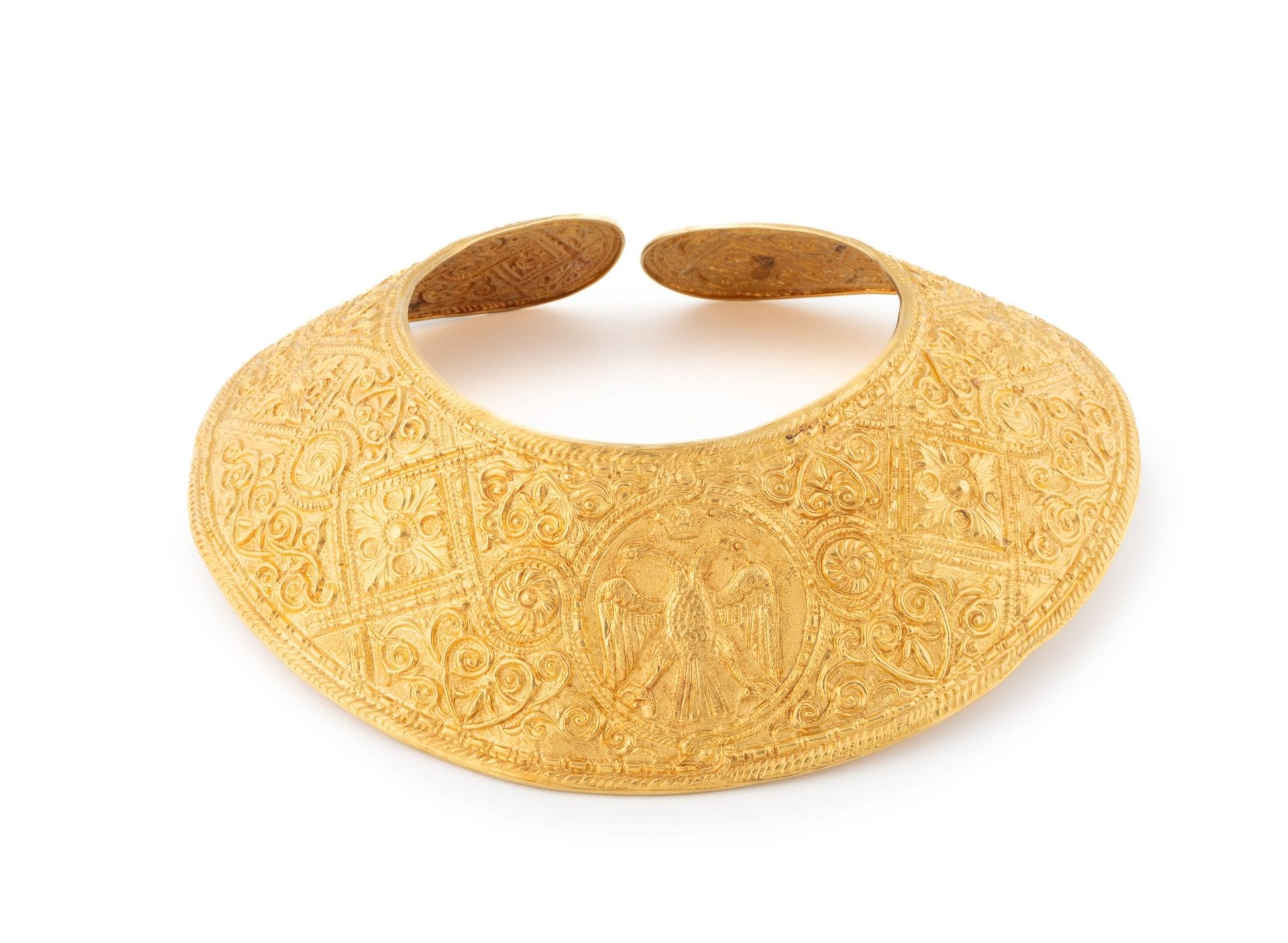
Important ruff necklace. Consisting of a tapering band with rounded ends, made of yellow gold sheet metal (min. 750) with repoussé decoration, in the center, an oval medallion featuring a double-headed eagle beneath a crown, framed by a row of four-leaf clovers within lozenges, alternating with swirling rosettes, on a background of foliage and fleur-de-lis hearts. The borders are accented with a twisted cord and a line of small rods. Rehallmarked with an owl. Late 19th or early 20th century. Gross weight: 283.6 g. - Neckline diameter: approx. 12 cm. - Widest point: 24 cm. Some flaws and minor historical restorations, a few scratches, dents, and small holes; distortions. This ruff necklace, inspired by Byzantine design—notably due to the presence of the eagle— appears to have been a prestigious garment embellishment for a costume ball, such as those held in the imperial courts of Russia or Austria—where the double-headed eagle served as the emblem—in the late 19th or early 20th century. Provenance: According to family tradition, this necklace belonged to a prominent family that lived in Constantinople in the early 20th century.
Estimate
€23,000 - €25,000
Buyer's premium
26.4%
Important ruff necklace.
Consisting of a tapering band with rounded ends, made of yellow gold sheet metal (min. 750) with repoussé decoration, in the center, an oval medallion featuring a double-headed eagle beneath a crown, framed by a row of four-leaf clovers within lozenges, alternating with swirling rosettes, on a background of foliage and fleur-de-lis hearts.
The borders are accented with a twisted cord and a line of small rods.
Rehallmarked with an owl.
Late 19th or early 20th century.
Gross weight: 283.6 g. - Neckline diameter: approx. 12 cm. - Widest point: 24 cm.
Some flaws and minor historical restorations, a few scratches, dents, and small holes; distortions.
This ruff necklace, inspired by Byzantine design—notably due to the presence of the eagle— appears to have been a prestigious garment embellishment for a costume ball, such as those held in the imperial courts of Russia or Austria—where the double-headed eagle served as the emblem—in the late 19th or early 20th century.
Provenance:
According to family tradition, this necklace belonged to a prominent family that lived in Constantinople in the early 20th century.
Sale
Friday 4 December・14:00 (Europe/Paris)
Salle 6 - Hôtel Drouot
9, rue Drouot
75009 Paris