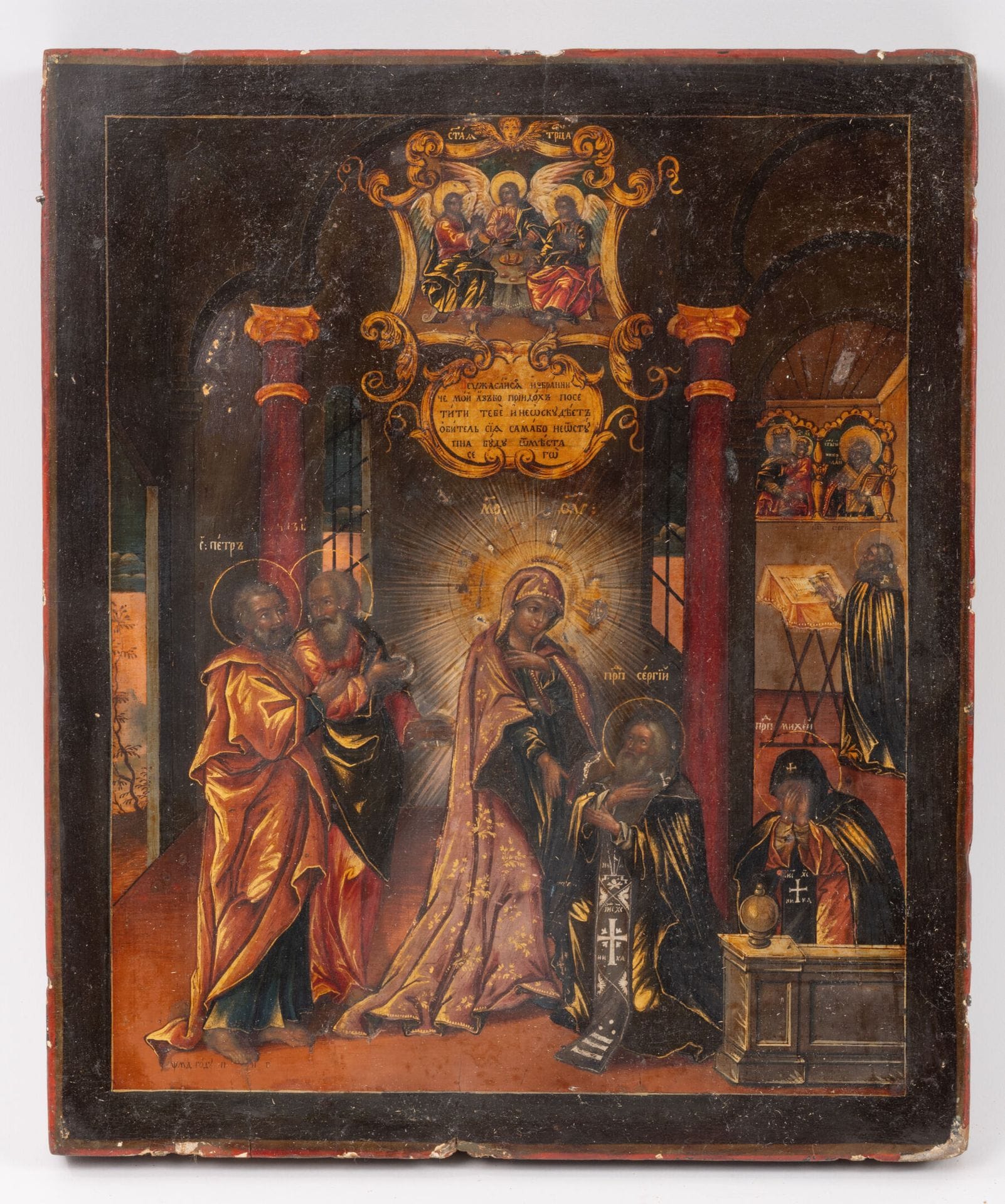
RUSSIA, mid-18th century Icon depicting the “Vision of Saint Sergius of Radonezh” or the “Miraculous Apparition of the Most Holy Mother of God.” Tempera and gold on a wooden panel, backed with softwood planks. Inscriptions above the figures identify them. At the bottom left, the date “year 1744” and two initials, possibly those of the iconographer. On the back, inscriptions in ink: one on a label indicating the dimensions [31.1 x 26.7 cm] and the silver fineness of the oklad [“with hallmark”], and another regarding its weight [555 gr.]. Icon without frame: 31.5 x 26.4 cm - Back: 31.2 x 26.7 cm. Signs of wear, some darkened areas and old restorations, some lifting and losses, particularly on the hands and faces, and around the edges; a few cracks, especially in the backing boards. Beautiful oklad made of thick silver sheet (84 zolotniks / 875 / min. 800) gilded with decorative repoussé work, echoing the composition of the tempera painting, but more ornate, and partially openwork. The halo of the Mother of God (attached) is secured by five prongs, featuring a (composite) design of emerald cabochons in a closed setting, with glued costume pearls and three faceted purple glass stones in claw settings, replacing the original (missing) halo secured by two through-pins. A simulated border with a flat band punctuated by rocaille cartouches on a grained background, some forming spandrels. A later inscription at the lower left tip reads “.... 134.” Profiles formerly blackened. Silversmith’s mark in Cyrillic [МГ]: M.G. According to bibliographic sources, this is either an unknown silversmith who appears to have been active between 1752 and 1767, according to Paul PAULSON [in *Guide to Russian Silver Hallmarks*, 1976, p. XVII]; or between 1754 and 1764, according to Geoffrey WATTS [in *Russian Silversmiths’ Hallmarks 1700 to 1917*, 2006, p. 152]; or an assay officer active between 1752 and 1771, according to Marina POSTNIKOVA-LOSEVA [in *Russian Silver & Gold Hallmarks*, n.d. circa 1995, no. 2082]. MOSCOW hallmark [St. George] with an incomplete date [175??]. Exempt from hallmarking as the piece predates 1838 (Art. 524bis of the CGI, paragraph a). Later inscriptions in ink on the reverse. Gross weight of the frame alone: 564 g. - Dimensions: 31.7 x 26.7 cm. Some wear, dents, and warping, with a few tears and small losses around the mounting holes and the metal edges folded into corners on the sides. Scattered oxidation. The difference in dates between the icon (1744) and the oklad (175?) is explained by the time it took to raise the funds to commission the creation of an ornate solid-silver riza to embellish and protect the icon. Given its inscribed date of 1744, this icon may have been painted to commemorate Empress Elizabeth Petrovna’s granting of the Lavra to the Trinity-St. Sergius Monastery in 1744, northeast of Moscow, founded in the 14th century by Saint Sergius of Radonezh (1314–1392), one of Russia’s most important saints, alongside Saint Nicholas and Saint Andrew. A distinguished privilege, rarely granted to monastic complexes in the Russian Empire, the title “Lavra” denotes the highest and most prestigious honor bestowed upon an Orthodox monastery of major historical, spiritual, demographic, and cultural significance.
Estimate
€2,500 - €3,500
Buyer's premium
26.4%
RUSSIA, mid-18th century
Icon depicting the “Vision of Saint Sergius of Radonezh” or the “Miraculous Apparition of the Most Holy Mother of God.”
Tempera and gold on a wooden panel, backed with softwood planks.
Inscriptions above the figures identify them. At the bottom left, the date “year 1744” and two initials, possibly those of the iconographer.
On the back, inscriptions in ink: one on a label indicating the dimensions [31.1 x 26.7 cm] and the silver fineness of the oklad [“with hallmark”], and another regarding its weight [555 gr.].
Icon without frame: 31.5 x 26.4 cm - Back: 31.2 x 26.7 cm.
Signs of wear, some darkened areas and old restorations, some lifting and losses, particularly on the hands and faces, and around the edges; a few cracks, especially in the backing boards.
Beautiful oklad made of thick silver sheet (84 zolotniks / 875 / min. 800) gilded with decorative repoussé work, echoing the composition of the tempera painting, but more ornate, and partially openwork.
The halo of the Mother of God (attached) is secured by five prongs, featuring a (composite) design of emerald cabochons in a closed setting, with glued costume pearls and three faceted purple glass stones in claw settings, replacing the original (missing) halo secured by two through-pins.
A simulated border with a flat band punctuated by rocaille cartouches on a grained background, some forming spandrels. A later inscription at the lower left tip reads “.... 134.” Profiles formerly blackened.
Silversmith’s mark in Cyrillic [МГ]: M.G.
According to bibliographic sources, this is either an unknown silversmith who appears to have been active between 1752 and 1767, according to Paul PAULSON [in *Guide to Russian Silver Hallmarks*, 1976, p. XVII]; or between 1754 and 1764, according to Geoffrey WATTS [in *Russian Silversmiths’ Hallmarks 1700 to 1917*, 2006, p. 152]; or an assay officer active between 1752 and 1771, according to Marina POSTNIKOVA-LOSEVA [in *Russian Silver & Gold Hallmarks*, n.d. circa 1995, no. 2082].
MOSCOW hallmark [St. George] with an incomplete date [175??].
Exempt from hallmarking as the piece predates 1838 (Art. 524bis of the CGI, paragraph a).
Later inscriptions in ink on the reverse.
Gross weight of the frame alone: 564 g. - Dimensions: 31.7 x 26.7 cm.
Some wear, dents, and warping, with a few tears and small losses around the mounting holes and the metal edges folded into corners on the sides. Scattered oxidation.
The difference in dates between the icon (1744) and the oklad (175?) is explained by the time it took to raise the funds to commission the creation of an ornate solid-silver riza to embellish and protect the icon.
Given its inscribed date of 1744, this icon may have been painted to commemorate Empress Elizabeth Petrovna’s granting of the Lavra to the Trinity-St. Sergius Monastery in 1744, northeast of Moscow, founded in the 14th century by Saint Sergius of Radonezh (1314–1392), one of Russia’s most important saints, alongside Saint Nicholas and Saint Andrew.
A distinguished privilege, rarely granted to monastic complexes in the Russian Empire, the title “Lavra” denotes the highest and most prestigious honor bestowed upon an Orthodox monastery of major historical, spiritual, demographic, and cultural significance.
Sale
Friday 4 December・14:00 (Europe/Paris)
Salle 6 - Hôtel Drouot
9, rue Drouot
75009 Paris