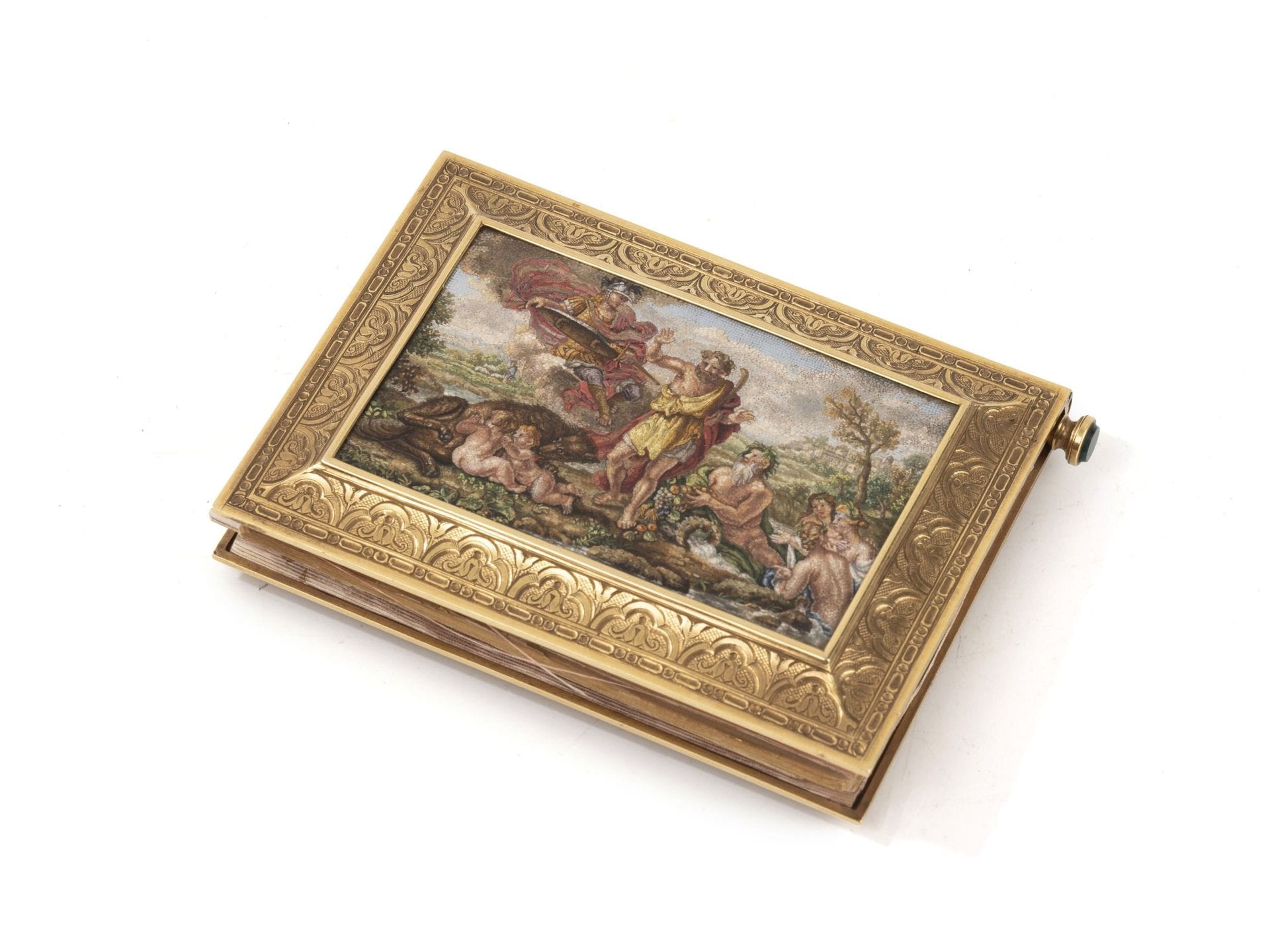
EUROPE, second half of the 19th century A ballbook with an elaborate rectangular frame in yellow gold (750), the covers centered around a panel adorned either with a Roman micro-mosaic plaque depicting a mythological scene from the life of Hercules, set in a bucolic landscape featuringa shepherd and his flock and villas, or a trellis punctuated by stylized square fleurons, framed by chiseled cavets featuring a frieze of fleurons within trefoil-shaped medallions, accented by a necklace of pearls and pirouettes. Curved hinged spine, decorated with a trellis pattern on a grooved background. Re-stamped with an owl. Pink moiré silk lining, with two small card holders, a notepad with blank pages, a folding French calendar for the year 1856, published by Mac-Henry on Rue de la Parcheminerie in Paris, and a French weekly planner titled “Tablettes de poche,” Paris, Published by [Courtois], 26 Rue Phelipeaux. Includes a French mechanical pencil, attached separately, made of yellow gold (750) with wavy guilloché engraving, topped with a (blank) seal featuring a circular base of bloodstone. Eagle’s head hallmark and traces of a goldsmith’s hallmark. Gross weight of the case (without the notebooks): 137.6 g. - 97 x 72 x 16 mm. Gross weight of the mechanical pencil: 5.8 g. - Height: 104 mm. Previously restored with a metal plate; a few scratches and very minor wear marks on the case; small chips in the jasper of the pencil holder; damage to the moiré lining, which is partially faded, with small stains, a few tears, and has come loose from the back of the main cover. The mythological scene depicts Hercules, standing in the center; to his right, Minerva on clouds, his protective goddess, and Remus and Romulus with the She-Wolf, symbolizing Rome; and to his left, the river god Achelous, whom he fought for the hand of Deianira, and the cornucopia resulting from that battle, along with three bathers or naiads. This micro-mosaic plaque appears to be an Italian souvenir from the Grand Tour, set in a European frame upon returning from that journey. The publishers Mac-Henry and Courtois were active in Paris during the 19th century.
Estimate
€5,000 - €6,000
Buyer's premium
26.4%
EUROPE, second half of the 19th century
A ballbook with an elaborate rectangular frame in yellow gold (750), the covers centered around a panel adorned either with a Roman micro-mosaic plaque depicting a mythological scene from the life of Hercules, set in a bucolic landscape featuringa shepherd and his flock and villas, or a trellis punctuated by stylized square fleurons, framed by chiseled cavets featuring a frieze of fleurons within trefoil-shaped medallions, accented by a necklace of pearls and pirouettes.
Curved hinged spine, decorated with a trellis pattern on a grooved background.
Re-stamped with an owl.
Pink moiré silk lining, with two small card holders, a notepad with blank pages, a folding French calendar for the year 1856, published by Mac-Henry on Rue de la Parcheminerie in Paris, and a French weekly planner titled “Tablettes de poche,” Paris, Published by [Courtois], 26 Rue Phelipeaux.
Includes a French mechanical pencil, attached separately, made of yellow gold (750) with wavy guilloché engraving, topped with a (blank) seal featuring a circular base of bloodstone.
Eagle’s head hallmark and traces of a goldsmith’s hallmark.
Gross weight of the case (without the notebooks): 137.6 g. - 97 x 72 x 16 mm.
Gross weight of the mechanical pencil: 5.8 g. - Height: 104 mm.
Previously restored with a metal plate; a few scratches and very minor wear marks on the case; small chips in the jasper of the pencil holder; damage to the moiré lining, which is partially faded, with small stains, a few tears, and has come loose from the back of the main cover.
The mythological scene depicts Hercules, standing in the center; to his right, Minerva on clouds, his protective goddess, and Remus and Romulus with the She-Wolf, symbolizing Rome; and to his left, the river god Achelous, whom he fought for the hand of Deianira, and the cornucopia resulting from that battle, along with three bathers or naiads.
This micro-mosaic plaque appears to be an Italian souvenir from the Grand Tour, set in a European frame upon returning from that journey.
The publishers Mac-Henry and Courtois were active in Paris during the 19th century.
Sale
Friday 4 December・14:00 (Europe/Paris)
Salle 6 - Hôtel Drouot
9, rue Drouot
75009 Paris