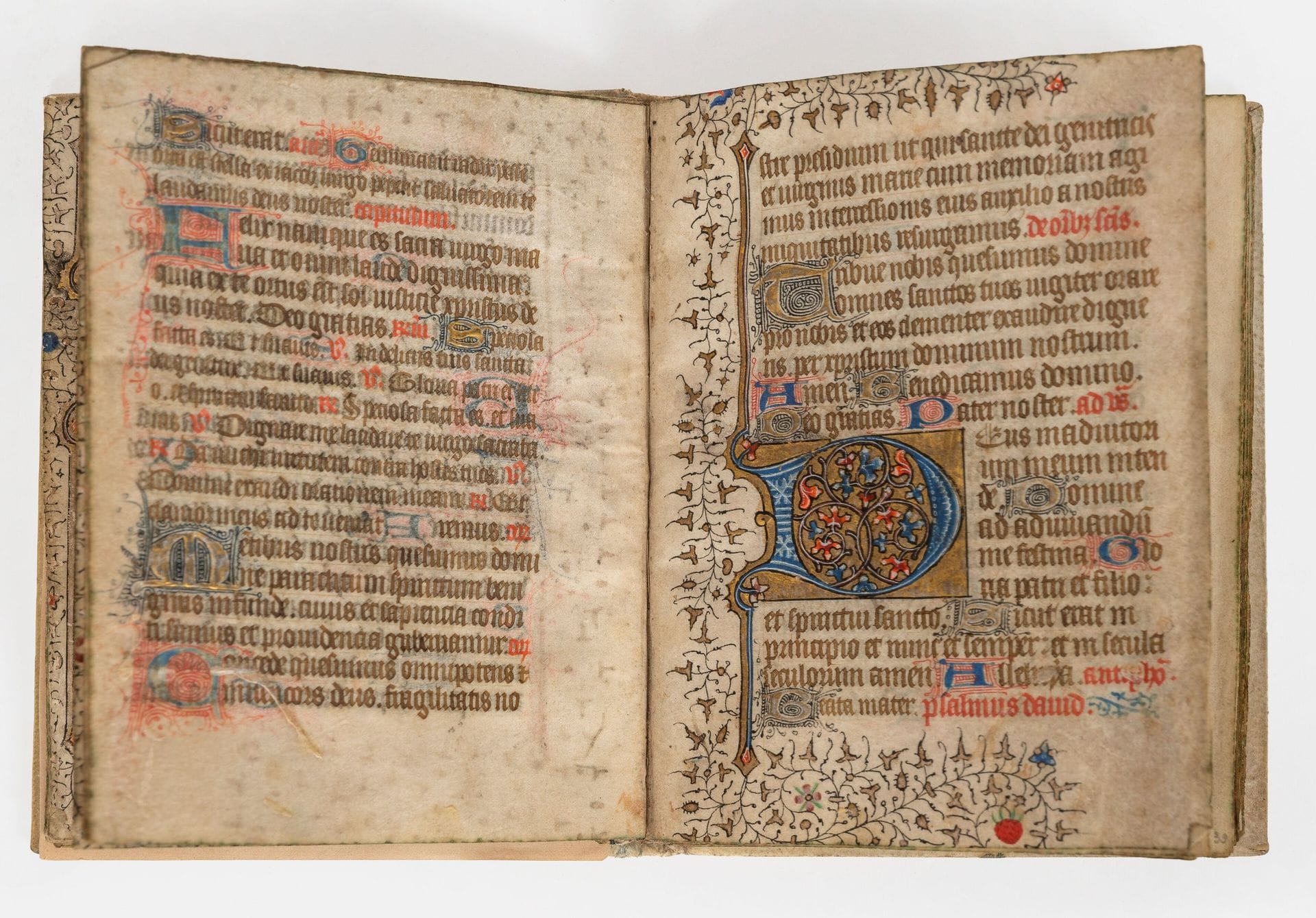
[MANUSCRIPT]. [HOURS] Fragment from a book of hours (for use in Évreux) Hours of the Virgin and Prayers to the Saints. France, ca. 1430–1450 With 7 large ornamental initials. 98 ff., fragmentary manuscript (Matins from the Hours of the Virgin are missing, as are, most certainly, the other constituent parts of a book of hours (at a minimum: the calendar, the Hours of the Cross and of the Holy Spirit, Psalms of Penance, and the Office of the Dead), Gothic script in brown ink, 20 lines per page (text size: 100 x 70 mm), rubrics in red, filigree initials in gold or blue with decoration in dark blue or red (1 to 2 lines high), ornate line ends in blue and red, large initials in blue or pink with white highlights on burnished gold backgrounds featuring a decoration of scrollwork, colored vine leaves, and small flowers (6 lines high), marking the major liturgical divisions, extensions of the large initials featuring burnished gold lines and a decoration of fine scrolls, vine leaves, and small gold discs with colored flowers. Rigid full vellum binding, smooth spine, endpapers of dark blue paper. Reported losses, stained parchment, leaves trimmed short in places, first leaf partially detached from the stitching, some ornate initials rubbed. Dimensions of the binding: 138 x 108 mm. This manuscript contains a fragment of a book of hours, intended for the uncommon use in Évreux. It is interesting to note that it was most likely produced between 1430 and 1450 (based on stylistic evidence) and thus dates to roughly the very end of the Hundred Years’ War and the return of Normandy to the rule of the kings of France. However, it should be noted that the county of Évreux, which had once been under the control of the House of Évreux-Navarre, was confiscated by Charles VI as early as 1385. Évreux returned to the sovereignty of the King of France for good in 1441. TEXT: Matins from the Hours of the Virgin are missing. This manuscript contains the majority of the Hours of the Virgin according to the Evreux usage (see the list of antiphons and capitula below). pp. 1–13, Lauds from the Hours of the Virgin, antiphon, “O admirabile”; chapter verse, “Te laudant”; hymn, “O gloriosa domina.” pp. 13–20, Prime of the Hours of the Virgin, antiphon, “O admirabile”; capitulum, “In omnibus requiem.” pp. 20–24, Terce of the Hours of the Virgin, antiphon, “Quando natus”; chapter verse, “Paradisi porta.” pp. 24–29, Sext of the Hours of the Virgin, antiphon, “Rubum quem videat”; chapter verse, “Gaude Maria.” pp. 29–33, None of the Hours of the Virgin, antiphon, “Germinavit radix”; chapter verse, “Felix namque.” pp. 33–41, Vespers of the Hours of the Virgin, antiphon, “Beata Maria”; chapter verse, “Beata es virgo.” pp. 41–46, Compline of the Hours of the Virgin, antiphon, “Cum iocunditate”; chapter verse, “Sicut cynamomum”; followed by the antiphon of the Nunc dimittis, “Ecce complecta sunt.” pp. 46–87, Suffrages and prayers, including suffrages to the Archangel Michael, John the Baptist, John the Evangelist, Christopher, Sebastian, Lawrence, Martin, Germain, Mathurin, Lubin, Nicholas, Anne, Mary Magdalene, Margaret, Catherine, and the Holy Shroud. ff. 87–98, Litany in honor of the Virgin Mary, followed by prayers to the Virgin.
Estimate
€3,000 - €3,500
Buyer's premium
26.4%
[MANUSCRIPT]. [HOURS]
Fragment from a book of hours (for use in Évreux)
Hours of the Virgin and Prayers to the Saints.
France, ca. 1430–1450
With 7 large ornamental initials.
98 ff., fragmentary manuscript (Matins from the Hours of the Virgin are missing, as are, most certainly, the other constituent parts of a book of hours (at a minimum: the calendar, the Hours of the Cross and of the Holy Spirit, Psalms of Penance, and the Office of the Dead), Gothic script in brown ink, 20 lines per page (text size: 100 x 70 mm), rubrics in red, filigree initials in gold or blue with decoration in dark blue or red (1 to 2 lines high), ornate line ends in blue and red, large initials in blue or pink with white highlights on burnished gold backgrounds featuring a decoration of scrollwork, colored vine leaves, and small flowers (6 lines high), marking the major liturgical divisions, extensions of the large initials featuring burnished gold lines and a decoration of fine scrolls, vine leaves, and small gold discs with colored flowers.
Rigid full vellum binding, smooth spine, endpapers of dark blue paper. Reported losses, stained parchment, leaves trimmed short in places, first leaf partially detached from the stitching, some ornate initials rubbed.
Dimensions of the binding: 138 x 108 mm.
This manuscript contains a fragment of a book of hours, intended for the uncommon use in Évreux. It is interesting to note that it was most likely produced between 1430 and 1450 (based on stylistic evidence) and thus dates to roughly the very end of the Hundred Years’ War and the return of Normandy to the rule of the kings of France. However, it should be noted that the county of Évreux, which had once been under the control of the House of Évreux-Navarre, was confiscated by Charles VI as early as 1385. Évreux returned to the sovereignty of the King of France for good in 1441.
TEXT:
Matins from the Hours of the Virgin are missing. This manuscript contains the majority of the Hours of the Virgin according to the Evreux usage (see the list of antiphons and capitula below).
pp. 1–13, Lauds from the Hours of the Virgin, antiphon, “O admirabile”; chapter verse, “Te laudant”; hymn, “O gloriosa domina.”
pp. 13–20, Prime of the Hours of the Virgin, antiphon, “O admirabile”; capitulum, “In omnibus requiem.”
pp. 20–24, Terce of the Hours of the Virgin, antiphon, “Quando natus”; chapter verse, “Paradisi porta.”
pp. 24–29, Sext of the Hours of the Virgin, antiphon, “Rubum quem videat”; chapter verse, “Gaude Maria.”
pp. 29–33, None of the Hours of the Virgin, antiphon, “Germinavit radix”; chapter verse, “Felix namque.”
pp. 33–41, Vespers of the Hours of the Virgin, antiphon, “Beata Maria”; chapter verse, “Beata es virgo.”
pp. 41–46, Compline of the Hours of the Virgin, antiphon, “Cum iocunditate”; chapter verse, “Sicut cynamomum”; followed by the antiphon of the Nunc dimittis, “Ecce complecta sunt.”
pp. 46–87, Suffrages and prayers, including suffrages to the Archangel Michael, John the Baptist, John the Evangelist, Christopher, Sebastian, Lawrence, Martin, Germain, Mathurin, Lubin, Nicholas, Anne, Mary Magdalene, Margaret, Catherine, and the Holy Shroud.
ff. 87–98, Litany in honor of the Virgin Mary, followed by prayers to the Virgin.
Sale
Friday 4 December・14:00 (Europe/Paris)
Salle 6 - Hôtel Drouot
9, rue Drouot
75009 Paris