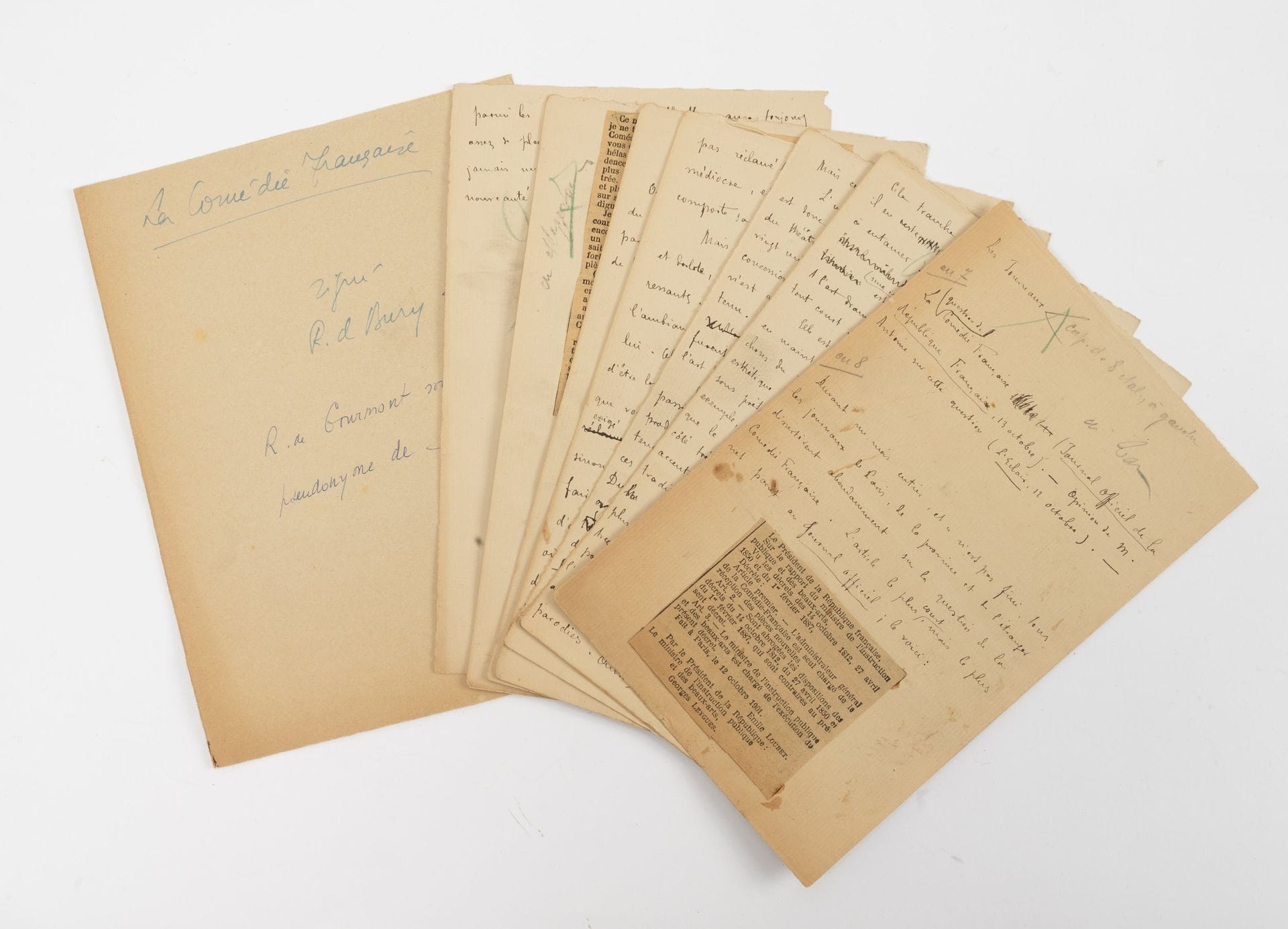
Remy de GOURMONT (1858–1915) Autograph manuscript, signed with his pseudonym “R. de Bury,” *Les Journaux*, [October 1901]; 5½ pages, in-8 format, with pasted-in newspaper clippings. On the Comédie Française and the decree of October 12, 1901. Gourmont wonders whether the Comédie Française is “a useful, harmful, or indifferent institution” to art. While it upholds tradition, it often distorts it, and the modern repertoire (Augier, Dumas, Ponsard) is very limited: “It hasn’t even had the courage to stage a drama by Ibsen […] It rejected a play by Courteline on the pretext that it was inappropriate […] of all genres, it seems to admit only the Augiesque genre.” He protests against the continued inclusion “of these two names, which offend poetry—Augier, Dumas, these two leading figures of ‘gossip’ (the term is Mr. Paul Adam’s) […] It has been harmful through its choices as much as through its omissions; it has not demanded the best, but has seized upon the mediocre, and done so with all the frenzy of its bourgeois dignity.” Dumas is already out of fashion, and it is up to Claretie—who is free to make his own choices—to give voice to the new literature. Gourmont speaks out against the abolition of the reading committee, as did ANTOINE, whose opinion (newspaper clipping) is quoted.
Estimate
€150 - €200
Buyer's premium
26%
Remy de GOURMONT (1858–1915)
Autograph manuscript, signed with his pseudonym “R. de Bury,” *Les Journaux*, [October 1901]; 5½ pages, in-8 format, with pasted-in newspaper clippings.
On the Comédie Française and the decree of October 12, 1901. Gourmont wonders whether the Comédie Française is “a useful, harmful, or indifferent institution” to art. While it upholds tradition, it often distorts it, and the modern repertoire (Augier, Dumas, Ponsard) is very limited: “It hasn’t even had the courage to stage a drama by Ibsen […] It rejected a play by Courteline on the pretext that it was inappropriate […] of all genres, it seems to admit only the Augiesque genre.” He protests against the continued inclusion “of these two names, which offend poetry—Augier, Dumas, these two leading figures of ‘gossip’ (the term is Mr. Paul Adam’s) […] It has been harmful through its choices as much as through its omissions; it has not demanded the best, but has seized upon the mediocre, and done so with all the frenzy of its bourgeois dignity.” Dumas is already out of fashion, and it is up to Claretie—who is free to make his own choices—to give voice to the new literature. Gourmont speaks out against the abolition of the reading committee, as did ANTOINE, whose opinion (newspaper clipping) is quoted.
Sale
Monday 16 November・20:00 (Europe/Paris)
Sale location coming soon
7 rue Drouot
75009 Paris