JEAN FOUQUET (1899–1984) Brooch in white gold (750) and platinum (850) parts per thousand, rectangular in shape and folded along the long diagonal, adorned with two old-cut diamonds in a closed-set setting within a geometric “duality” motif, enhanced by a substantial pavé of old-cut diamonds in a grain setting. Signed, numbered, with the master’s hallmark “GF” for Georges FOUQUET. In a case from the house of G. FOUQUET. Modernist jewelry, circa 1930–35. Weight of the two main diamonds: approx. 1.80 and 1.30 carats. Gross weight: 11 g. - Dimensions: 5.1 x 2.4 cm. Provenance: Collection of Jan MARTEL, then passed down through the family to the current owner. In the aftermath of World War I, in 1919, Jean Fouquet began working for his father. The House of Fouquet had been run by his father, Georges, since 1895 and dominated the Parisian jewelry scene. Paris during the Roaring Twenties encouraged bold creativity. As a designer at the family business, Jean rubbed shoulders with figures such as architect Eric Bagge, sculptors Jan and Joel Martel, Cassandre, and painter Lambert-Rucki. In 1925, the Exposition des Arts Décoratifs was held, where Jean stood out for his innovative work and won an award; he created pieces with geometric shapes using new materials such as ebony, silver, lacquer, chrome-plated steel, and white gold. The House of Fouquet represents nearly a century of jewelry design, reflecting the successive styles of a period marked by numerous historical, political, and artistic events. Although the 1930s are commonly associated with Art Deco, an innovative movement emerged: Modernism. Inspired by the modernity of the late first half of the 20th century, artists explored the scientific and technical discoveries of their time. Their creations stood out for their innovative materials—notably the use of white gold, silver, lacquer, and nickel- or chrome-plated metal—as well as the introduction of semi-precious stones. Jean Fouquet was part of this movement, as were Jean Dunand (1877–1942), Jean Desprès (1889–1980), and Raymond Templier (1891–1968). They all joined the UAM (Union des Artistes Modernes) in 1929. These pieces, with their clean lines and graphic design, are characterized by strong contrasts between materials that create plays of light. Bibliography: *Les Fouquet, Bijoutiers & Joailliers à Paris 1860–1960*, Musée des Arts Décoratifs, Flammarion, edited by Marie-Noel de Gary. This brooch is reminiscent of other similar pieces created by Jean Fouquet (see page 170 of the aforementioned book, no. 176).
Estimate
€6,000 - €8,000
Result
€63,000
Buyer's premium
26.41%
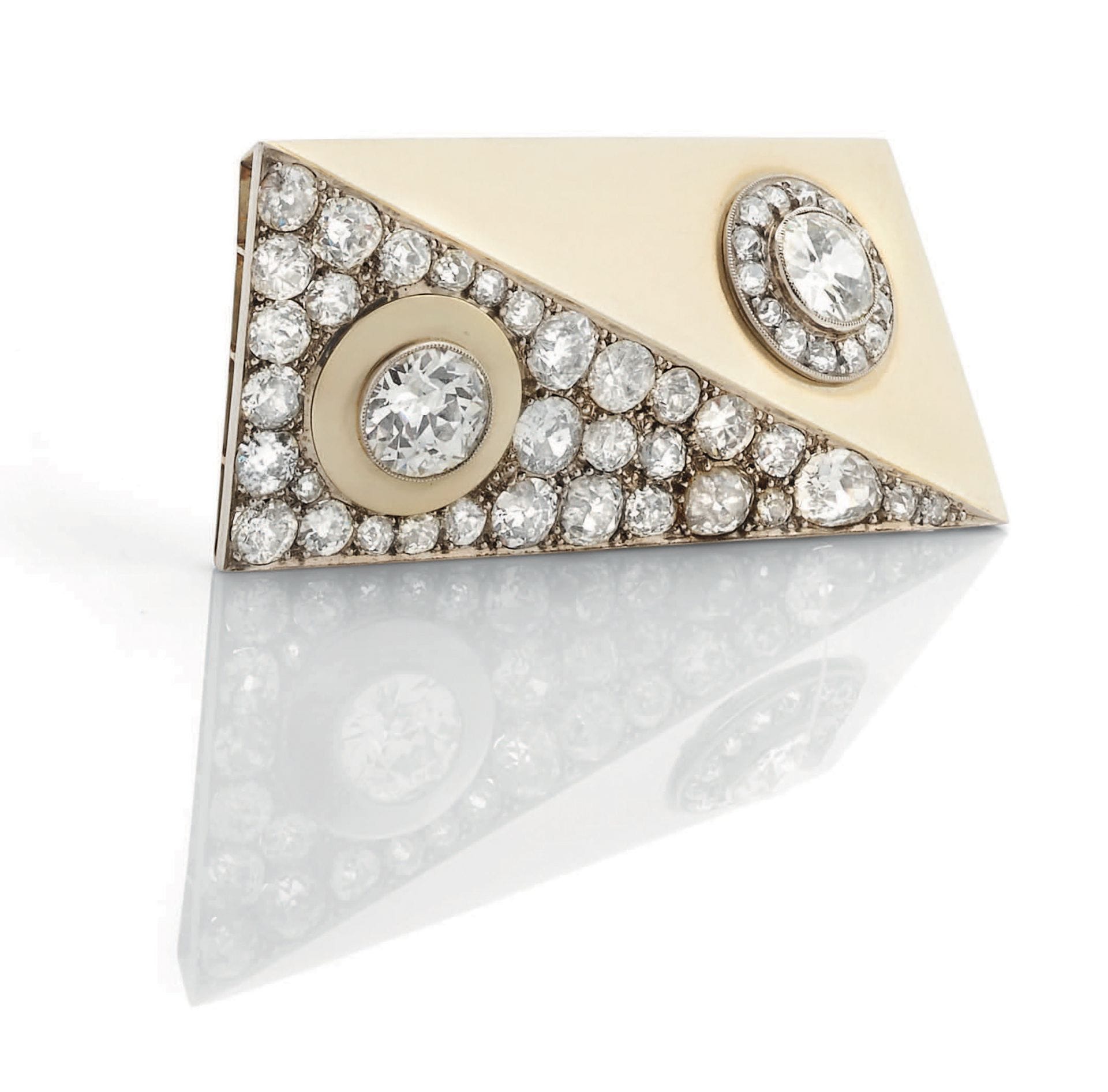
JEAN FOUQUET (1899–1984)
Brooch in white gold (750) and platinum (850) parts per thousand, rectangular in shape and folded along the long diagonal, adorned with two old-cut diamonds in a closed-set setting within a geometric “duality” motif, enhanced by a substantial pavé of old-cut diamonds in a grain setting.
Signed, numbered, with the master’s hallmark “GF” for Georges FOUQUET.
In a case from the house of G. FOUQUET.
Modernist jewelry, circa 1930–35.
Weight of the two main diamonds: approx. 1.80 and 1.30 carats.
Gross weight: 11 g. - Dimensions: 5.1 x 2.4 cm.
Provenance:
Collection of Jan MARTEL, then passed down through the family to the current owner.
In the aftermath of World War I, in 1919, Jean Fouquet began working for his father.
The House of Fouquet had been run by his father, Georges, since 1895 and dominated the Parisian jewelry scene.
Paris during the Roaring Twenties encouraged bold creativity.
As a designer at the family business, Jean rubbed shoulders with figures such as architect Eric Bagge, sculptors Jan and Joel Martel, Cassandre, and painter Lambert-Rucki.
In 1925, the Exposition des Arts Décoratifs was held, where Jean stood out for his innovative work and won an award; he created pieces with geometric shapes using new materials such as ebony, silver, lacquer, chrome-plated steel, and white gold.
The House of Fouquet represents nearly a century of jewelry design, reflecting the successive styles of a period marked by numerous historical, political, and artistic events.
Although the 1930s are commonly associated with Art Deco, an innovative movement emerged: Modernism. Inspired by the modernity of the late first half of the 20th century, artists explored the scientific and technical discoveries of their time.
Their creations stood out for their innovative materials—notably the use of white gold, silver, lacquer, and nickel- or chrome-plated metal—as well as the introduction of semi-precious stones. Jean Fouquet was part of this movement, as were Jean Dunand (1877–1942), Jean
Desprès (1889–1980), and Raymond Templier (1891–1968).
They all joined the UAM (Union des Artistes Modernes) in 1929.
These pieces, with their clean lines and graphic design, are characterized by strong contrasts between materials that create plays of light.
Bibliography: *Les Fouquet, Bijoutiers & Joailliers à Paris 1860–1960*, Musée des Arts Décoratifs, Flammarion, edited by Marie-Noel de Gary.
This brooch is reminiscent of other similar pieces created by Jean Fouquet (see page 170 of the aforementioned book, no. 176).
Sale
Friday 3 July・14:00 (Europe/Paris)
Salle 3 - Hôtel Drouot
9, rue Drouot
75009 Paris