FRANCE, early First Empire, circa 1804-1805 Rare award saber, presented to Marshal KELLERMANN (1735-1820), probably in 1804, upon his promotion to Marshal of the Empire: Made by the Manufacture de Klingenthal Coulaux frères. Light cavalry-type model, engraved, chased and gilded brass guard, round openwork branch at the top, ending in an offset; body knot decorated on each side with a leafy lozenge, two triangular aurillons chased with a palmette; quillon bent downwards with the same decoration as the branch and ending in a finial; pommel missing; ebony spindle, carved with scales and fluting on the sides. Exceptional curved damascus blade with round back and full-length side groove, finished with a counter-edge, carp tongue tip; the first third engraved with etching, gilding and bluing: the first side decorated with trophies of arms, a cannon, foliage and a sword in pale surmounted by a heraldic helmet, and the other side decorated with trophies of arms, foliage, an Eagle on a sphere and, above, a cup filled with flowers and fruit surmounted by the imperial crown. Center parts marked "AU MARÉCHAL KELLERMANN" in damascus steel letters, forged into the damascus of the blade; back signed "Manufacture de Klingenthal Coulaux Frères" on a gold background. Chagrin-covered wooden scabbard with three gilded brass fittings, engraved with rectangular reserves and terminating in palmettes, each with a central laurel-chased strap, of which only the first two bear a laurel guilloche piton with a ring; buckler engraved at the end with foliage and arrows; lyre-shaped sting. Blade length: 83 cm - Total length: 101 cm. Some wear; split and a few knocks to the spindle; a few old oxidation stains, notably on the blade; scabbard: a few knocks to the fittings, the chagrin has worked and shrunk at the central trim, a few cuts and small chips. The pommel was probably lost many years ago, perhaps over a century (various heirs have always owned this sword without a pommel). Note: To date, fewer than 10 swords are known with the attribution forged into the damascus of the blade. All were made at the Manufacture de Klingenthal during the Consulate and early First Empire, including : - three swords for First Consul Bonaparte (one in the Malmaison Museum, one in the Moscow Historical Museum, and one in a private collection), - General Rapp's in the Musée de Colmar, - General Ordener's in a private collection, - that of Conseiller d'Etat and Préfet du Bas Rhin Shée, dating from around 1802-1810, in a private collection. Provenance : - Gift from Princess Henriette GINETTI (1841-1920), great-granddaughter of the Maréchal, to Eugène-Camille JESSON (1845-1923), mayor of the commune of Valmy from 1885 to 1908, to thank him for having initiated the subscription launched for the erection of the monument with the bronze statue by KELLERMANN for the centenary of the cannonade on September 20, 1892. This monument still stands today on the Place de Valmy, next to KELLERMANN's obelisk carditaph (or cardiograph), erected in 1821. - Then by descent. KELLERMANN François Étienne Christophe, Duc de Valmy, Marshal of France, born in Strasbourg on May 28, 1735, died in Paris on September 13, 1820. He entered the Lowendahl regiment as a cadet volunteer in 1752; became an ensign in the Bavière royal regiment in 1753; became a lieutenant in the Alsace volunteers in May 1756; served in Germany from 1758 to 1762; was 2nd captain in a dragoon regiment in April 1758; distinguished himself at Bergen and Friedberg; reformed captain in the Dauphiné volunteers in April 1761; distinguished himself in several encounters where he took 300 grenadiers and general SCHEIDER prisoner; captain in the Conflans legion, April 1763; entrusted with important missions in Poland and Tartary, 1765-1766; captain of hussars, March 24, 1769; knight of Saint-Louis, July 13, 1771... Lieutenant-colonel of the regiment colonel general of hussars, April 1780; mestre de camp en 2ème of the 2nd regiment colonel general of hussars, February 1784; maréchal de camp, March 9, 1788; commandant of Haut Rhin, February 1791; commander of Saint-Louis, March 7, 1792; lieutenant general, March 20, 1792... Commander-in-chief of the Army of the Center in place of LUCKNER, August 20, 1792 (became the Army of Moselle, October 1, 1792); took possession of his command on September 2; subordinate to DUMOURIEZ from September 19 to October 5, 1792; was the real victor of Valmy on September 20.
Estimate
€18,000 - €20,000
Result
Not communicated
Buyer's premium
26.4%
FRANCE, early First Empire, circa 1804-1805
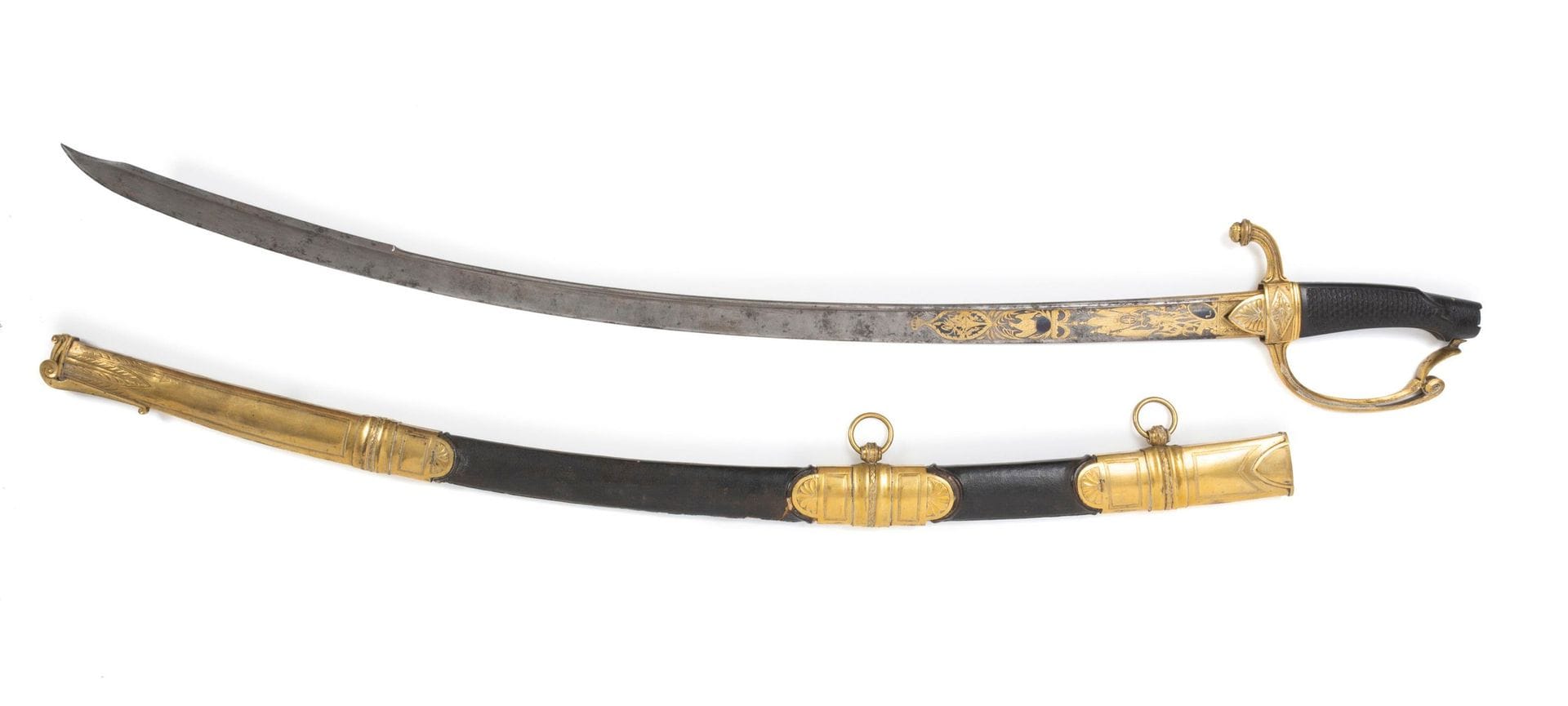
Rare award saber, presented to Marshal KELLERMANN (1735-1820), probably in 1804, upon his promotion to Marshal of the Empire:
Made by the Manufacture de Klingenthal Coulaux frères.
Light cavalry-type model, engraved, chased and gilded brass guard, round openwork branch at the top, ending in an offset; body knot decorated on each side with a leafy lozenge, two triangular aurillons chased with a palmette; quillon bent downwards with the same decoration as the branch and ending in a finial; pommel missing; ebony spindle, carved with scales and fluting on the sides.
Exceptional curved damascus blade with round back and full-length side groove, finished with a counter-edge, carp tongue tip; the first third engraved with etching, gilding and bluing: the first side decorated with trophies of arms, a cannon, foliage and a sword in pale surmounted by a heraldic helmet, and the other side decorated with trophies of arms, foliage, an Eagle on a sphere and, above, a cup filled with flowers and fruit surmounted by the imperial crown.
Center parts marked "AU MARÉCHAL KELLERMANN" in damascus steel letters, forged into the damascus of the blade; back signed "Manufacture de Klingenthal Coulaux Frères" on a gold background.
Chagrin-covered wooden scabbard with three gilded brass fittings, engraved with rectangular reserves and terminating in palmettes, each with a central laurel-chased strap, of which only the first two bear a laurel guilloche piton with a ring; buckler engraved at the end with foliage and arrows; lyre-shaped sting.
Blade length: 83 cm - Total length: 101 cm.
Some wear; split and a few knocks to the spindle; a few old oxidation stains, notably on the blade; scabbard: a few knocks to the fittings, the chagrin has worked and shrunk at the central trim, a few cuts and small chips.
The pommel was probably lost many years ago, perhaps over a century (various heirs have always owned this sword without a pommel).
Note:
To date, fewer than 10 swords are known with the attribution forged into the damascus of the blade. All were made at the Manufacture de Klingenthal during the Consulate and early First Empire, including :
- three swords for First Consul Bonaparte (one in the Malmaison Museum, one in the Moscow Historical Museum, and one in a private collection),
- General Rapp's in the Musée de Colmar,
- General Ordener's in a private collection,
- that of Conseiller d'Etat and Préfet du Bas Rhin Shée, dating from around 1802-1810, in a private collection.
Provenance :
- Gift from Princess Henriette GINETTI (1841-1920), great-granddaughter of the Maréchal, to Eugène-Camille JESSON (1845-1923), mayor of the commune of Valmy from 1885 to 1908, to thank him for having initiated the subscription launched for the erection of the monument with the bronze statue by KELLERMANN for the centenary of the cannonade on September 20, 1892.
This monument still stands today on the Place de Valmy, next to KELLERMANN's obelisk carditaph (or cardiograph), erected in 1821.
- Then by descent.
KELLERMANN François Étienne Christophe, Duc de Valmy, Marshal of France, born in Strasbourg on May 28, 1735, died in Paris on September 13, 1820.
He entered the Lowendahl regiment as a cadet volunteer in 1752; became an ensign in the Bavière royal regiment in 1753; became a lieutenant in the Alsace volunteers in May 1756; served in Germany from 1758 to 1762; was 2nd captain in a dragoon regiment in April 1758; distinguished himself at Bergen and Friedberg; reformed captain in the Dauphiné volunteers in April 1761; distinguished himself in several encounters where he took 300 grenadiers and general SCHEIDER prisoner; captain in the Conflans legion, April 1763; entrusted with important missions in Poland and Tartary, 1765-1766; captain of hussars, March 24, 1769; knight of Saint-Louis, July 13, 1771... Lieutenant-colonel of the regiment colonel general of hussars, April 1780; mestre de camp en 2ème of the 2nd regiment colonel general of hussars, February 1784; maréchal de camp, March 9, 1788; commandant of Haut Rhin, February 1791; commander of Saint-Louis, March 7, 1792; lieutenant general, March 20, 1792... Commander-in-chief of the Army of the Center in place of LUCKNER, August 20, 1792 (became the Army of Moselle, October 1, 1792); took possession of his command on September 2; subordinate to DUMOURIEZ from September 19 to October 5, 1792; was the real victor of Valmy on September 20.