Curious and astonishing saber presented to Adjutant General DAUVERGNE by the government of Padua: Very fine single-branch guard, entirely in brass, chased and gilded, embellished with silver elements; branch with two rows of pearls adorned in the middle with a chain and silver diamond-point pearls; long-tailed cap in the shape of a fantastic animal's head, embellished with silver scales or foliage; quillon ending in an animal's head topped with silver foliage; the two circular, gilded brass aurillons, the front one edged with pearls and centered with a silver Republic in an added openwork circle, the rear one entirely in brass chased with a rosette; alternating spindle with guilloche gilded brass rings and silver diamond points. Strong, curved, military-style blade (hussar) from the late 18th century, engraved on both sides with the Austrian coat of arms: double-headed eagle surmounted by a crown; back signed: "Jean Schimmelbusch et fils à Solingen"; one side bears the engraved dedication: "À L'Ami Dauvergne Le Gouvernement de Padoue". Black patent leather scabbard, without splints, with three fittings: - large gilded brass cope with ring, adorned on the front over the entire surface with a large embossed and openwork silver motif: two crossed trumpets of renown, a lictor bundle topped by a Phrygian cap in a laurel wreath, a basin garnished with flowers and, below, a child holding a shield, seated on the head of a lion, behind him two crossed standards ; - the intermediate trim, also with a gilded brass ring, cut out and engraved, in the center, a silver motif forming a rectangular frame with, in the middle, a woman's head wearing a draped headdress; - the gilded brass bouterole, ending in a brace, engraved on the border with laurels, gilded brass stinger. Revolutionary period. Total length: 101.5 cm. - Blade length: 82.7 cm - Gross weight: 1.590 g. The leather is very old and may not be original; it was already this one at the LEVI sale in 1936; it has a fold in the middle, later. Some wear to the gilding and engraving on the blade; a few knocks; small lack of silver applied to the top of the guard, with slight play at the attachment to the pommel, otherwise very good condition. Provenance: - Purchased at the sale of the André LÉVI collection, Hôtel Drouot, June 27, 1936, room no. 6 (originally scheduled for June 19, room no. 10), lot no. 36; piece reproduced on Plate VII. - Then by family inheritance. At the time of this sale, a number of documents were attached to the saber: - Service records of DAUVERGNE, Adjutant General commanding the Place de Lyon; - 5 letters relating to the service of the city of Lyon; - good revolutionary vignettes. These documents have since been lost. Exhibition: This piece was included in the La Sabretache exhibition at the Musée des Arts Décoratifs in 1935. This Italian saber is strongly influenced by the work of the Naples Manufactory; on this one, the diamond points are silver instead of ice-polished steel. The maker appears to be Louis-François DAUVERGNE (1751-1801), about whom little is known: - married in 1780 to Marie DECOUDRAY (+ in 1791), with whom he had two children, then remarried in 1792 to Marie MIGNARD (1766-1828), with whom he had three children [Geneanet]. - In a letter dated Messidor 3 and 4, Year II [June 21 and 22, 1794], he is said to be "commandant of the Marseille troops in the Bouches-du-Rhône and Vaucluse departments" [De Baecque sale in Lyon, January 30, 2014, lot 200, L.A.S. and manuscript A.S. to "his comrades making up the Avignon garrison"]. - In a placard addressed to the inhabitants of Lyon, dated Brumaire 28, An VIII [November 19, 1799], he is described as "Adjutant-General, commanding the troops in the Rhône Department, the commune of Lyon and its suburbs in a state of siege" [Musée Carnavalet, Paris, Inv. AFF3016]. - He served in the Italian campaign under General Brune, in Major General Grouchy's 4th Division, as "Adjutant-Commander and Deputy Chief of General Staff for the organization of this division" [in Lieutenant Henri LEPLUS, La campagne de 1800 à l'Armée des Grisons, Paris, Lib. militaire R. Chapelot, 1908, pp. 26 and 34]. It is not known on what occasion he received this saber, probably for protecting the town of Padua and its inhabitants during this military campaign.
Estimate
€14,000 - €16,000
Result
€13,000
Buyer's premium
26%
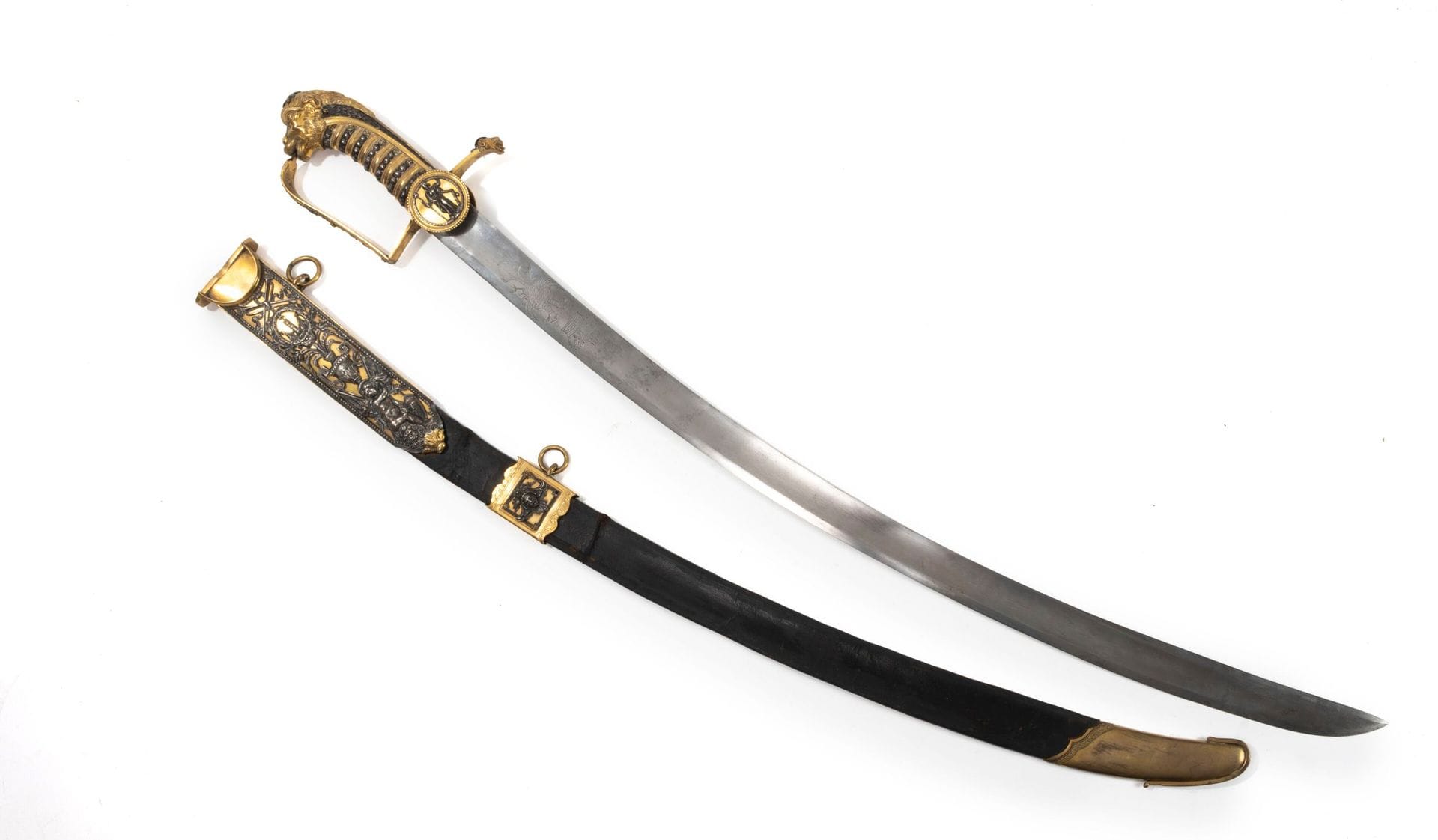
Curious and astonishing saber presented to Adjutant General DAUVERGNE by the government of Padua:
Very fine single-branch guard, entirely in brass, chased and gilded, embellished with silver elements; branch with two rows of pearls adorned in the middle with a chain and silver diamond-point pearls; long-tailed cap in the shape of a fantastic animal's head, embellished with silver scales or foliage; quillon ending in an animal's head topped with silver foliage; the two circular, gilded brass aurillons, the front one edged with pearls and centered with a silver Republic in an added openwork circle, the rear one entirely in brass chased with a rosette; alternating spindle with guilloche gilded brass rings and silver diamond points.
Strong, curved, military-style blade (hussar) from the late 18th century, engraved on both sides with the Austrian coat of arms: double-headed eagle surmounted by a crown; back signed: "Jean Schimmelbusch et fils à Solingen"; one side bears the engraved dedication: "À L'Ami Dauvergne Le Gouvernement de Padoue".
Black patent leather scabbard, without splints, with three fittings:
- large gilded brass cope with ring, adorned on the front over the entire surface with a large embossed and openwork silver motif: two crossed trumpets of renown, a lictor bundle topped by a Phrygian cap in a laurel wreath, a basin garnished with flowers and, below, a child holding a shield, seated on the head of a lion, behind him two crossed standards ;
- the intermediate trim, also with a gilded brass ring, cut out and engraved, in the center, a silver motif forming a rectangular frame with, in the middle, a woman's head wearing a draped headdress;
- the gilded brass bouterole, ending in a brace, engraved on the border with laurels, gilded brass stinger.
Revolutionary period.
Total length: 101.5 cm. - Blade length: 82.7 cm - Gross weight: 1.590 g.
The leather is very old and may not be original; it was already this one at the LEVI sale in 1936; it has a fold in the middle, later.
Some wear to the gilding and engraving on the blade; a few knocks; small lack of silver applied to the top of the guard, with slight play at the attachment to the pommel, otherwise very good condition.
Provenance:
- Purchased at the sale of the André LÉVI collection, Hôtel Drouot, June 27, 1936, room no. 6 (originally scheduled for June 19, room no. 10), lot no. 36; piece reproduced on Plate VII.
- Then by family inheritance.
At the time of this sale, a number of documents were attached to the saber:
- Service records of DAUVERGNE, Adjutant General commanding the Place de Lyon;
- 5 letters relating to the service of the city of Lyon;
- good revolutionary vignettes.
These documents have since been lost.
Exhibition:
This piece was included in the La Sabretache exhibition at the Musée des Arts Décoratifs in 1935.
This Italian saber is strongly influenced by the work of the Naples Manufactory; on this one, the diamond points are silver instead of ice-polished steel.
The maker appears to be Louis-François DAUVERGNE (1751-1801), about whom little is known:
- married in 1780 to Marie DECOUDRAY (+ in 1791), with whom he had two children, then remarried in 1792 to Marie MIGNARD (1766-1828), with whom he had three children [Geneanet].
- In a letter dated Messidor 3 and 4, Year II [June 21 and 22, 1794], he is said to be "commandant of the Marseille troops in the Bouches-du-Rhône and Vaucluse departments" [De Baecque sale in Lyon, January 30, 2014, lot 200, L.A.S. and manuscript A.S. to "his comrades making up the Avignon garrison"].
- In a placard addressed to the inhabitants of Lyon, dated Brumaire 28, An VIII [November 19, 1799], he is described as "Adjutant-General, commanding the troops in the Rhône Department, the commune of Lyon and its suburbs in a state of siege" [Musée Carnavalet, Paris, Inv. AFF3016].
- He served in the Italian campaign under General Brune, in Major General Grouchy's 4th Division, as "Adjutant-Commander and Deputy Chief of General Staff for the organization of this division" [in Lieutenant Henri LEPLUS, La campagne de 1800 à l'Armée des Grisons, Paris, Lib. militaire R. Chapelot, 1908, pp. 26 and 34].
It is not known on what occasion he received this saber, probably for protecting the town of Padua and its inhabitants during this military campaign.