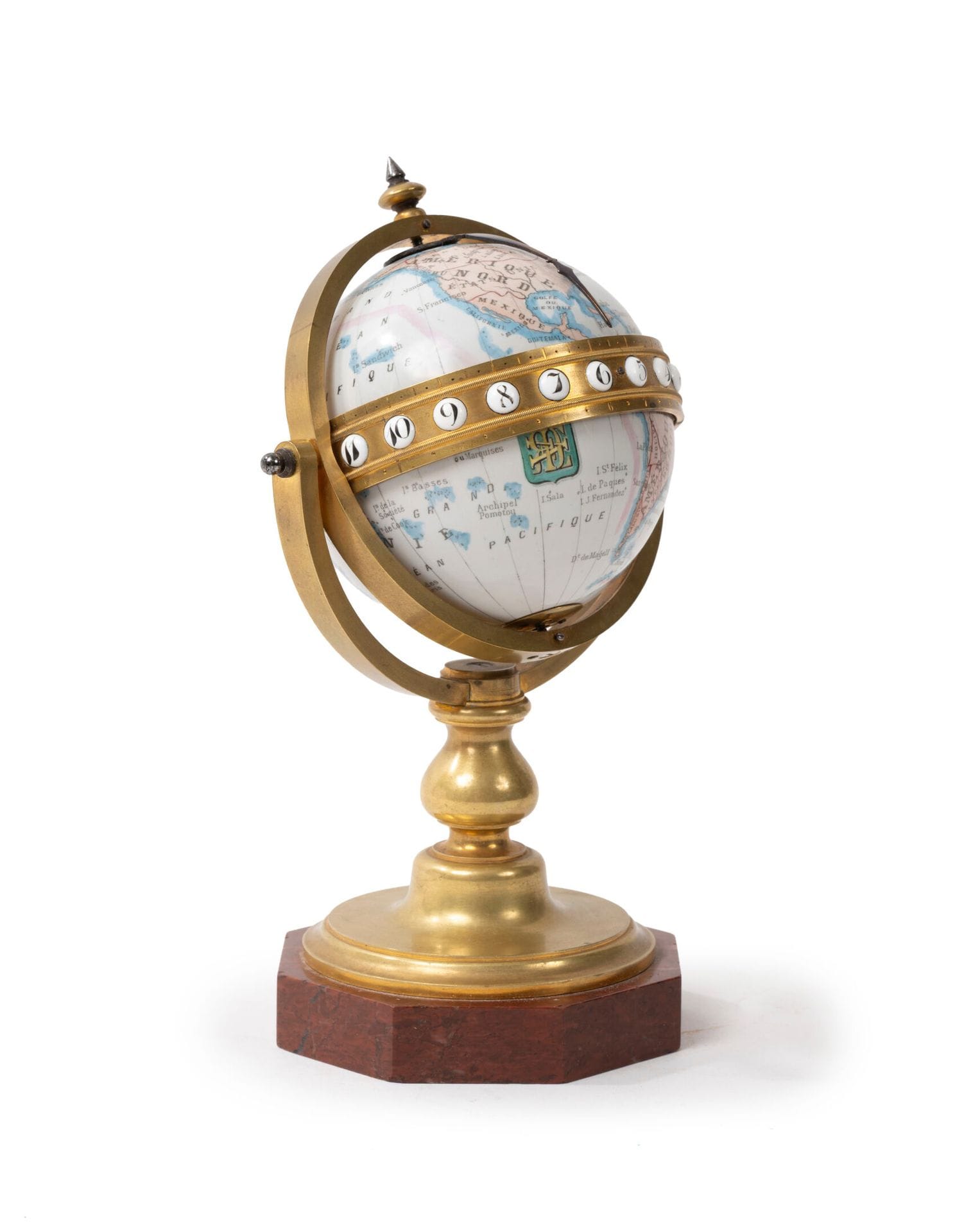
Antoine REDIER (1817-1892) Ring-shaped brass clock in the form of a "moving sphere" globe, mounted on a gimbal, in white enameled metal, partially colored, with indications printed in black for the 24 time zones, names and rivers; the boundaries of continents and countries are marked in blue or red. The globe is engraved A. RED. [in the Pacific Ocean]. The Equator materialized by a brass ring, graduated and punctuated with 24 white enamelled hemispherical lozenges with Arabic numerals for the hours (2 x 12 h.), read from right to left. Below these lozenges, two other series of 12 engraved crescents, read from left to right. Blued steel hand. Bottom winding (key with two locking rods, missing). On a turned baluster shaft and molded circular pedestal. Octagonal base in white and black veined red marble. Circa 1870-1875. H. Approx. 20 cm - Globe diameter 8 cm. Some wear, notably to the engraved numerals, scratches and a few knocks, including one to the chipped globe [at 3 o'clock facing Martinique]. Small chips on the base. Mechanism to be revised (globe not open). Hand-engraved inscription "R.E" on the lower part of the ring dial ribbon [between 3 and 2 o'clock above SpirituSanto]. Bibliography : Sphère mouvante by M. A. Redier, in "La Nature, Revue des sciences et de leurs applications aux arts et à l'industrie, Journal hebdomadaire illustré", 1883, no. 533, pp. 191-192, figs. 1-3. Second series, recognizable by its globe, which is free to rotate in both directions, by the way it winds the spring (by locking the disc at the South Pole with a two-rod key and manually turning the globe counter-clockwise) and by the way it sets the time (by moving the hand). A weight placed inside the hemisphere, opposite the hand, ensures that the hour ring remains at an easily readable angle for the duration of use. Several "moving sphere" clocks have come onto the market. And they don't always have the hour digits in the same place. The son of a watchmaker from Perpignan, Joseph-Antoine-Jean REDIER, went to Paris with François ARAGO to train at the new watchmaking school under Louis Frédéric Perrelet. After completing his apprenticeship, he moved to Paris in 1842, taking over the Duchemin watchmaking business on Place du Châtelet. In addition to advances in watchmaking, he studied and invented several scientific instruments, including a complex barograph, and registered nearly 60 patents in these various technologies.
Estimate
€1,500 - €2,000
Result
€2,600
Buyer's premium
26%
Antoine REDIER (1817-1892)
Ring-shaped brass clock in the form of a "moving sphere" globe, mounted on a gimbal, in white enameled metal, partially colored, with indications printed in black for the 24 time zones, names and rivers; the boundaries of continents and countries are marked in blue or red.
The globe is engraved A. RED. [in the Pacific Ocean].
The Equator materialized by a brass ring, graduated and punctuated with 24 white enamelled hemispherical lozenges with Arabic numerals for the hours (2 x 12 h.), read from right to left. Below these lozenges, two other series of 12 engraved crescents, read from left to right. Blued steel hand.
Bottom winding (key with two locking rods, missing).
On a turned baluster shaft and molded circular pedestal. Octagonal base in white and black veined red marble.
Circa 1870-1875.
H. Approx. 20 cm - Globe diameter 8 cm.
Some wear, notably to the engraved numerals, scratches and a few knocks, including one to the chipped globe [at 3 o'clock facing Martinique]. Small chips on the base. Mechanism to be revised (globe not open).
Hand-engraved inscription "R.E" on the lower part of the ring dial ribbon [between 3 and 2 o'clock above SpirituSanto].
Bibliography :
Sphère mouvante by M. A. Redier, in "La Nature, Revue des sciences et de leurs applications aux arts et à l'industrie, Journal hebdomadaire illustré", 1883, no. 533, pp. 191-192, figs. 1-3.
Second series, recognizable by its globe, which is free to rotate in both directions, by the way it winds the spring (by locking the disc at the South Pole with a two-rod key and manually turning the globe counter-clockwise) and by the way it sets the time (by moving the hand).
A weight placed inside the hemisphere, opposite the hand, ensures that the hour ring remains at an easily readable angle for the duration of use.
Several "moving sphere" clocks have come onto the market. And they don't always have the hour digits in the same place.
The son of a watchmaker from Perpignan, Joseph-Antoine-Jean REDIER, went to Paris with François ARAGO to train at the new watchmaking school under Louis Frédéric Perrelet. After completing his apprenticeship, he moved to Paris in 1842, taking over the Duchemin watchmaking business on Place du Châtelet.
In addition to advances in watchmaking, he studied and invented several scientific instruments, including a complex barograph, and registered nearly 60 patents in these various technologies.