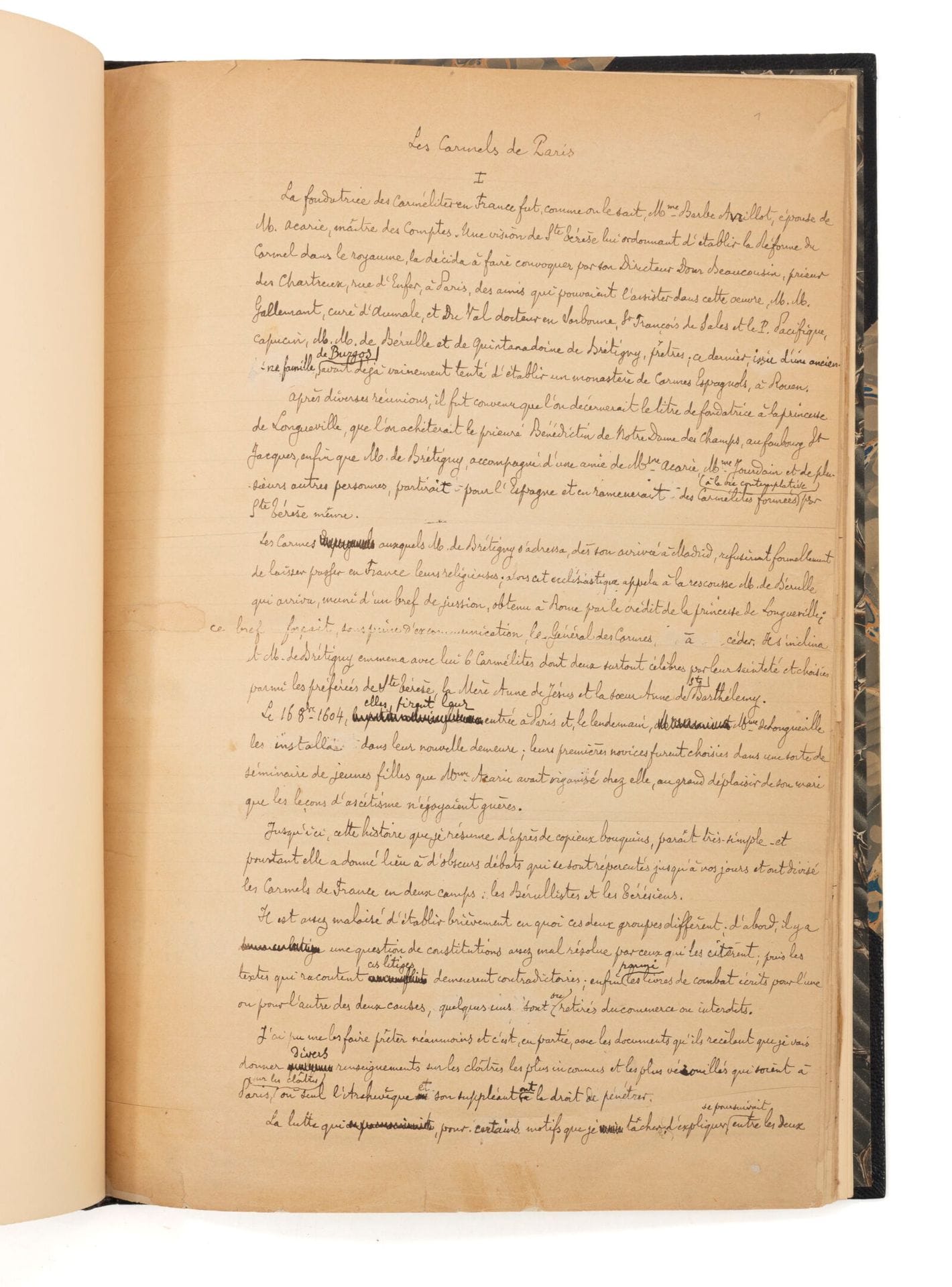
Joris-Karl HUYSMANS (1848-1907) Autograph manuscript signed, Les Carmels de Paris, ; 13 in-fol. pages cut out for printing and pasted back together with gummed paper, bound in an in-fol. half-black morocco volume with corners (J. Faki). Complete manuscript of the three articles published in L'Écho de Paris on March 1, 15 and 29, 1899, forming the text collected in De Tout (Stock, 1902). The manuscript shows erasures and corrections, and interlinear additions. The first article traces the history of the Carmels in France: "The foundress of the Reformed Carmelites in France was, as is well known, Mme Barbe Avrillot, wife of M. Acarie, maître des Comptes", following a vision of Saint Teresa... "... On 16 8bre 1604, they made their entry into Paris, and the next day Mme de Longueville installed them in their new home; their first novices were chosen from a sort of seminary for young girls that Mme Acarie had organized in her home, to the great displeasure of her husband, whose ascetic lessons did little to cheer him up"... He refers to the controversy between the Berullists and Teresians, but beyond the rivalries of Carmel's obedience, the Carmelites "nonetheless fulfill, one as much as the other, the work of reparation and satisfaction intended by their true foundress, the admirable Teresa of Jesus. Through prayer and penance, they work to atone for the sins of others, to convert heretics and sinners; they strive to repair the damage done by priests, to obtain graces for the clergy, who are in great need of them; they toil, in a word, for the triumph of the Church. To pray and suffer is Carmel". The second article describes the daily life of the Carmelites, following a strict and austere rule. Huysmans then turns to "the three Carmels in Paris", all of which grew out of the first convent set up by the Princesse de Longueville "in the Benedictine priory of Notre-Dame-des-Champs", which took the name of "Monastère de l'Incarnation", but which was falling into ruin, and was rebuilt in what is now rue Denfert-Rochereau. Huysmans describes it, with its ugly but "recollected and very intimate" chapel, where he attended "a high mass one winter, a mass of sorrow". The third article recalls the second Carmel, founded in 1616 "by the care of dame Catherine de Gonzagues-Clèves, duchesse de Longueville", in rue Chapon, "later transferred to the parish of Saint-Nicolas-des-Champs, in the hôtel dit de Châlons", and disappeared in 1790. Then he comes to "another asceterium that still exists today, at no. 26 Avenue de Saxe", first erected rue du Bouloy by Queen Marie-Térèse, whose history Huysmans recounts before describing the new convent, built in 1854, and the church, a "mediocre pastiche" of Gothic style: "This sanctuary becomes singularly mysterious when, on this night, you listen to the moaning of the Carmelites; it comes out like a winter wind from their grille, and the soul folds in on itself, frozen, and examines itself. You can make yourself suffer in that church, and it's good"... He ends with the last Carmel, "located at no. 23 avenue de Messine; it is the only house on this avenue, lined with luxury buildings, that is clean; it appears collected and charming, in its little Gothic dress, in the midst of all these hotels that line up, pretentious and rigid, new and silly. [...] A few people still go to pray at Rue Denfert and Avenue de Saxe; but here, at Avenue de Messine, it seems that no soul ever comes, because during the week, the church door is always closed. You have to ask the tourière for the key to get in. [...] All in all, this little church is a pleasant place to be, a haven in such a non-religious neighborhood, in this avenue inhabited by landlords, stockbrokers and bankers, and it has to be said that the brave nuns have a lot to pray for, to make up for the filth committed by the peat of Jews who live just a stone's throw from them, near the Parc!.."... Enclosed is the 1885 issue of Hommes d'aujourd'hui devoted to Huysmans, with its color caricature by Coll-Toc [A. Collignon and G. Tocqueville], and the notice written by Huysmans himself under the pseudonym A. Meunier. Enclosed is a small iconographic file on Huysmans (2 photographs, engraved portrait, drawings and engravings by Ch. Jouas); 6 booklets on Huysmans; plus Henri Calet, Les Murs de Fresnes (Éd. des Quatre Vents, 1945, cart.); and Henri Michaux, Portrait d'homme (La Maison des Amis des Livres, 1992, br.).
Estimate
€1,500 - €2,000
Result
€1,800
Buyer's premium
26%
Joris-Karl HUYSMANS (1848-1907)
Autograph manuscript signed, Les Carmels de Paris, ; 13 in-fol. pages cut out for printing and pasted back together with gummed paper, bound in an in-fol. half-black morocco volume with corners (J. Faki).
Complete manuscript of the three articles published in L'Écho de Paris on March 1, 15 and 29, 1899, forming the text collected in De Tout (Stock, 1902). The manuscript shows erasures and corrections, and interlinear additions.
The first article traces the history of the Carmels in France: "The foundress of the Reformed Carmelites in France was, as is well known, Mme Barbe Avrillot, wife of M. Acarie, maître des Comptes", following a vision of Saint Teresa... "... On 16 8bre 1604, they made their entry into Paris, and the next day Mme de Longueville installed them in their new home; their first novices were chosen from a sort of seminary for young girls that Mme Acarie had organized in her home, to the great displeasure of her husband, whose ascetic lessons did little to cheer him up"... He refers to the controversy between the Berullists and Teresians, but beyond the rivalries of Carmel's obedience, the Carmelites "nonetheless fulfill, one as much as the other, the work of reparation and satisfaction intended by their true foundress, the admirable Teresa of Jesus. Through prayer and penance, they work to atone for the sins of others, to convert heretics and sinners; they strive to repair the damage done by priests, to obtain graces for the clergy, who are in great need of them; they toil, in a word, for the triumph of the Church. To pray and suffer is Carmel".
The second article describes the daily life of the Carmelites, following a strict and austere rule. Huysmans then turns to "the three Carmels in Paris", all of which grew out of the first convent set up by the Princesse de Longueville "in the Benedictine priory of Notre-Dame-des-Champs", which took the name of "Monastère de l'Incarnation", but which was falling into ruin, and was rebuilt in what is now rue Denfert-Rochereau. Huysmans describes it, with its ugly but "recollected and very intimate" chapel, where he attended "a high mass one winter, a mass of sorrow".
The third article recalls the second Carmel, founded in 1616 "by the care of dame Catherine de Gonzagues-Clèves, duchesse de Longueville", in rue Chapon, "later transferred to the parish of Saint-Nicolas-des-Champs, in the hôtel dit de Châlons", and disappeared in 1790. Then he comes to "another asceterium that still exists today, at no. 26 Avenue de Saxe", first erected rue du Bouloy by Queen Marie-Térèse, whose history Huysmans recounts before describing the new convent, built in 1854, and the church, a "mediocre pastiche" of Gothic style: "This sanctuary becomes singularly mysterious when, on this night, you listen to the moaning of the Carmelites; it comes out like a winter wind from their grille, and the soul folds in on itself, frozen, and examines itself. You can make yourself suffer in that church, and it's good"... He ends with the last Carmel, "located at no. 23 avenue de Messine; it is the only house on this avenue, lined with luxury buildings, that is clean; it appears collected and charming, in its little Gothic dress, in the midst of all these hotels that line up, pretentious and rigid, new and silly. [...] A few people still go to pray at Rue Denfert and Avenue de Saxe; but here, at Avenue de Messine, it seems that no soul ever comes, because during the week, the church door is always closed. You have to ask the tourière for the key to get in. [...] All in all, this little church is a pleasant place to be, a haven in such a non-religious neighborhood, in this avenue inhabited by landlords, stockbrokers and bankers, and it has to be said that the brave nuns have a lot to pray for, to make up for the filth committed by the peat of Jews who live just a stone's throw from them, near the Parc!.."...
Enclosed is the 1885 issue of Hommes d'aujourd'hui devoted to Huysmans, with its color caricature by Coll-Toc [A. Collignon and G. Tocqueville], and the notice written by Huysmans himself under the pseudonym A. Meunier.
Enclosed is a small iconographic file on Huysmans (2 photographs, engraved portrait, drawings and engravings by Ch. Jouas); 6 booklets on Huysmans; plus Henri Calet, Les Murs de Fresnes (Éd. des Quatre Vents, 1945, cart.); and Henri Michaux, Portrait d'homme (La Maison des Amis des Livres, 1992, br.).