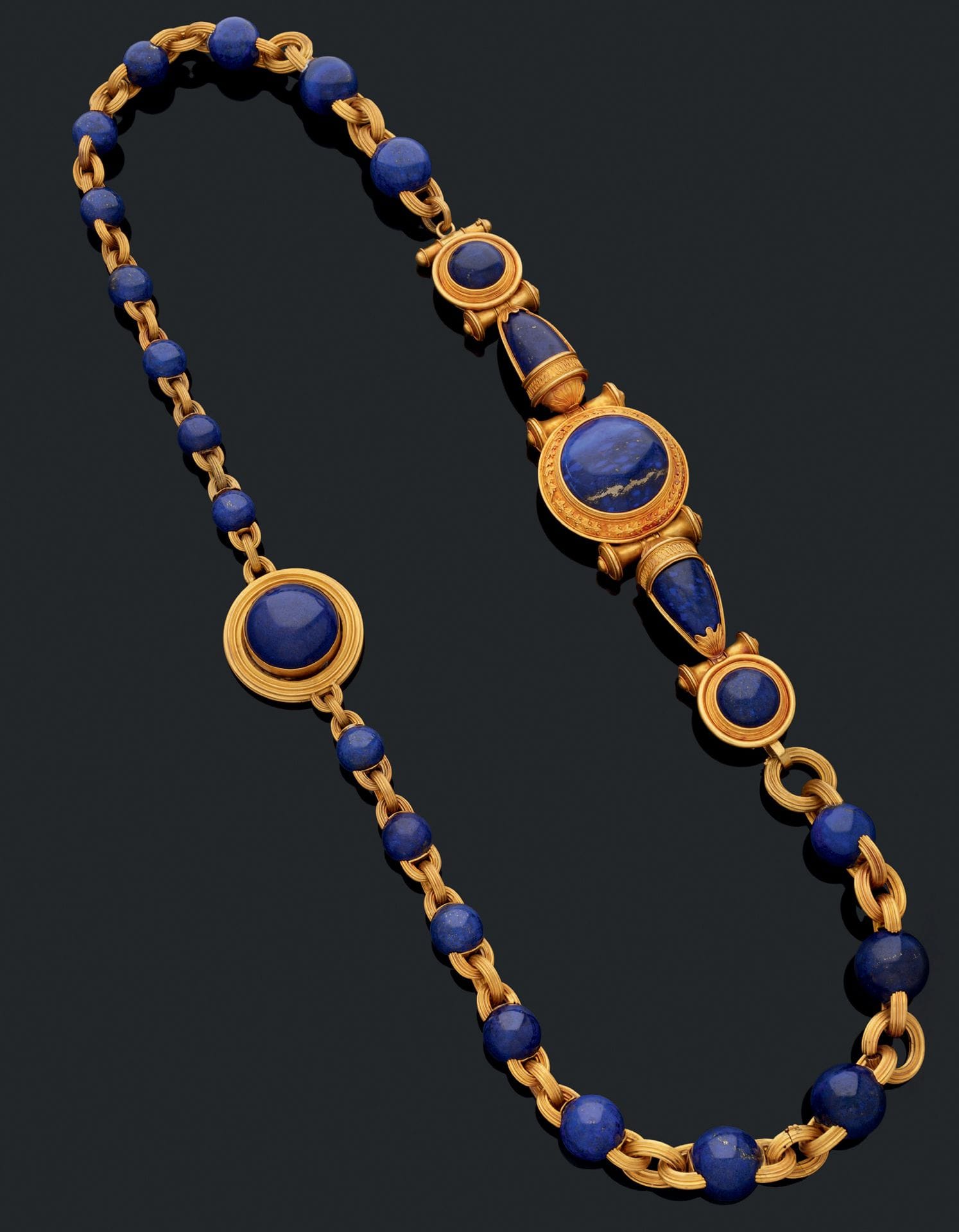
ERNESTO PIERRET (1824-1898) Very beautiful and rare yellow gold (750) belt with transformations that can also form an antique-style bracelet and necklace, formed of alternating round lapis lazuli beads in a tumble and grooved round and oval links. The center, removable and convertible into a large bracelet, is formed of three round lapis cabochons set in filigree mounts, the larger central one surrounded by an ivy frieze, linked by Etruscan-style scrolls and two convex tapered lapis sections. The back is adorned with a cabochon of lapis lazuli in a closed setting in a grooved surround, probably formerly opening on the reverse and forming a keepsake holder. Pin clasp simulating a scroll. Ratchet clasps concealed in three round gold links for transformation into a necklace. Signed on the clasp. Mid-19th century. Italian hallmarks. Gross weight : 224.2 g. - Length: 79 cm. Accidents to some links, scratches to the lapis and small cracks, wear and oxidation to the gold and small shocks; missing bottom under the lapis cabochon on the back, trace of hinge; one ring added for the non-original bracelet clasp, original clasp missing, some traces of restorations, lapis probably bathed. Ernesto Pierret was born in Paris in 1824 and trained as a goldsmith in Rome from 1840. Often compared to Castellani, whose pupil he may have been, he opened his own workshop in 1846, specializing in neo-antique "revivalist" jewelry. Based in Piazza di Spagna, in what the Romans now call Palazzo Pierret, he also mounted his customers' travel souvenirs (Egyptian scarabs, antique intaglios and cameos) in the antique style. Some of his creations can be found in the collections of the British Museum.
Estimate
€20,000 - €30,000
Result
Not communicated
Buyer's premium
26.4%
ERNESTO PIERRET (1824-1898)
Very beautiful and rare yellow gold (750) belt with transformations that can also form an antique-style bracelet and necklace, formed of alternating round lapis lazuli beads in a tumble and grooved round and oval links.
The center, removable and convertible into a large bracelet, is formed of three round lapis cabochons set in filigree mounts, the larger central one surrounded by an ivy frieze, linked by Etruscan-style scrolls and two convex tapered lapis sections.
The back is adorned with a cabochon of lapis lazuli in a closed setting in a grooved surround, probably formerly opening on the reverse and forming a keepsake holder.
Pin clasp simulating a scroll.
Ratchet clasps concealed in three round gold links for transformation into a necklace.
Signed on the clasp.
Mid-19th century.
Italian hallmarks.
Gross weight : 224.2 g. - Length: 79 cm.
Accidents to some links, scratches to the lapis and small cracks, wear and oxidation to the gold and small shocks; missing bottom under the lapis cabochon on the back, trace of hinge; one ring added for the non-original bracelet clasp, original clasp missing, some traces of restorations, lapis probably bathed.
Ernesto Pierret was born in Paris in 1824 and trained as a goldsmith in Rome from 1840. Often compared to Castellani, whose pupil he may have been, he opened his own workshop in 1846, specializing in neo-antique "revivalist" jewelry. Based in Piazza di Spagna, in what the Romans now call Palazzo Pierret, he also mounted his customers' travel souvenirs (Egyptian scarabs, antique intaglios and cameos) in the antique style. Some of his creations can be found in the collections of the British Museum.
Sale
Friday 3 April・14:00 (Europe/Paris)
Salle 7 - Hôtel Drouot
9, rue Drouot
75009 Paris