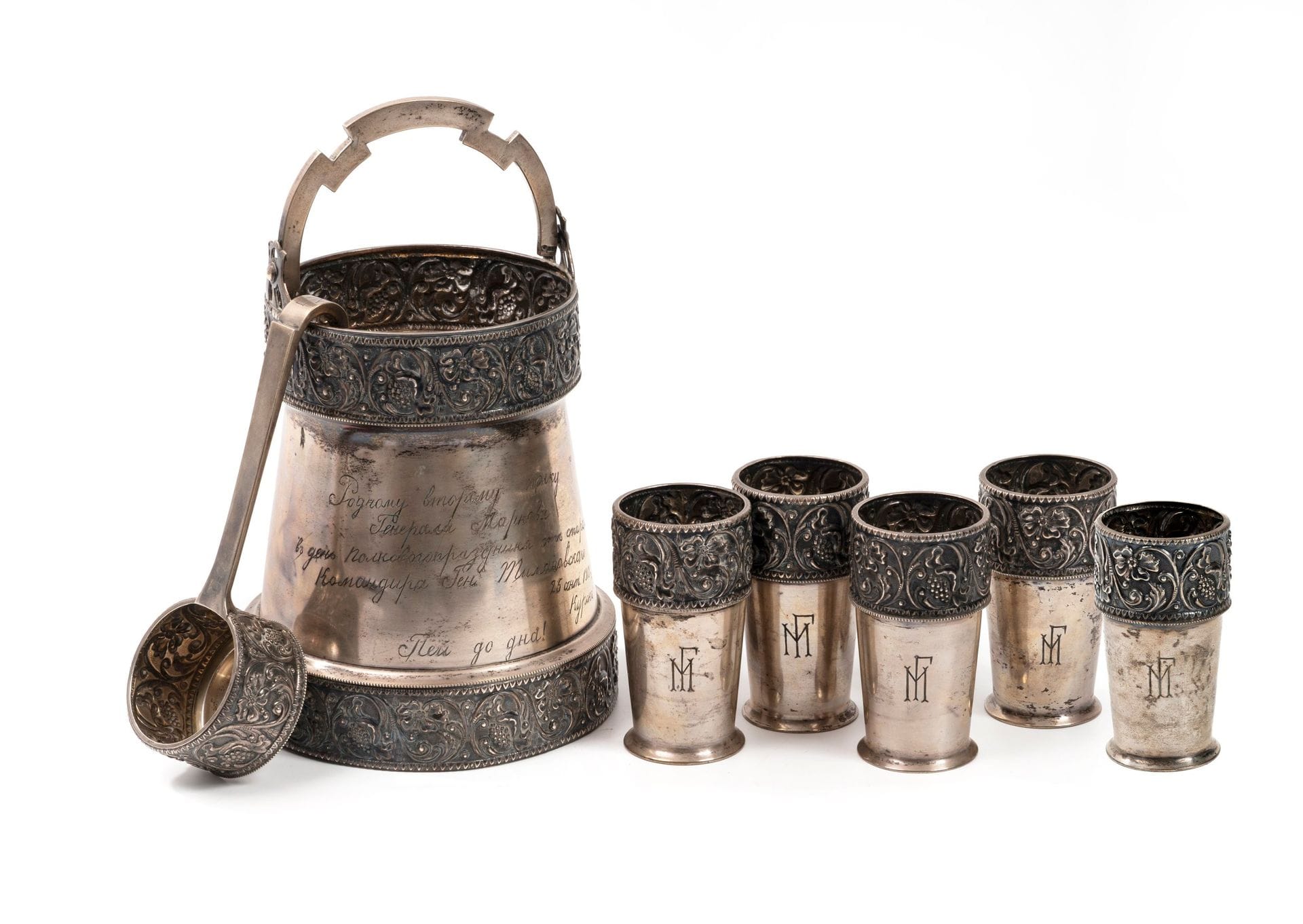
RUSSIA 84 zolotniks silver punch set (875 thousandths/min.800) comprising a bucket, 5 tumblers and a ladle, with repoussé decoration of foliate friezes and flowers, the bucket engraved on one side with the Cyrillic dedication "To General Markov's dear 2nd regiment, on this regimental holiday, on behalf of the former commander, General Timanovsky / September 25, 1919 / Kursk / Drink to the last drop! "The other side engraved with the Cyrillic monogram "GM" for General Markov, each of the four kettledrums engraved with the same monogram. Minor dents and oxidation. Moscow, 1908-1917. Goldsmith: "PX" in Cyrillic, not listed. Bucket : H. : 20.5 - Diam. :15.3 cm. - Weight: 674 g. Glasses: H.: 10 - Diam.: 5.5 cm. -Total weight: 563 g. Ladle: H. 4.6 x L. 19 cm - Weight: 113.4 g. Provenance: - Given by General Nikolai Stepanovich Timanovsky (1885-1919), regimental commander from April 27 to October 1918. - Captain Alexandre Leonidovitch Zrajevsky (Ukraine, Kherson province, 1897 - Meudon, 1981) - Then by descent. History : An officer in the Imperial Russian Army, Alexandre Leonidovitch Zrajevsky (1897-1981) trained at the Odessa from which he graduated with honors in 1916. Enlisted at the front in the First World War front, he served with the 243ᵉ Kholmsky infantry regiment, where he was wounded in action in August 1916. From June 1918, he joined the Volunteer Army and was assigned to General Markov's 1st Regiment of Officers. General Markov's Regiment, the elite unit of the White Movement, made up mainly of former imperial officers emblematic of the anti-Bolshevik struggle. He served in combat units, successively in mounted reconnaissance in mounted reconnaissance, in signals, then in a cavalry unit, participating directly in military operations until the evacuation of the Crimea. Promoted to the rank of captain in 1919, he remained remains loyal to the regiment during exile. After internment at Gallipoli in 1920, then redeployment to Bulgaria, he settled in France, where he continued to command a unit of the regiment. continues to command a unit of the Markov Regiment within the Russian veterans' organizations in exile. He died in Meudon, near Paris, in 1981.
Estimate
€3,000 - €5,000
Result
€2,800
Buyer's premium
26.4%
RUSSIA
84 zolotniks silver punch set (875 thousandths/min.800) comprising a bucket, 5 tumblers and a ladle, with repoussé decoration of foliate friezes and flowers, the bucket engraved on one side with the Cyrillic dedication "To General Markov's dear 2nd regiment, on this regimental holiday, on behalf of the former commander, General Timanovsky / September 25, 1919 / Kursk / Drink to the last drop! "The other side engraved with the Cyrillic monogram "GM" for General Markov, each of the four kettledrums engraved with the same monogram. Minor dents and oxidation.
Moscow, 1908-1917.
Goldsmith: "PX" in Cyrillic, not listed.
Bucket : H. : 20.5 - Diam. :15.3 cm. - Weight: 674 g.
Glasses: H.: 10 - Diam.: 5.5 cm. -Total weight: 563 g.
Ladle: H. 4.6 x L. 19 cm - Weight: 113.4 g.
Provenance:
- Given by General Nikolai Stepanovich Timanovsky (1885-1919), regimental commander from April 27 to
October 1918.
- Captain Alexandre Leonidovitch Zrajevsky (Ukraine, Kherson province, 1897 - Meudon, 1981)
- Then by descent.
History :
An officer in the Imperial Russian Army, Alexandre Leonidovitch Zrajevsky (1897-1981) trained at the Odessa
from which he graduated with honors in 1916. Enlisted at the front in the First World War
front, he served with the 243ᵉ Kholmsky infantry regiment, where he was wounded in action in August 1916.
From June 1918, he joined the Volunteer Army and was assigned to General Markov's 1st Regiment of Officers.
General Markov's Regiment, the elite unit of the White Movement, made up mainly of former imperial officers
emblematic of the anti-Bolshevik struggle. He served in combat units, successively in mounted reconnaissance
in mounted reconnaissance, in signals, then in a cavalry unit, participating directly in military
operations until the evacuation of the Crimea. Promoted to the rank of captain in 1919, he remained
remains loyal to the regiment during exile.
After internment at Gallipoli in 1920, then redeployment to Bulgaria, he settled in France, where he continued to command a unit of the regiment.
continues to command a unit of the Markov Regiment within the Russian veterans' organizations
in exile. He died in Meudon, near Paris, in 1981.