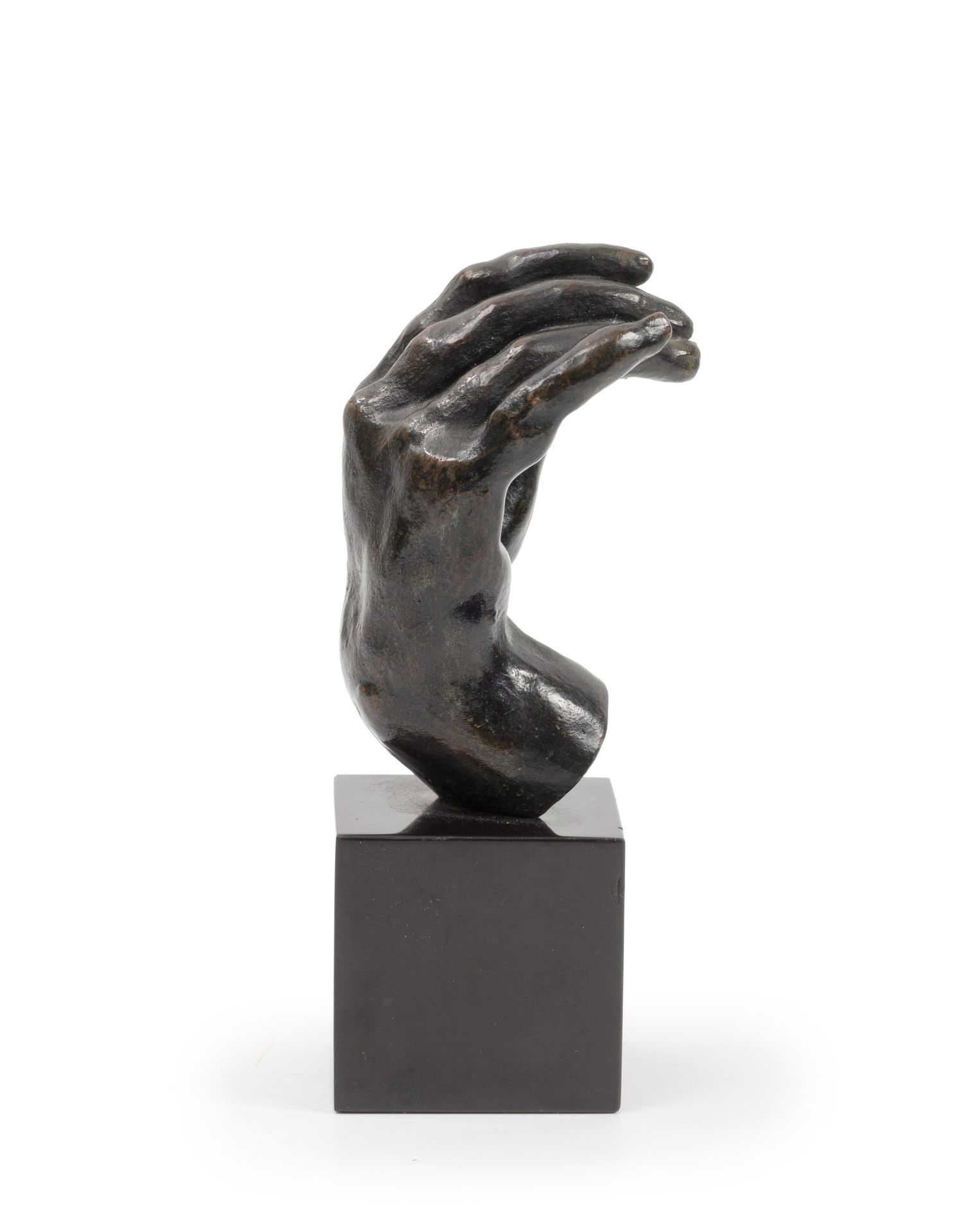
Auguste RODIN (1840-1917) Left hand n°07, small model. Bronze with brown patina shaded with green. 8 x 5.2 x 4.5 cm. Signed "A. Rodin" on the right wrist and the founder's mark "G. Rudier / Fond. Paris" on the back of the wrist. Conceived between 1880 and 1900, this bronze proof was made in 1969. Minor patina wear. Provenance : Musée Rodin, Paris, Private collection, Neuilly-Sur Seine (acquired from above, August 1969), Private collection, France (received as a gift). A letter of inclusion in the Catalogue Critique de l'œuvre Sculptée d'Auguste Rodin currently being prepared by Brame & Laurenceau will be given to the purchaser. "Rodin accumulated these detailed studies; the display cases in his studio are full of partial studies of torsos and hands. He passionately sought out the expression of the human hand", declared Gustave Kahn (...). Most of the hands were modeled in the 1880s and 1890s, and although the first ones were simple fragments destined for La Porte de l'Enfer, he knew how to give each of them, however small, an extraordinary power that designated them to become autonomous works. He was encouraged in this by the ancient fragments he collected, as well as by the long tradition of making the hand almost an individual in its own right, long before Caesar isolated a finger to pay homage to the thumb in 1965. Rodin et le Bronze, Catalogue des œuvres conservées au musée Rodin, Antoinette Le Normand-Romain, Tome 1, Paris 2007, Ed. Musée Rodin.
Estimate
€15,000 - €25,000
Result
€15,000
Buyer's premium
26%
Auguste RODIN (1840-1917)
Left hand n°07, small model.
Bronze with brown patina shaded with green.
8 x 5.2 x 4.5 cm.
Signed "A. Rodin" on the right wrist and the founder's mark "G. Rudier / Fond. Paris" on the back of the wrist.
Conceived between 1880 and 1900, this bronze proof was made in 1969.
Minor patina wear.
Provenance :
Musée Rodin, Paris,
Private collection, Neuilly-Sur Seine (acquired from above, August 1969),
Private collection, France (received as a gift).
A letter of inclusion in the Catalogue Critique de l'œuvre Sculptée d'Auguste Rodin currently being prepared by Brame & Laurenceau will be given to the purchaser.
"Rodin accumulated these detailed studies; the display cases in his studio are full of partial studies of torsos and hands. He passionately sought out the expression of the human hand", declared Gustave Kahn (...). Most of the hands were modeled in the 1880s and 1890s, and although the first ones were simple fragments destined for La Porte de l'Enfer, he knew how to give each of them, however small, an extraordinary power that designated them to become autonomous works. He was encouraged in this by the ancient fragments he collected, as well as by the long tradition of making the hand almost an individual in its own right, long before Caesar isolated a finger to pay homage to the thumb in 1965.
Rodin et le Bronze, Catalogue des œuvres conservées au musée Rodin, Antoinette Le Normand-Romain, Tome 1, Paris 2007, Ed. Musée Rodin.