GEILER VON KAISERSBERG (Johann) (1445-1510) RHENANUS (Beatus) (1485-1547) Navicula sive speculu[m] fatuo[rum] prestantissimi sacrarum literarum doctoris Joannis Geyler Keysersbergii concionatoris Argentinensis in sermones iuxta turmarum seriem divisa, suis figuris iam insignita, a Jacobo Othero diligenter collecta. Compendiosa vite eiusdem descriptio per Beatum Rhenanum Selestatinum. Strasbourg, [Mathias Schürer], February 3, 1510 and Strasbourg [Johannes Prüss], January 16, 1511 Small in-4°, [22] uncounted ff. (title and index) - 280 ff. unencumbered, preceded and followed by two paper endpapers, with 113 woodcuts, some based on models by Dürer, others attributed to the "Master of Heintz-Narr"; first woodcut to title preceded by "Ad Narragoniam"; text of the "Ioannis Geileri Vita" [Life of Johann Geiler von Kaisersberg] by Beatus Rhenanus at end of volume (sig. CC4-CC6); numerous contemporary marginal annotations in ink, in Latin and German. Colophon at the end of Ioannis Geileri Vita: "Argentorati transscriptum .xvi. die Mensis Ianuarii. An[no] M.D.XI"; colophon at the end of Jacobus Ottherus' address to the reader marking the end of Geiler's work (sig. CC 3 verso): "Argen[torati] iii idus Februarij. Anno. 1510". Jacob Other was Geiler's last secretary. Johann Geiler died in 1510, and a Life of Johann Geiler was added at the end of the volume in 1511. Bound in full hard vellum, decorated in the Duseuil style, with fleurons (tinted black) at the outer corners and ornamental motif at the center of the boards (tinted black), smooth spine with black fleurons (spine split, boards stained), edges blued. Preserved in a modern articulated beige cloth slipcase, red leather title page, gilt lettering. Binding dimensions: 205 x 155 mm; leaf dimensions: 195 x 150 mm. Last leaf of first quire weakened and detaching from seam; a few scattered freckles; a few annotations cropped short; a few skilful paper restorations; a few printing irregularities, e.g. sig. f6 verso, with running title printed upside down. Provenance: Bookplate inscription on upper flyleaf, "Cha[rle]s Kirkpatrick Sharpe". Charles Kirkpatrick Sharpe (1781-1851) was a Scottish writer and antiquarian. He was also a draughtsman, notably in the satirical register. VD 16, G 778; Adams G 316; Dacheux 50; Kristeller 623; Meder S. 274; Ritter 959; Schmidt 48; STC 335. Rare and beautiful Strasbourg edition of sermons by Johann Geiler von Kaisersberg, preacher at Strasbourg Cathedral between 1478 and 1510, inspired by the Nef des fous by Sebastian Brandt, a Strasbourg-born humanist who lived in Basel for a time before returning to Strasbourg in 1500 as "city secretary". Illustrated with a title vignette and 112 engravings in the text, the engravings are based partly on compositions by Albrecht Dürer and partly on other artists such as the "Master of Heinz-Narr" and a number of unidentified engravers (four in all?). The work is a fine example of the Rhenish humanism that developed between Basel and Strasbourg. Johann Geiler's eloquence quickly spread throughout Europe, beyond Alsace. First edition of this collection of sermons in Latin (with some passages in German, e.g. sig. L8) by Geiler, delivered in Strasbourg in preparation for Lent in 1498-1499, inspired by the very popular Nef des Fous, by Sebastian Brant, a great humanist and friend of Geiler. The German translation followed in 1520, printed in Strasbourg. This first Latin edition, published posthumously, contains woodcuts, some of which (around two-thirds) are by Albrecht Dürer (1471-1528), first used to illustrate the incunabula edition of Sebastian Brant's Nave of Fools, published in Basel in February 1494 (Das Narrenschyff), which made him famous throughout Europe. This series was used in the Latin edition of the Narrenschiff (Stultifera navis, translation by Jakob Locher, 1497), then reused or copied in all subsequent editions of Geiler's work, for example in 1520. The Ship of Fools or Narrenschyff is a satirical, moralizing poem packed with classical and biblical quotations, spanning some 7,000 verses in German: Brandt denounces vices that are contrary to divine morality and human reason, and those afflicted were madmen embarked on ships leading to their perdition. The madman became the symbol of all that was criticized: the defects of society, the shortcomings of the Church, the abuses of power. By 1500, Sebastian Brandt had settled in Strasbourg, on the banks of the Rhine.
Estimate
€3,000 - €4,000
Result
€4,700
Buyer's premium
26.4%
GEILER VON KAISERSBERG (Johann) (1445-1510)
RHENANUS (Beatus) (1485-1547)
Navicula sive speculu[m] fatuo[rum] prestantissimi sacrarum literarum doctoris Joannis Geyler Keysersbergii concionatoris Argentinensis in sermones iuxta turmarum seriem divisa, suis figuris iam insignita, a Jacobo Othero diligenter collecta. Compendiosa vite eiusdem descriptio per Beatum Rhenanum Selestatinum.
Strasbourg, [Mathias Schürer], February 3, 1510 and Strasbourg [Johannes Prüss], January 16, 1511
Small in-4°, [22] uncounted ff. (title and index) - 280 ff. unencumbered, preceded and followed by two paper endpapers, with 113 woodcuts, some based on models by Dürer, others attributed to the "Master of Heintz-Narr"; first woodcut to title preceded by "Ad Narragoniam"; text of the "Ioannis Geileri Vita" [Life of Johann Geiler von Kaisersberg] by Beatus Rhenanus at end of volume (sig. CC4-CC6); numerous contemporary marginal annotations in ink, in Latin and German.
Colophon at the end of Ioannis Geileri Vita: "Argentorati transscriptum .xvi. die Mensis Ianuarii. An[no] M.D.XI"; colophon at the end of Jacobus Ottherus' address to the reader marking the end of Geiler's work (sig. CC 3 verso): "Argen[torati] iii idus Februarij. Anno. 1510". Jacob Other was Geiler's last secretary. Johann Geiler died in 1510, and a Life of Johann Geiler was added at the end of the volume in 1511.
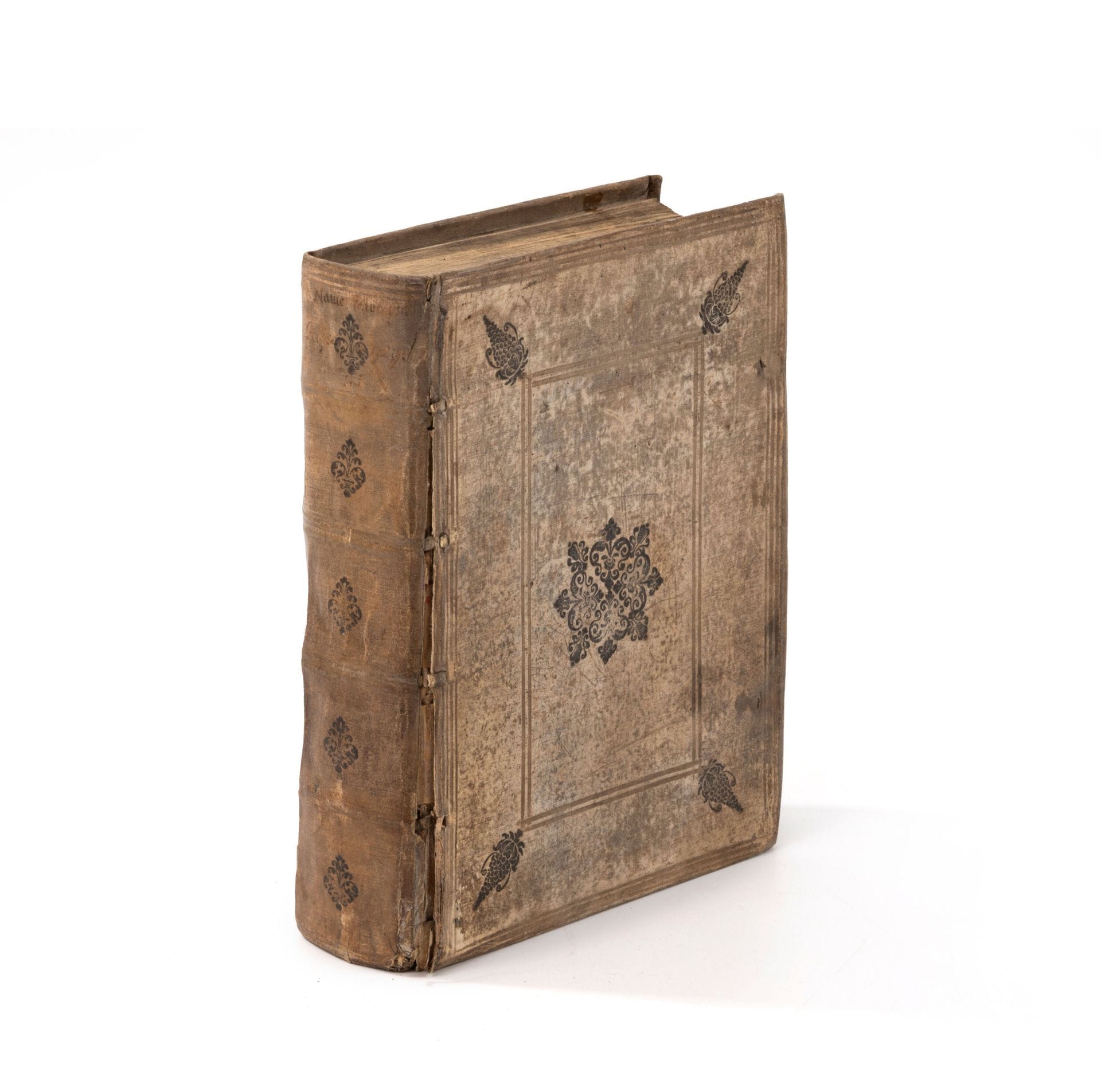
Bound in full hard vellum, decorated in the Duseuil style, with fleurons (tinted black) at the outer corners and ornamental motif at the center of the boards (tinted black), smooth spine with black fleurons (spine split, boards stained), edges blued. Preserved in a modern articulated beige cloth slipcase, red leather title page, gilt lettering.
Binding dimensions: 205 x 155 mm; leaf dimensions: 195 x 150 mm.
Last leaf of first quire weakened and detaching from seam; a few scattered freckles; a few annotations cropped short; a few skilful paper restorations; a few printing irregularities, e.g. sig. f6 verso, with running title printed upside down.
Provenance: Bookplate inscription on upper flyleaf, "Cha[rle]s Kirkpatrick Sharpe". Charles Kirkpatrick Sharpe (1781-1851) was a Scottish writer and antiquarian. He was also a draughtsman, notably in the satirical register.
VD 16, G 778; Adams G 316; Dacheux 50; Kristeller 623; Meder S. 274; Ritter 959; Schmidt 48; STC 335.
Rare and beautiful Strasbourg edition of sermons by Johann Geiler von Kaisersberg, preacher at Strasbourg Cathedral between 1478 and 1510, inspired by the Nef des fous by Sebastian Brandt, a Strasbourg-born humanist who lived in Basel for a time before returning to Strasbourg in 1500 as "city secretary". Illustrated with a title vignette and 112 engravings in the text, the engravings are based partly on compositions by Albrecht Dürer and partly on other artists such as the "Master of Heinz-Narr" and a number of unidentified engravers (four in all?). The work is a fine example of the Rhenish humanism that developed between Basel and Strasbourg. Johann Geiler's eloquence quickly spread throughout Europe, beyond Alsace.
First edition of this collection of sermons in Latin (with some passages in German, e.g. sig. L8) by Geiler, delivered in Strasbourg in preparation for Lent in 1498-1499, inspired by the very popular Nef des Fous, by Sebastian Brant, a great humanist and friend of Geiler. The German translation followed in 1520, printed in Strasbourg. This first Latin edition, published posthumously, contains woodcuts, some of which (around two-thirds) are by Albrecht Dürer (1471-1528), first used to illustrate the incunabula edition of Sebastian Brant's Nave of Fools, published in Basel in February 1494 (Das Narrenschyff), which made him famous throughout Europe. This series was used in the Latin edition of the Narrenschiff (Stultifera navis, translation by Jakob Locher, 1497), then reused or copied in all subsequent editions of Geiler's work, for example in 1520.
The Ship of Fools or Narrenschyff is a satirical, moralizing poem packed with classical and biblical quotations, spanning some 7,000 verses in German: Brandt denounces vices that are contrary to divine morality and human reason, and those afflicted were madmen embarked on ships leading to their perdition. The madman became the symbol of all that was criticized: the defects of society, the shortcomings of the Church, the abuses of power. By 1500, Sebastian Brandt had settled in Strasbourg, on the banks of the Rhine.
Sale
Friday 20 June 2025・14:00 (Europe/Paris)
Salle 4 - Hôtel Drouot
9, rue Drouot
75009 Paris