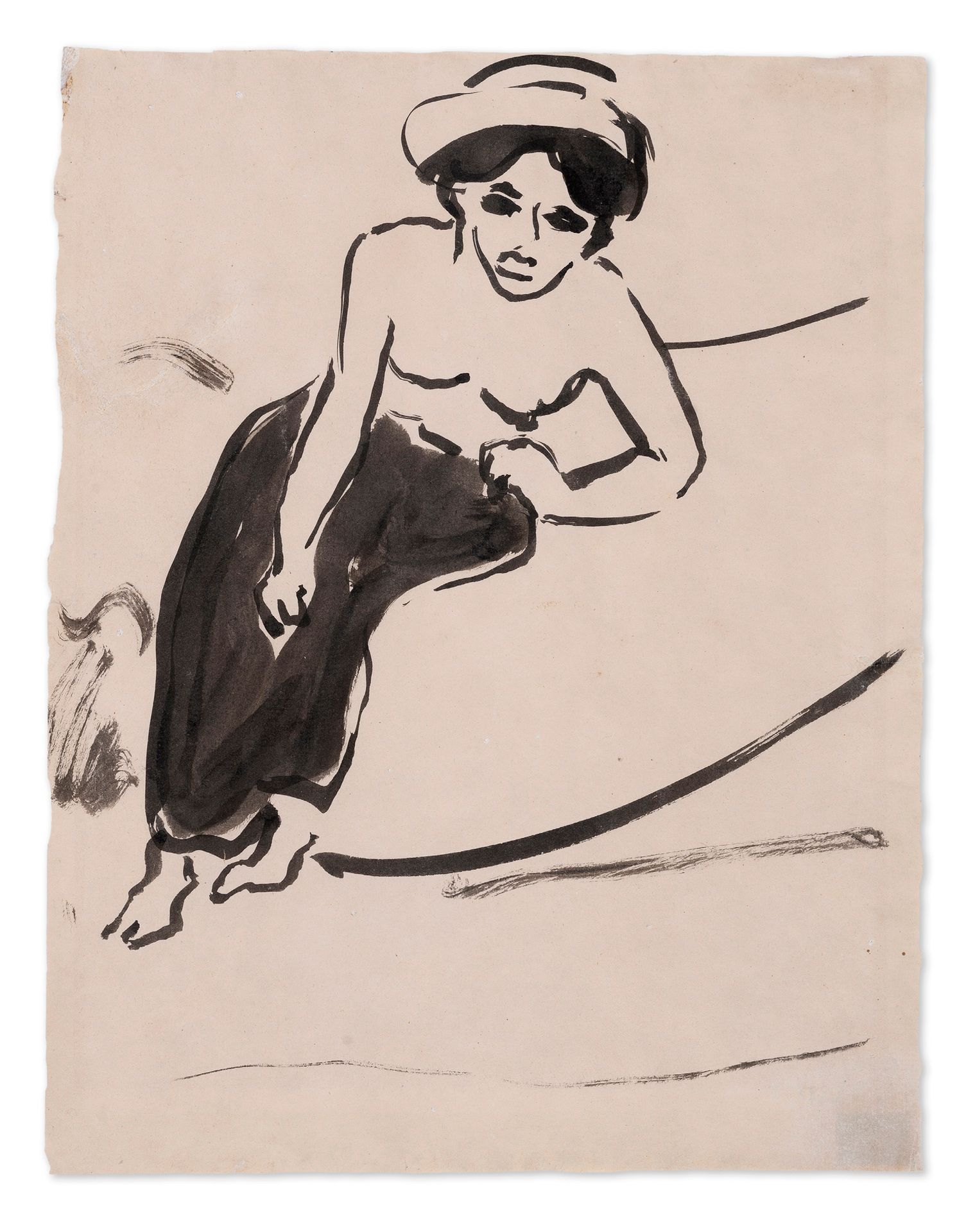
Ernst Ludwig KIRCHNER (1880-1938) Half-naked girl with hat. (Dodo seated with black skirt and bare torso, chalk-marked with hat), circa 1908. Brush and black ink on brown vellum. Bears the estate stamp, the inscription "F Dre/Bi 23" in ink, as well as the numbering "K 4788" and the number "1220/31" in pencil on the back. 40.5 x 32 cm (44 x 34.3 cm). Provenance: Studio of Ernst Ludwig Kirchner (until his death in 1938). Erna Kirchner, widow of Ernst Ludwig Kirchner, in Davos until her death in 1945. Kirchner Estate, from 1946 to 1954, on deposit at the Kunstmuseum Basel. Stuttgar Art Cabinet, Roman Norbert Ketterer, 1954. Stuttgart Art Cabinet, auction, May 31, 1958, cat. 468 illustrated. Dr. Schöwitz, Stuttgart, 1958. Villa Grisebach, Berlin, November 25, 1944, cat. 18 (illustrated). Galerie Kronfeld, Bern, June 21, 2002, cat 61 (illustrated). Picadilly Gallery LTP, London. This work is listed in the Ernst Ludwig Kirchner archive, Witchtrach/Berne. As an architecture student in Dresden, Kirchner and his friend Fritz Bleyl rebelled against academic art education. Joined by Eric Heckel and Karl Schmitt-Rottluf, they founded the "Die Brücke" group on June 7, 1905. In 1906 Emil Nolde and Max Peschtein, and the following year Finnish artist Gallen Kallela and Swiss artist Cuno Amiet completed the group. Between 1906 and 1910, the Brücke artists synthesized the avant-gardes of the previous decade and the turn of the century into a personal language: Neo-Impressionism and the Pont-Aven school, Cézanne, Van Gogh and Japonism, Jugenstill and Fauvism. The nude is considered by Kirchner to be the basis of all the plastic arts, and occupies a central place in his work. Here, Dodo, Kirchner's first companion and favorite model, is depicted on the studio sofa. In our drawing, the contrast of black ink on a white background owes much to his long experience as a wood engraver, essential to the development of German Expressionism. The cursive, cheerful brushwork synthesizes shapes and flattens them out in a Japanese-style formula. The work is also indebted to the drawing aesthetics of the French Fauves. In 1908, the Brücke exhibition at Dresden's Galerie Arnold included works by Van Dongen, Marquet, Vlaminck,... for the first time in eastern Germany.
Estimate
€10,000 - €15,000
Result
€9,500
Buyer's premium
25%
Ernst Ludwig KIRCHNER (1880-1938)
Half-naked girl with hat.
(Dodo seated with black skirt and bare torso, chalk-marked with hat), circa 1908.
Brush and black ink on brown vellum.
Bears the estate stamp, the inscription "F Dre/Bi 23" in ink, as well as the numbering "K 4788" and the number "1220/31" in pencil on the back. 40.5 x 32 cm (44 x 34.3 cm).
Provenance:
Studio of Ernst Ludwig Kirchner (until his death in 1938).
Erna Kirchner, widow of Ernst Ludwig Kirchner, in Davos until her death in 1945.
Kirchner Estate, from 1946 to 1954, on deposit at the Kunstmuseum Basel.
Stuttgar Art Cabinet, Roman Norbert Ketterer, 1954.
Stuttgart Art Cabinet, auction, May 31, 1958, cat. 468 illustrated.
Dr. Schöwitz, Stuttgart, 1958.
Villa Grisebach, Berlin, November 25, 1944, cat. 18 (illustrated).
Galerie Kronfeld, Bern, June 21, 2002, cat 61 (illustrated).
Picadilly Gallery LTP, London.
This work is listed in the Ernst Ludwig Kirchner archive, Witchtrach/Berne.
As an architecture student in Dresden, Kirchner and his friend Fritz Bleyl rebelled against academic art education. Joined by Eric Heckel and Karl Schmitt-Rottluf, they founded the "Die Brücke" group on June 7, 1905. In 1906 Emil Nolde and Max Peschtein, and the following year Finnish artist Gallen Kallela and Swiss artist Cuno Amiet completed the group. Between 1906 and 1910, the Brücke artists synthesized the avant-gardes of the previous decade and the turn of the century into a personal language: Neo-Impressionism and the Pont-Aven school, Cézanne, Van Gogh and Japonism, Jugenstill and Fauvism.
The nude is considered by Kirchner to be the basis of all the plastic arts, and occupies a central place in his work. Here, Dodo, Kirchner's first companion and favorite model, is depicted on the studio sofa. In our drawing, the contrast of black ink on a white background owes much to his long experience as a wood engraver, essential to the development of German Expressionism. The cursive, cheerful brushwork synthesizes shapes and flattens them out in a Japanese-style formula.
The work is also indebted to the drawing aesthetics of the French Fauves. In 1908, the Brücke exhibition at Dresden's Galerie Arnold included works by Van Dongen, Marquet, Vlaminck,... for the first time in eastern Germany.
Sale
Friday 5 April 2024・14:01 (Europe/Paris)
Salle 6 - Hôtel Drouot
9, rue Drouot
75009 Paris