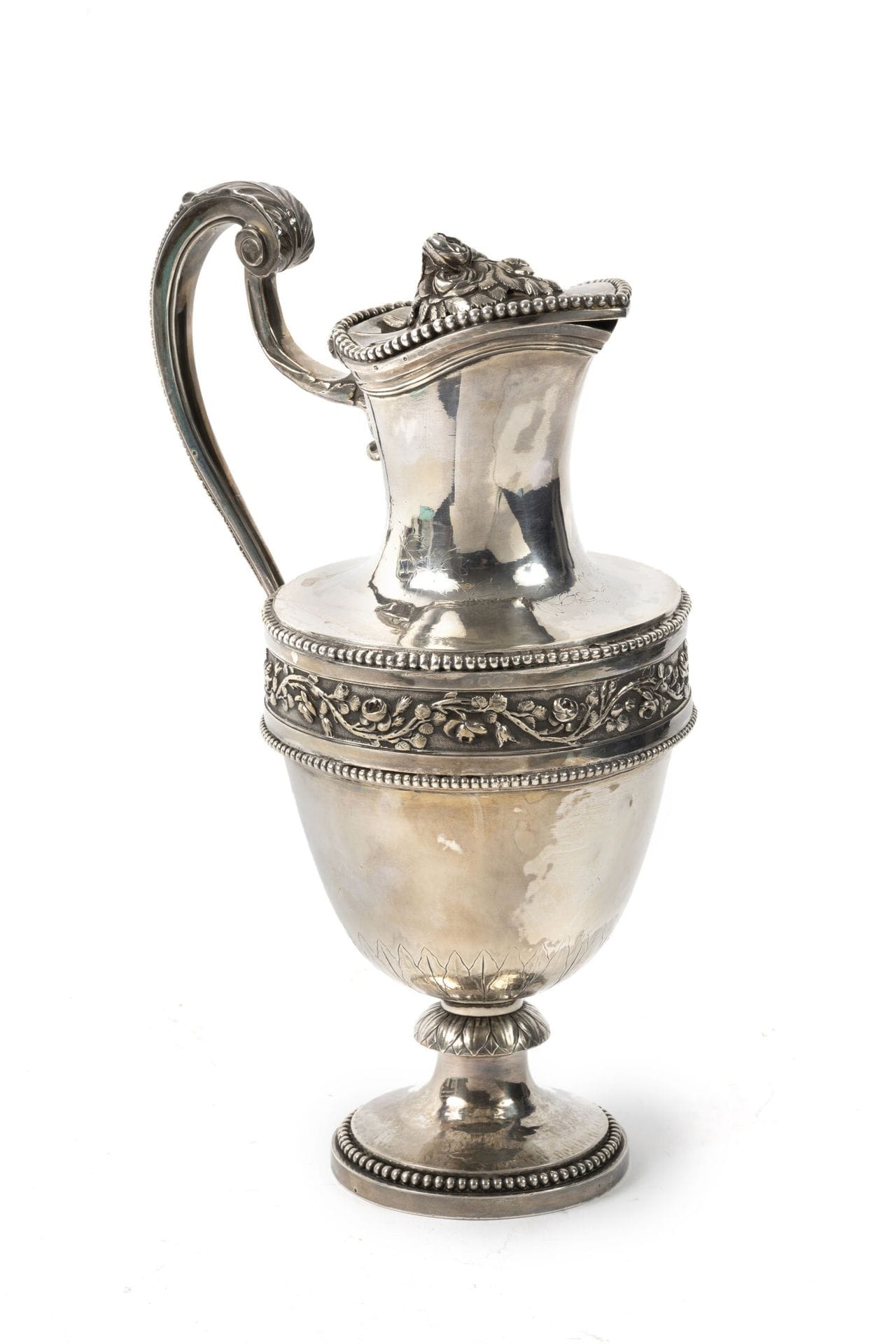
FRANCE, époque Louis XVI Tapered silver ewer (950), decorated with pearl friezes, on a circular pedestal with a leaf corolla on the leg. The body is decorated on the shoulder with a ribbon and a frieze of rose branches with flowers and leaves, and at the base with long, engraved laurel leaves. The neck is outlined with fillets and decorated at the base with an engraved garland of small laurel leaves. The hinged lid is adorned with a frétel and decorated with chased flowers and foliage. The handle is decorated with leaves and a line of pearls. Goldsmith's hallmark: Antoine BOULLIER, received Master in Paris in 1775. PARIS, Charge [A / L.L] and Export [aiguière] hallmarks for 1782-1789 and Jurande for 1783 [U]. Repoinçonnée au Crabe. Weight : 1.143 g - H. : 29.5 cm. Heavy wear to the engraved garland on the neck; scratches and knocks from use; slightly distorted nose of the lid, no longer covering the spout; tiny tear at the hinge attachment. Antoine BOULLIER (1749-), goldsmith trained in Châteauroux, was admitted to the master's program on December 16, 1775. He set up shop at Pont au Change until 1786, then moved to rue Saint Honoré. His output appears to be considerable, destined for the great families of the aristocracy and sovereigns, both French and European, and as far afield as America. He produced several toiletries, including one in 1786 for Vladimir BOROSOVITCH, General Prince GALITZIN, and his wife Natalia Petrovna [Christie's, London, June 7, 2011, lot 206]. The ewer in this set is similar in shape to the one shown above, but its rose scroll decoration is different. However, the friezes of rose branches decorating the basin and some of the pedestal-mounted pieces in this set are very similar to those on our ewer. The Revolution slowed down his activity to the point where he retired as a farmer. He took up his scissors again under the First Empire, participating in the Exposition des Produits de l'Industrie in 1806, and in 1810, alongside Martin-Guillaume BIENNAIS, in the creation of the Emperor NAPOLÉON I's tea service, creating the famous tea fountain. His career slowed down with the return of the Bourbon family, and seems to have ended in 1818. Our ewer has an export mark [aiguière] proving that it left France between 1782 and 1789, probably following its manufacture. Unfortunately, the absence of an import hallmark from the country of destination or a coat-of-arms makes it impossible to determine its final destination. On its return to France, it was stamped with the Crab hallmark, i.e. after 1838.
Estimate
€1,500 - €1,800
Result
€1,400
Buyer's premium
25%
FRANCE, époque Louis XVI
Tapered silver ewer (950), decorated with pearl friezes, on a circular pedestal with a leaf corolla on the leg.
The body is decorated on the shoulder with a ribbon and a frieze of rose branches with flowers and leaves, and at the base with long, engraved laurel leaves.
The neck is outlined with fillets and decorated at the base with an engraved garland of small laurel leaves.
The hinged lid is adorned with a frétel and decorated with chased flowers and foliage.
The handle is decorated with leaves and a line of pearls.
Goldsmith's hallmark: Antoine BOULLIER, received Master in Paris in 1775.
PARIS, Charge [A / L.L] and Export [aiguière] hallmarks for 1782-1789 and Jurande for 1783 [U].
Repoinçonnée au Crabe.
Weight : 1.143 g - H. : 29.5 cm.
Heavy wear to the engraved garland on the neck; scratches and knocks from use; slightly distorted nose of the lid, no longer covering the spout; tiny tear at the hinge attachment.
Antoine BOULLIER (1749-), goldsmith trained in Châteauroux, was admitted to the master's program on December 16, 1775.
He set up shop at Pont au Change until 1786, then moved to rue Saint Honoré.
His output appears to be considerable, destined for the great families of the aristocracy and sovereigns, both French and European, and as far afield as America.
He produced several toiletries, including one in 1786 for Vladimir BOROSOVITCH, General Prince GALITZIN, and his wife Natalia Petrovna [Christie's, London, June 7, 2011, lot 206]. The ewer in this set is similar in shape to the one shown above, but its rose scroll decoration is different. However, the friezes of rose branches decorating the basin and some of the pedestal-mounted pieces in this set are very similar to those on our ewer.
The Revolution slowed down his activity to the point where he retired as a farmer.
He took up his scissors again under the First Empire, participating in the Exposition des Produits de l'Industrie in 1806, and in 1810, alongside Martin-Guillaume BIENNAIS, in the creation of the Emperor NAPOLÉON I's tea service, creating the famous tea fountain. His career slowed down with the return of the Bourbon family, and seems to have ended in 1818.
Our ewer has an export mark [aiguière] proving that it left France between 1782 and 1789, probably following its manufacture. Unfortunately, the absence of an import hallmark from the country of destination or a coat-of-arms makes it impossible to determine its final destination.
On its return to France, it was stamped with the Crab hallmark, i.e. after 1838.
Sale
Friday 19 January 2024・14:00 (Europe/Paris)
Salle 6 - Hôtel Drouot
9, rue Drouot
75009 Paris