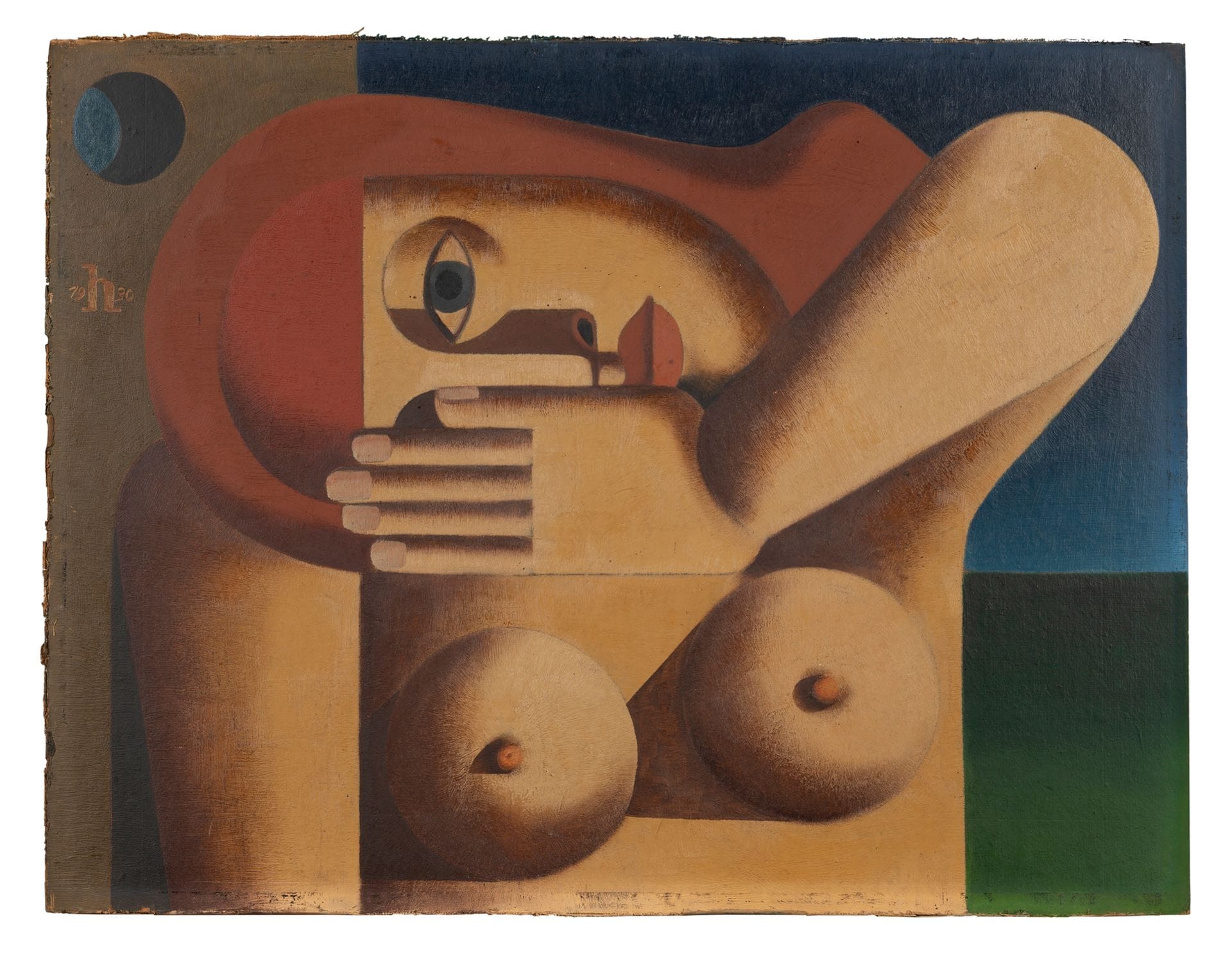
Heinrich HOERLE (1895-1936) Woman with head bowed, 1930. Oil on cardboard. Monogrammed and dated lower left. Numbered "45 11" and stamped by French Customs on the back. 39 x 50 cm. Provenance : Maurice Marsal Collection (1895-1990). Purchased in France, 1950-1960 A native of the Vosges (Liffol-Legrand), Maurice Marsal was a Second Lieutenant in the First World War, with a mastery of the German language and culture. He moved to Paris in 1936, where he taught philosophy at the Lycée Louis le Grand. Collection Claude Marsal, son of Maurice Marsal, by descent. Exhibition : Hans Schmitt-Rost: Heinrich Hoerle, Recklinghausen, 1965, S.54, verschollen. Bibliography : Heinrich Hoerle. Leben und Werk 1895-1936. Hoerle, Heinrich - Dirck Backes u. a, published by Köln, Rheinland Verlag, 1981, no. 62. German painting in the '20s In the 1920s, after Expressionism had run out of steam and Dada had died out, two contradictory trends emerged in German painting. On the one hand, there was New Objectivity, which sought to represent reality, right down to its most sordid aspects. On the other, Constructivism, abstract and apolitical, was the exact opposite of New Objectivity. Objectivity. This constructivism would have different expressions: geometric, abstract and technological in the Weimar Bauhaus. The Cologne Progressives In Cologne, the Progressive group, which included Frans Wilhelm Seiwert , Freundlich and Hoerle, was strongly politically committed and consequently refused to abstract from the subject, even if it was treated geometrically and synthetically. Hoerle was one of the founders of the Cologne Progressive group. Initially Expressionist, then Dadaist with his friend Seiwert, they were strongly influenced by foreign currents, such as Juan Gris's Cubism, the Purism developed by Ozenfant, Fernand Léger and Le Corbusier, and from 1922 by the art of Chirico and metaphysical painting. Woman, head bent (1930) Our painting bears witness to this original synthesis. The squared hairstyle, the anatomy and face constructed in pure geometry, the rigorously spherical breasts recall Léger's women of 1920/1924. "For me, the human figure and the human body are no more important than keys or bicycles... For me, they are plastically valid objects to be arranged as I see fit", proclaims Léger. But Hoerle shifts away from purism by introducing a strangeness that comes from Chirico's "Métaphysique". In Femme, tête penchée, the axis of the face makes a right angle with the vertical of the bust, while a hand veils one of the eyes. The subject refuses to indulge in visual apprehension of the world alone: a cylindrical oculus, a porthole in the block behind the hair, suggests instead an opening into the mysterious and the unknown.
Estimate
€60,000 - €80,000
Result
€202,000
Buyer's premium
25%
Heinrich HOERLE (1895-1936)
Woman with head bowed, 1930.
Oil on cardboard.
Monogrammed and dated lower left.
Numbered "45 11" and stamped by French Customs on the back.
39 x 50 cm.
Provenance :
Maurice Marsal Collection (1895-1990).
Purchased in France, 1950-1960
A native of the Vosges (Liffol-Legrand), Maurice Marsal was a Second Lieutenant in the First World War, with a mastery of the German language and culture. He moved to Paris in 1936, where he taught philosophy at the Lycée Louis le Grand.
Collection Claude Marsal, son of Maurice Marsal, by descent.
Exhibition :
Hans Schmitt-Rost: Heinrich Hoerle, Recklinghausen, 1965, S.54, verschollen.
Bibliography :
Heinrich Hoerle. Leben und Werk 1895-1936. Hoerle, Heinrich - Dirck Backes u. a, published by Köln, Rheinland Verlag, 1981, no. 62.
German painting in the '20s
In the 1920s, after Expressionism had run out of steam and Dada had died out, two contradictory trends emerged in German painting.
On the one hand, there was New Objectivity, which sought to represent reality, right down to its most sordid aspects.
On the other, Constructivism, abstract and apolitical, was the exact opposite of New Objectivity.
Objectivity. This constructivism would have different expressions: geometric, abstract and technological in the Weimar Bauhaus.
The Cologne Progressives
In Cologne, the Progressive group, which included Frans Wilhelm Seiwert , Freundlich and Hoerle, was strongly politically committed and consequently refused to abstract from the subject, even if it was treated geometrically and synthetically.
Hoerle was one of the founders of the Cologne Progressive group. Initially Expressionist, then Dadaist with his friend Seiwert, they were strongly influenced by foreign currents, such as Juan Gris's Cubism, the Purism developed by Ozenfant, Fernand Léger and Le Corbusier, and from 1922 by the art of Chirico and metaphysical painting.
Woman, head bent (1930)
Our painting bears witness to this original synthesis. The squared hairstyle, the anatomy and face constructed in pure geometry, the rigorously spherical breasts recall Léger's women of 1920/1924. "For me, the human figure and the human body are no more important than keys or bicycles... For me, they are plastically valid objects to be arranged as I see fit", proclaims Léger. But Hoerle shifts away from purism by introducing a strangeness that comes from Chirico's "Métaphysique". In Femme, tête penchée, the axis of the face makes a right angle with the vertical of the bust, while a hand veils one of the eyes. The subject refuses to indulge in visual apprehension of the world alone: a cylindrical oculus, a porthole in the block behind the hair, suggests instead an opening into the mysterious and the unknown.
Sale
Friday 8 December 2023・14:00 (Europe/Paris)
Salle 5 - Hôtel Drouot
9, rue Drouot
75009 Paris