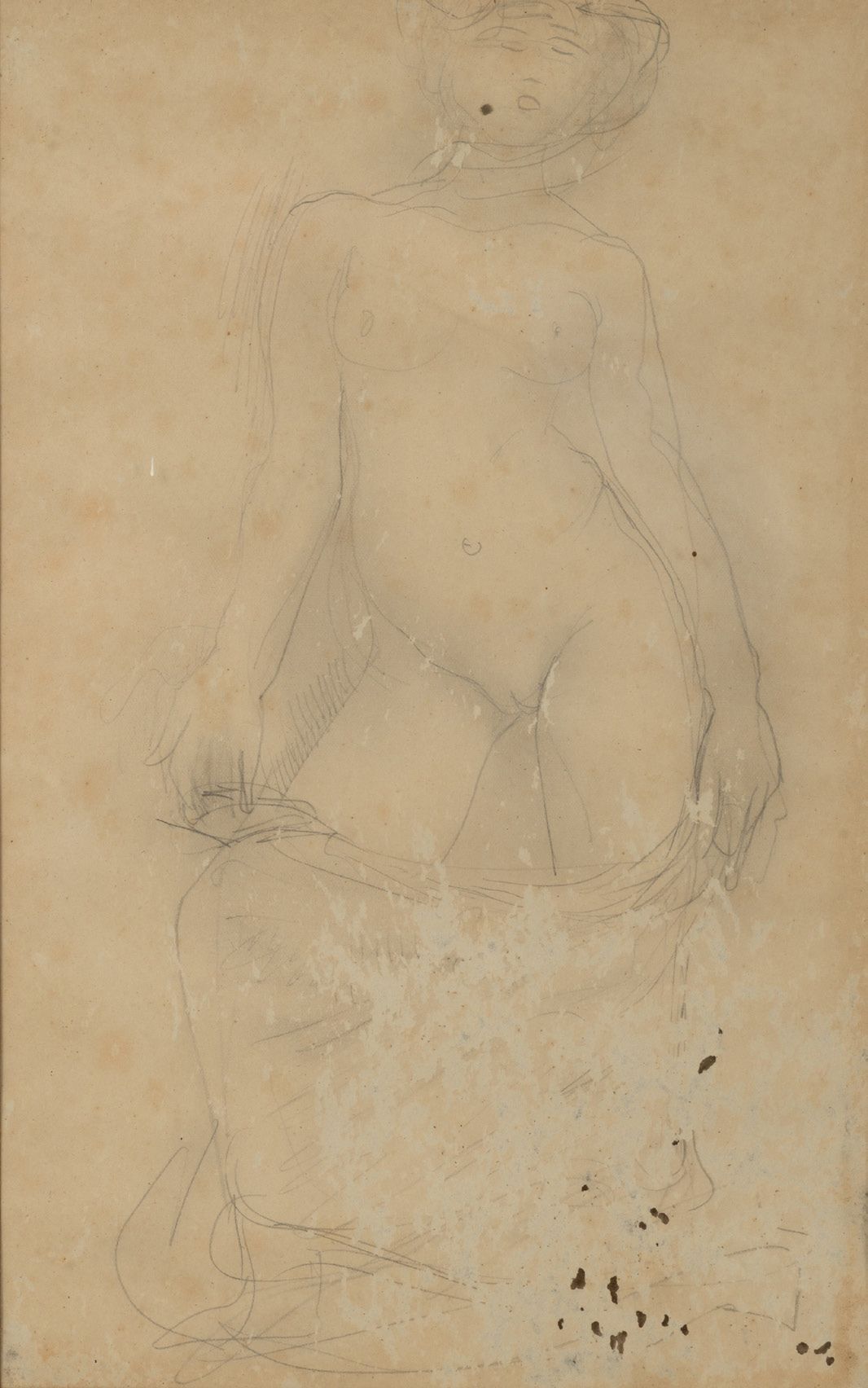
Auguste RODIN (1840-1917) Standing nude holding a drape. Graphite on paper. 31 x 19 cm. Wormholes and rubbing with removal of material. Provenance: Henri-Charles-Étienne Dujardin-Beaumetz (1852-1913). Then by descent, to the present owners. The Dujardin-Beaumetz Rodins Under-Secretary of State for Fine Arts from January 1905 to January 1912, Étienne Dujardin-Beaumetz (1852-1913), met Rodin on numerous occasions during his career, in particular to negotiate the placement of monuments (The Thinker at the Panthéon, the monument to Victor Hugo in the gardens of the Palais-Royal and L'Homme qui marche at the Palais Foyal). The Walking Man in the Farnese Palace). In October 1907, he became particularly interested in the sculptor's drawings when he first discovered 300 watercolors at the Bernheim Jeune gallery. This lesser-known aspect of the artist's work was evoked in the Entretiens avec Rodin published by Dujardin-Beaumetz in 1913. We now know that he owned no fewer than six drawings, including five in pencil and stump, representing a relatively large collection of this series. Among these is the dedicated drawing Femme debout, se déshabillant, a remarkable example of Rodin's work around 1900-1908. In this period, Rodin was interested in all the possibilities offered by the pencil technique: lines, hatching, blurring, erasing, giving the female body a palpable, more realistic modelling. (This sheet is an excerpt from Christina Buley-Uribe's inclusion notice).
Estimate
€2,000 - €2,500
Result
€2,200
Buyer's premium
25%
Auguste RODIN (1840-1917)
Standing nude holding a drape.
Graphite on paper.
31 x 19 cm.
Wormholes and rubbing with removal of material.
Provenance:
Henri-Charles-Étienne Dujardin-Beaumetz (1852-1913).
Then by descent, to the present owners.
The Dujardin-Beaumetz Rodins
Under-Secretary of State for Fine Arts from January 1905 to January 1912, Étienne Dujardin-Beaumetz (1852-1913), met Rodin on numerous occasions during his career, in particular to negotiate the placement of monuments (The Thinker at the Panthéon, the monument to Victor Hugo in the gardens of the Palais-Royal and L'Homme qui marche at the Palais Foyal).
The Walking Man in the Farnese Palace).
In October 1907, he became particularly interested in the sculptor's drawings when he first discovered 300 watercolors at the Bernheim Jeune gallery. This lesser-known aspect of the artist's work was evoked in the
Entretiens avec Rodin published by Dujardin-Beaumetz in 1913. We now know that he owned no fewer than six drawings, including five in pencil and stump, representing a relatively large collection of this series.
Among these is the dedicated drawing Femme debout, se déshabillant, a remarkable example of Rodin's work around 1900-1908.
In this period, Rodin was interested in all the possibilities offered by the pencil technique: lines, hatching, blurring, erasing, giving the female body a palpable, more realistic modelling.
(This sheet is an excerpt from Christina Buley-Uribe's inclusion notice).
Sale
Friday 8 December 2023・14:00 (Europe/Paris)
Salle 5 - Hôtel Drouot
9, rue Drouot
75009 Paris