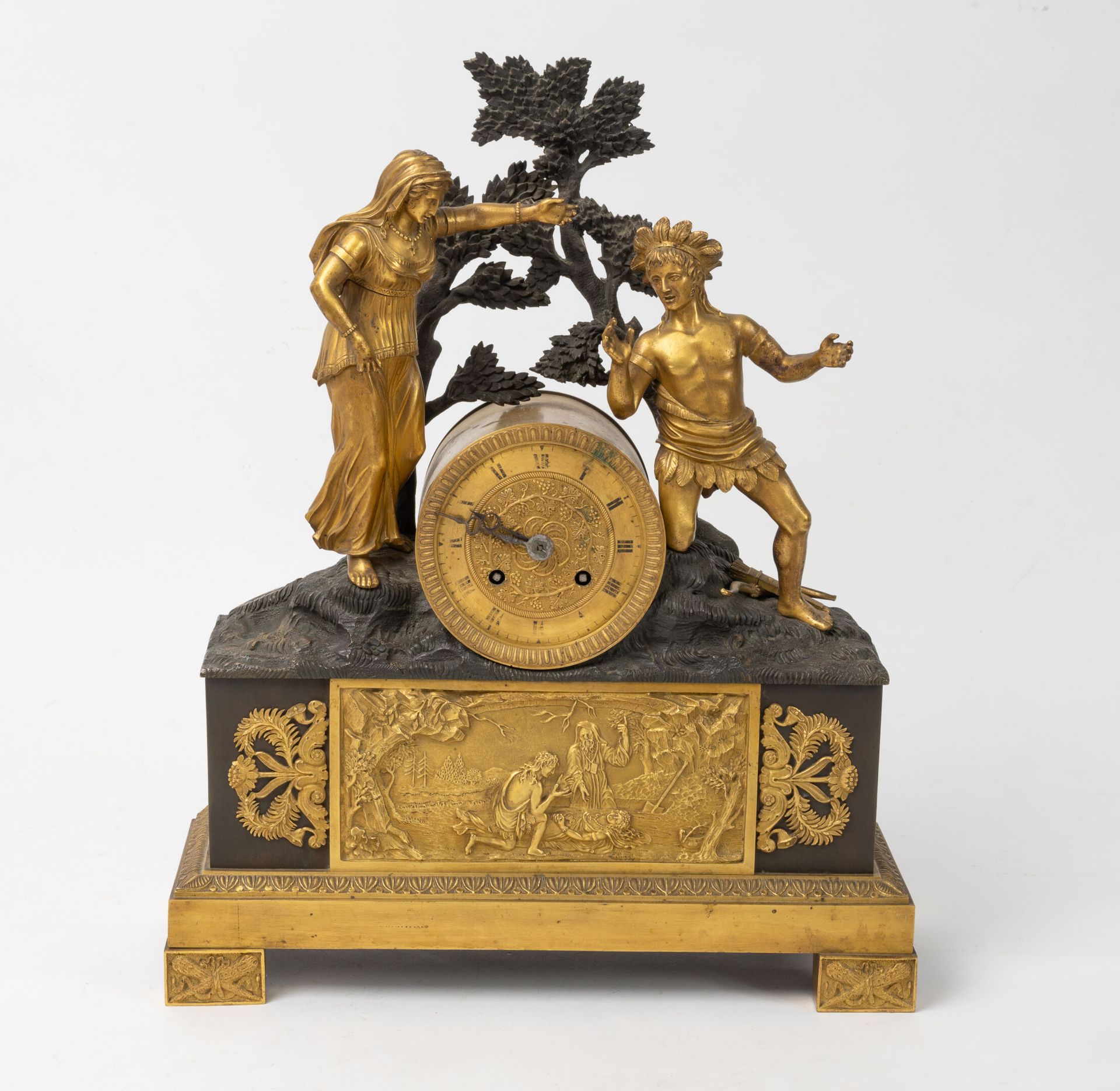
Boundary clock in chased bronze with double gold and brown patina, decorated with a young woman, Atala, and the kneeling Indian Chactas, in front of two branches supporting the cylindrical case. Rectangular base decorated with palms supporting a bas-relief depicting Atala's death. Resting on four rectangular feet with crossed flames. Roman numeral hour markers. Mechanical movement with key winding. Early 19th century. 41 x 33 x 11.5 cm. Wear to patina and numerals, oxidation, scratches, decoration to be refixed. At the beginning of the 19th century, many novels offered exotic and romantic subjects - the theme of the Bon Sauvage frequently recurring - for the decor of objets d'art and bronze clocks. The fictional Atala, published in 1801 by François René de Chateaubriand (1768-1848), is a good illustration for this clock. During his trip to the United States in 1791, Chateaubriand met a number of Indian tribes, including the Natchez, an experience that undoubtedly inspired the Romantic Natchez cycle to which Atala is linked.
Estimate
€800 - €1,200
Result
€750
Buyer's premium
25%
Boundary clock in chased bronze with double gold and brown patina, decorated with a young woman, Atala, and the kneeling Indian Chactas, in front of two branches supporting the cylindrical case.
Rectangular base decorated with palms supporting a bas-relief depicting Atala's death. Resting on four rectangular feet with crossed flames.
Roman numeral hour markers.
Mechanical movement with key winding.
Early 19th century.
41 x 33 x 11.5 cm.
Wear to patina and numerals, oxidation, scratches, decoration to be refixed.
At the beginning of the 19th century, many novels offered exotic and romantic subjects - the theme of the Bon Sauvage frequently recurring - for the decor of objets d'art and bronze clocks. The fictional Atala, published in 1801 by François René de Chateaubriand (1768-1848), is a good illustration for this clock. During his trip to the United States in 1791, Chateaubriand met a number of Indian tribes, including the Natchez, an experience that undoubtedly inspired the Romantic Natchez cycle to which Atala is linked.
Sale
Friday 3 November 2023・14:00 (Europe/Paris)
Salle 6 - Hôtel Drouot
9, rue Drouot
75009 Paris