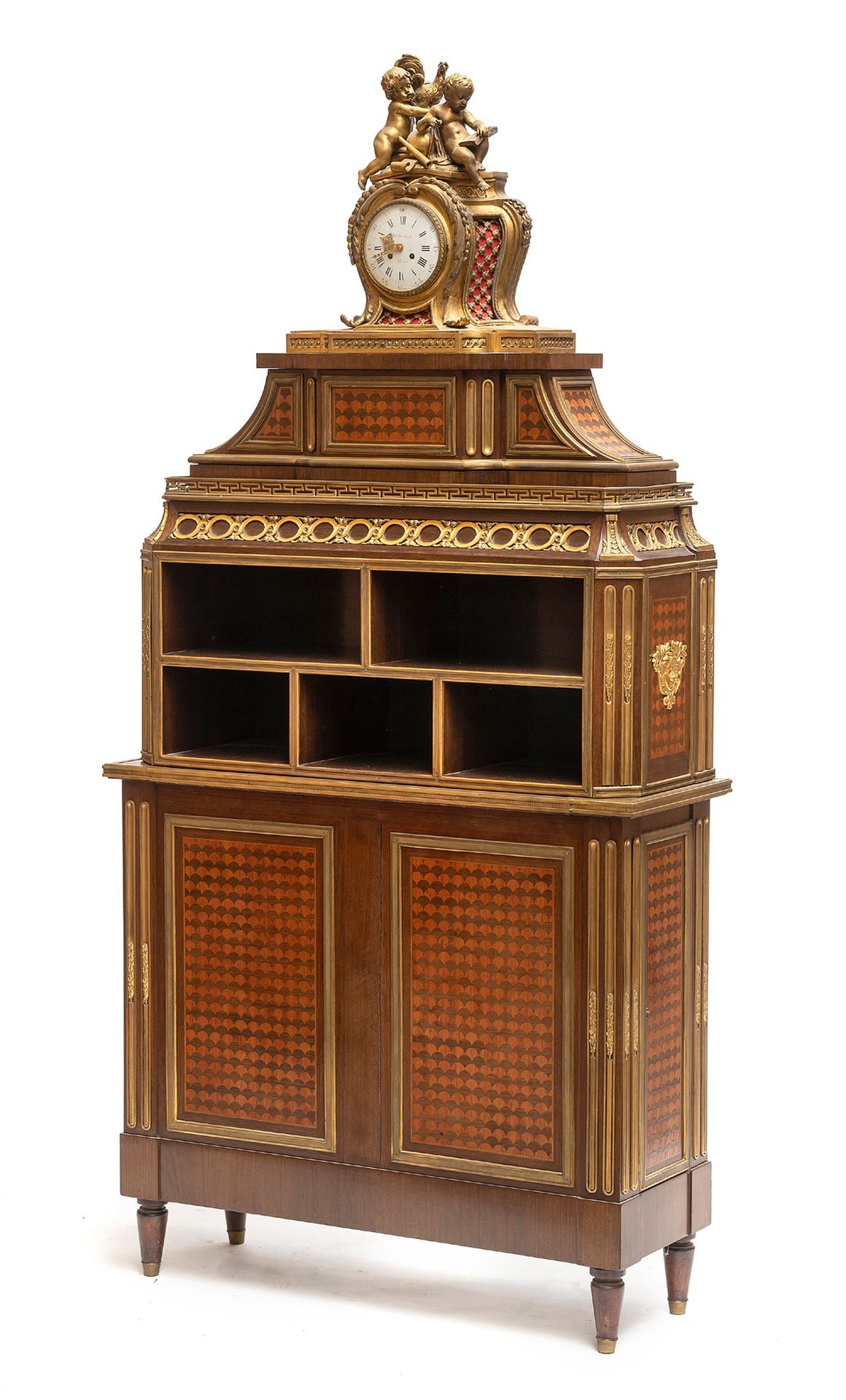
All-sided, solid mahogany and veneered, satin-finish veneered end-of-desk cabinet, decorated on three sides with reserves decorated with stylized feathers, and on the back with nine geometric boxes with colored wood veneer frames, composed of three parts: - a rectangular-section pedestal opening with two side panels, resting on four tapered legs. - an intermediate section with five windows, recessed corners and cavet. - and a raised step supporting a gilt bronze clock, with a dial signed by Charles DU TERTRE, and topped by two children, symbolizing the Sciences. Rich gilded bronze and brass fittings, such as: rudentées fluting, some with asperges, fretted or grained moldings and frames, friezes of flowery interlacing, gallery with frieze of Greciques, corner falls with piastres, two faces of Daphné. Unsigned key-wound mechanical movement with Brocot blade suspension. No visible maker's mark, probably Faubourg Saint Antoine. Transitional Louis XV-Louis XVI style, second half of the 19th century. Cartonnier: 161 x 101.5 x 38 cm - Pendule: 51 x 48 x 20 cm. A few scratches, small dents and cracks; a few bumps; some wear and scratches to the gilding; some oxidation. Around 1770, a bureau and a cartonnier à poser were delivered for the Duc de Choiseul at Chanteloup, usually attributed to the cabinetmaker Simon Oeben. This desk was modified by the addition of a box to accommodate the cartonnier, and a step to support the clock, which was also replaced. This set is preserved in the Galerie des Batailles at the Château de Chantilly [OA355], having been purchased by the Duc d'Aumale at the Hamilton sale. Our piece of furniture is therefore a copy of this cartonnier, modified in the early 19th century. Cabinetmakers LINKE and SORMANI copied this set, but our cartonnier shows no maker's signature.
Estimate
€3,500 - €5,000
Result
€6,800
Buyer's premium
25%
All-sided, solid mahogany and veneered, satin-finish veneered end-of-desk cabinet, decorated on three sides with reserves decorated with stylized feathers, and on the back with nine geometric boxes with colored wood veneer frames, composed of three parts:
- a rectangular-section pedestal opening with two side panels, resting on four tapered legs.
- an intermediate section with five windows, recessed corners and cavet.
- and a raised step supporting a gilt bronze clock, with a dial signed by Charles DU TERTRE, and topped by two children, symbolizing the Sciences.
Rich gilded bronze and brass fittings, such as: rudentées fluting, some with asperges, fretted or grained moldings and frames, friezes of flowery interlacing, gallery with frieze of Greciques, corner falls with piastres, two faces of Daphné.
Unsigned key-wound mechanical movement with Brocot blade suspension.
No visible maker's mark, probably Faubourg Saint Antoine.
Transitional Louis XV-Louis XVI style, second half of the 19th century.
Cartonnier: 161 x 101.5 x 38 cm - Pendule: 51 x 48 x 20 cm.
A few scratches, small dents and cracks; a few bumps; some wear and scratches to the gilding; some oxidation.
Around 1770, a bureau and a cartonnier à poser were delivered for the Duc de Choiseul at Chanteloup, usually attributed to the cabinetmaker Simon Oeben.
This desk was modified by the addition of a box to accommodate the cartonnier, and a step to support the clock, which was also replaced.
This set is preserved in the Galerie des Batailles at the Château de Chantilly [OA355], having been purchased by the Duc d'Aumale at the Hamilton sale.
Our piece of furniture is therefore a copy of this cartonnier, modified in the early 19th century.
Cabinetmakers LINKE and SORMANI copied this set, but our cartonnier shows no maker's signature.
Sale
Friday 30 June 2023・14:00 (Europe/Paris)
Salle 6 - Hôtel Drouot
9, rue Drouot
75009 Paris