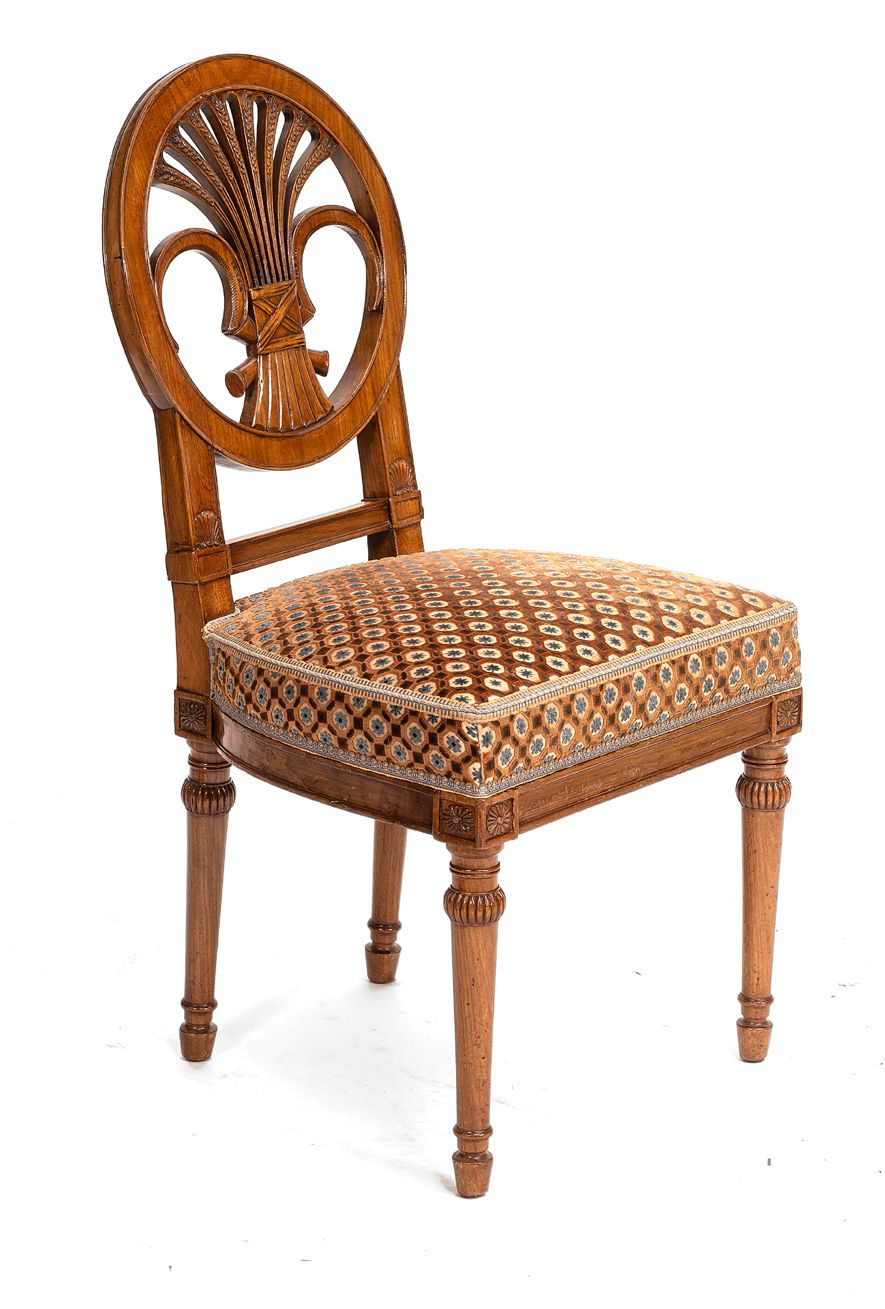
Varnished, solid or veneered, molded mahogany (?) chair with circular back decorated with a sheaf of wheat ears and two crossed sickles, uprights adorned with shells, molded crosspieces and connecting dice decorated with rosettes, resting on four tapered legs with gadrooned rings. City names engraved on the sickle blades. Stamped I.B. SENE on the reverse of the rear crosspiece. Late 18th century, possibly from the revolutionary period. Old gold and blue velvet upholstery on a cream background, decorated with crosses and stars. H. 90 cm - W. 46 cm - D. 42.5 cm. Some wear, scratches, small knocks, a few chips and cracks, notably on the back of the backrest; small gouges on the reverse of the belt; a few wormholes. Jean-Baptiste Claude SENE (1747-1803), received the title of Master Carpenter in Paris on May 10, 1769. André Theunissen, French historian of 18th-century furniture, wrote in 1934 that this chair model is "extremely intriguing", and that it may have been "part of a very important set of furniture intended for use by the members of the Assembly established after the Convention". He dated the model to the beginning of the French Revolution, around 1792-1793. In André Theunissen, "Meubles et sièges du XVIIIe siècle : menuisiers, ébénistes, marques, plans et ornementation de leurs oeuvres", Paris, Éditions Le Document , 1934, Footnote no. 1. Some of these chairs were also made by Henri JACOB (1753-1824), and bear his stamp. In 1951, a chair of this model, also stamped by J.B. Séné, was included in the exhibition "Chefs-d'oeuvre des grands ébénistes", presented at the Musée des Arts Décoratifs in Paris, under no. 170. The model of this chair is known with a few decorative variations, notably on the back and legs.
Estimate
€500 - €800
Result
€1,000
Buyer's premium
25%
Varnished, solid or veneered, molded mahogany (?) chair with circular back decorated with a sheaf of wheat ears and two crossed sickles, uprights adorned with shells, molded crosspieces and connecting dice decorated with rosettes, resting on four tapered legs with gadrooned rings.
City names engraved on the sickle blades.
Stamped I.B. SENE on the reverse of the rear crosspiece.
Late 18th century, possibly from the revolutionary period.
Old gold and blue velvet upholstery on a cream background, decorated with crosses and stars.
H. 90 cm - W. 46 cm - D. 42.5 cm.
Some wear, scratches, small knocks, a few chips and cracks, notably on the back of the backrest; small gouges on the reverse of the belt; a few wormholes.
Jean-Baptiste Claude SENE (1747-1803), received the title of Master Carpenter in Paris on May 10, 1769.
André Theunissen, French historian of 18th-century furniture, wrote in 1934 that this chair model is "extremely intriguing", and that it may have been "part of a very important set of furniture intended for use by the members of the Assembly established after the Convention". He dated the model to the beginning of the French Revolution, around 1792-1793.
In André Theunissen, "Meubles et sièges du XVIIIe siècle : menuisiers, ébénistes, marques, plans et ornementation de leurs oeuvres", Paris, Éditions Le Document , 1934, Footnote no. 1.
Some of these chairs were also made by Henri JACOB (1753-1824), and bear his stamp.
In 1951, a chair of this model, also stamped by J.B. Séné, was included in the exhibition "Chefs-d'oeuvre des grands ébénistes", presented at the Musée des Arts Décoratifs in Paris, under no. 170.
The model of this chair is known with a few decorative variations, notably on the back and legs.
Sale
Friday 30 June 2023・14:00 (Europe/Paris)
Salle 6 - Hôtel Drouot
9, rue Drouot
75009 Paris