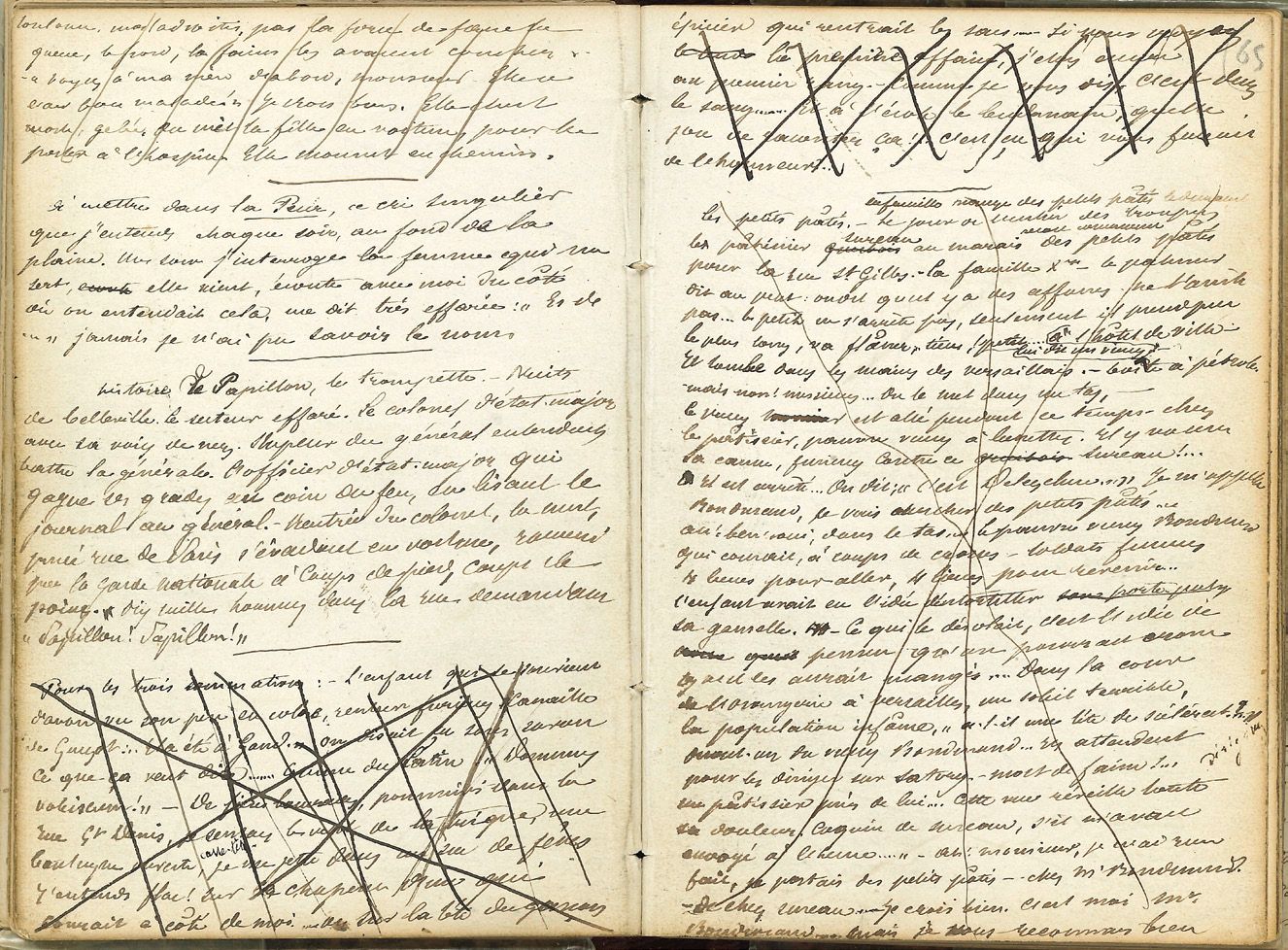
Alphonse DAUDET (1840-1897) Autograph notebook, Lettres à un absent [Contes du Lundi]; in-12 (14 x 9.5 cm) of 94 ff. in original cloth-backed boards (some ff. detached). Precious sketchbook of the Contes du Lundi. From 1871 to 1873, Daudet gave many stories or tales to newspapers, first under the title Lettres à un absent then under the title Contes du Lundi : in Le Soir (February 1871-March 1872), L'Événement (April-December 1872), Le Bien public (1873). Several of these texts were collected in volumes: Lettres à un absent (A. Lemerre, November 1871; Daudet later withdrew this book from circulation), Contes du Lundi (A. Lemerre, February 1873; republished in 1875 with part of Lettres à un absent), Les Femmes d'artistes (Lemerre, 1874) and Robert Helmont (Dentu, July 1874). This notebook, used head to foot, is filled with small, tight handwriting, mostly in ink, with several passages in pencil; some pages are in Julia Daudet's hand, and mark the beginning of a conjugal collaboration that will develop. The pages are covered with Daudet's small, tight handwriting, with numerous erasures and corrections: plans, sketches, drafts and often several versions of the same texts follow one another or overlap, -sometimes even these versions are parallel, on the left and right pages of the notebook. After use, the pages are crossed out with a few pen strokes. One will note, notably on the endpapers and the introductory pages, some small drawings, various notes, lists of titles, plans. Some leaves have been cut out and removed from the notebook, which has been paginated late in pencil (from 1 to 185). On the introductory pages, Daudet has traced the plan of the collection Lettres à un absent, with the list of the stories, most of the titles having been crossed out after writing; another detailed plan of the Contes du Lundi appears on p. 77. One also notes in this notebook the trace of many other projects: "Les derniers jours de Tarascon", "St Albe, souvenirs d'un page du second empire", "Les femmes d'artistes (pièce ou livre)", "Scènes de la vie à deux"; "Confession d'un homme de trente ans" (p. 23), La bouteille de curaçao (p. 59-60), " Monselet assiégé " (p. 86), or Le Singe (p. 89-90, and 151-143), which will be collected in Robert Helmont; other pages which will be found in Robert Helmont, like this famous tirade of the Epilogue (p. 97-98): " O politics, I hate you. I hate you because you are ugly, rude, unfair, shouting, chattering"... This epilogue is here entirely written, under the title L'hydrophobie, with the end in draft by Julia Daudet (p. 142-138). One also notes several ideas which will give rise to the novels The Nabob (1877) and Kings in exile (1879)... Etc. We cannot note everything. We will point out the main sketches of the tales collected in the Contes du Lundi, by referring to the edition of Daudet's works given by Roger Ripoll in the Pléiade (Pl., tome I); several of these notes had been published in the OEuvres complètes illustrées (tome IV, p. 197- 211) Often, Daudet notes in a few lines the subject of a tale; then, later in the notebook, writes a first draft. One notes in particular the project of Un caravansérail: "for the Evening: to make a melancholic picture of a caravanserai in Algeria"... [p. 9, Plate 1545]; the first sketch of Un décoré du 15 août [p. 10, Plate 1547]; La Pendule de Bougival [p. 11, Plate 1505]: "Les pendules : une petite pendule du 2ème Empire, folle, n'ayant jamais marqué que les heures de folie"...; En ballon ! [p. 15]: "It would be a pretty fancy to make the vision of Gambetta or of Mr. Spuller... In a balloon, in the evening, in the basket"...; La Partie de billard [p. 17, 25-29 and 33-36, Pl. 1476], from the first idea: "A marshal Bazaine plays billiards. [...] In short, the game won, and the battle lost", then a first writing on four pages; A bookkeeper [p. 20-21, Pl. 1585]: "A nice Parisian guy. He wakes up at home, model of an employee"...; Les Fées de France [p. 21, 32, and 111-114, Pl. 1580]: "La mort des fées. The last fairy"...; The Blind Emperor [p.29-31 and 182- 175, Pl. 1627]; The Vision of the Judge of Colmar [p. 37-44, and 185-183, Pl. 1482]; The Death of Chauvin [p. 52-53, Pl. 1534]: "Monday's Tale to be done with the life and death of Chauvin"...; The Last Book [p. 55-57, Pl. 1604]: "A beautiful memory. The Books. D. had just died"...; Le Concert de la huitième [p. 58-59, Pl. 1566]; Le Porte-drapeau [p. 63 and 128, Pl. 1529]; Le Bac [p. 60, Pl. 1528]; Les Trois Sommations [p. 61, 64-65 and 66, Pl. 1591]; Les Petits Pâtés [p. 65-66, Pl. 1573]; Monologue à bord [p. 66-67, 104-109 and 132, Pl. 1577]; Un réveillon dans le Marais [p. 67-69, Pl. 1612]; Mon képi [p. 71-74, Pl. 1557]; Le Turco de la Commune [p. 75-76 and 174-166, Pl. 1560]; La Batille du Père-Lachaise [p. 78, Pl. 1567]; Un soir de première
Estimate
€4,000 - €5,000
Result
€3,600
Buyer's premium
25%
Alphonse DAUDET (1840-1897)
Autograph notebook, Lettres à un absent [Contes du Lundi]; in-12 (14 x 9.5 cm) of 94 ff. in original cloth-backed boards (some ff. detached).
Precious sketchbook of the Contes du Lundi.
From 1871 to 1873, Daudet gave many stories or tales to newspapers, first under the title Lettres à un absent then under the title Contes du Lundi : in Le Soir (February 1871-March 1872), L'Événement (April-December 1872), Le Bien public (1873). Several of these texts were collected in volumes: Lettres à un absent (A. Lemerre, November 1871; Daudet later withdrew this book from circulation), Contes du Lundi (A. Lemerre, February 1873; republished in 1875 with part of Lettres à un absent), Les Femmes d'artistes (Lemerre, 1874) and Robert Helmont (Dentu, July 1874).
This notebook, used head to foot, is filled with small, tight handwriting, mostly in ink, with several passages in pencil; some pages are in Julia Daudet's hand, and mark the beginning of a conjugal collaboration that will develop. The pages are covered with Daudet's small, tight handwriting, with numerous erasures and corrections: plans, sketches, drafts and often several versions of the same texts follow one another or overlap, -sometimes even these versions are parallel, on the left and right pages of the notebook. After use, the pages are crossed out with a few pen strokes. One will note, notably on the endpapers and the introductory pages, some small drawings, various notes, lists of titles, plans. Some leaves have been cut out and removed from the notebook, which has been paginated late in pencil (from 1 to 185).
On the introductory pages, Daudet has traced the plan of the collection Lettres à un absent, with the list of the stories, most of the titles having been crossed out after writing; another detailed plan of the Contes du Lundi appears on p. 77. One also notes in this notebook the trace of many other projects: "Les derniers jours de Tarascon", "St Albe, souvenirs d'un page du second empire", "Les femmes d'artistes (pièce ou livre)", "Scènes de la vie à deux"; "Confession d'un homme de trente ans" (p. 23), La bouteille de curaçao (p. 59-60), " Monselet assiégé " (p. 86), or Le Singe (p. 89-90, and 151-143), which will be collected in Robert Helmont; other pages which will be found in Robert Helmont, like this famous tirade of the Epilogue (p. 97-98): " O politics, I hate you. I hate you because you are ugly, rude, unfair, shouting, chattering"... This epilogue is here entirely written, under the title L'hydrophobie, with the end in draft by Julia Daudet (p. 142-138). One also notes several ideas which will give rise to the novels The Nabob (1877) and Kings in exile (1879)... Etc.
We cannot note everything. We will point out the main sketches of the tales collected in the Contes du Lundi, by referring to the edition of Daudet's works given by Roger Ripoll in the Pléiade (Pl., tome I); several of these notes had been published in the OEuvres complètes illustrées (tome IV, p. 197- 211) Often, Daudet notes in a few lines the subject of a tale; then, later in the notebook, writes a first draft.
One notes in particular the project of Un caravansérail: "for the Evening: to make a melancholic picture of a caravanserai in Algeria"... [p. 9, Plate 1545]; the first sketch of Un décoré du 15 août [p. 10, Plate 1547]; La Pendule de Bougival [p. 11, Plate 1505]: "Les pendules : une petite pendule du 2ème Empire, folle, n'ayant jamais marqué que les heures de folie"...; En ballon ! [p. 15]: "It would be a pretty fancy to make the vision of Gambetta or of Mr. Spuller... In a balloon, in the evening, in the basket"...; La Partie de billard [p. 17, 25-29 and 33-36, Pl. 1476], from the first idea: "A marshal Bazaine plays billiards. [...] In short, the game won, and the battle lost", then a first writing on four pages; A bookkeeper [p. 20-21, Pl. 1585]: "A nice Parisian guy. He wakes up at home, model of an employee"...; Les Fées de France [p. 21, 32, and 111-114, Pl. 1580]: "La mort des fées. The last fairy"...; The Blind Emperor [p.29-31 and 182- 175, Pl. 1627]; The Vision of the Judge of Colmar [p. 37-44, and 185-183, Pl. 1482]; The Death of Chauvin [p. 52-53, Pl. 1534]: "Monday's Tale to be done with the life and death of Chauvin"...; The Last Book [p. 55-57, Pl. 1604]: "A beautiful memory. The Books. D. had just died"...; Le Concert de la huitième [p. 58-59, Pl. 1566]; Le Porte-drapeau [p. 63 and 128, Pl. 1529]; Le Bac [p. 60, Pl. 1528]; Les Trois Sommations [p. 61, 64-65 and 66, Pl. 1591]; Les Petits Pâtés [p. 65-66, Pl. 1573]; Monologue à bord [p. 66-67, 104-109 and 132, Pl. 1577]; Un réveillon dans le Marais [p. 67-69, Pl. 1612]; Mon képi [p. 71-74, Pl. 1557]; Le Turco de la Commune [p. 75-76 and 174-166, Pl. 1560]; La Batille du Père-Lachaise [p. 78, Pl. 1567]; Un soir de première
Sale
Thursday 20 April 2023・14:00 (Europe/Paris)
Salle 11 - Hôtel Drouot
9, rue Drouot
75009 Paris