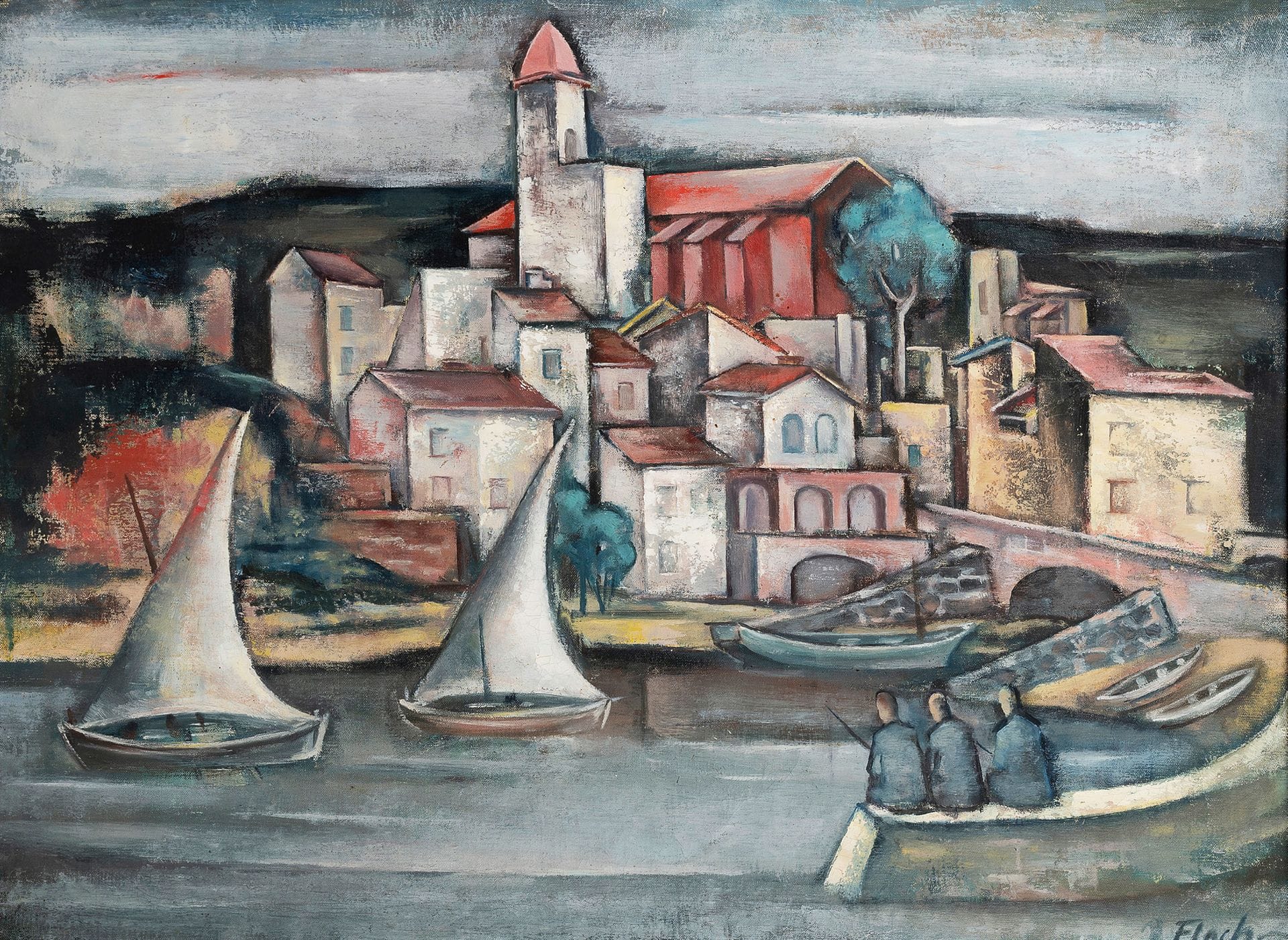
Josef FLOCH (1894/95-1977) The Mediterranean Harbor, circa 1927. Oil on canvas. Signed lower right. 61 x 80 cm. General bibliography on the painter: Joseph Floch, Leben und Weerk, 1894-1977; Karl Pallauf, Serge Lemoine, Österreichischer Kunst und Kulturverlag, 2000. Related work : The Agaves at Collioures, The Lighthouse of Collioures and the Coastal City, illustrated in the catalog raisonné of Joseph Floch, Leben und Weerk, 1894-1977; by Karl Pallauf, under nos. 134, 135, 136 p.157. We would like to thank Mr. Serge Lemoine who has verbally confirmed the authenticity of this painting and who has provided us with numerous biographical details about the painter. Josef Floch was a member of the Hagenbund between 1919 and 1938. This group of liberal-minded artists, founded at the time of the Vienna Secession, saw in the 1920s the coexistence or sometimes the confrontation of avant-garde aesthetic trends: cubism, new objectivity, expressionism. Of Jewish origin, Josef Floch moved to Paris in 1925 and shared a friendship with the painter Willy Eisenschitz. In 1929, the Parisian gallery owner Berthe Weill gave him a solo exhibition. This was followed by exhibitions at Bernheim et Cie in 1932, at Pierre Colle in 1933 and at Jeanne Castel in 1936. The painter knew a certain notoriety. His supporters were also the curators Germain Bazin and Jean Cassou. During his exile in New York from 1941 onwards, he painted some quite singular works, his "Terraces": figures sitting on the terraces of contemporary architectures, sometimes strangely from behind, seem to be gathered without reason, in silence and incommunicability. Our painting belongs to a contemporary series from a trip to the South of France around 1927. The Mediterranean village, an interlocking of cubes with brick roofs, is painted in its characteristic material, sometimes plastery, sometimes with a more patina. Two sailboats and three fishermen on the port are frozen in immobility: Floch thus paints the presence of an absence. Floch's poetry is born of the alliance of the climate of metaphysical painting combined with a Cézanne cubism (that of Derain and Vlaminck) still very much in vogue in European painting in the 1920s. Two important retrospectives were devoted to him in Vienna at the Belvedere Museum in 1972 and in 2017 at the W & K Gallery.
Estimate
€10,000 - €15,000
Result
€23,000
Buyer's premium
25%
Josef FLOCH (1894/95-1977)
The Mediterranean Harbor, circa 1927.
Oil on canvas.
Signed lower right.
61 x 80 cm.
General bibliography on the painter:
Joseph Floch, Leben und Weerk, 1894-1977; Karl Pallauf, Serge Lemoine, Österreichischer Kunst und Kulturverlag, 2000.
Related work :
The Agaves at Collioures, The Lighthouse of Collioures and the Coastal City, illustrated in the catalog raisonné of Joseph Floch, Leben und Weerk, 1894-1977; by Karl Pallauf, under nos. 134, 135, 136 p.157.
We would like to thank Mr. Serge Lemoine who has verbally confirmed the authenticity of this painting and who has provided us with numerous biographical details about the painter.
Josef Floch was a member of the Hagenbund between 1919 and 1938. This group of liberal-minded artists, founded at the time of the Vienna Secession, saw in the 1920s the coexistence or sometimes the confrontation of avant-garde aesthetic trends: cubism, new objectivity, expressionism. Of Jewish origin, Josef Floch moved to Paris in 1925 and shared a friendship with the painter Willy Eisenschitz. In 1929, the Parisian gallery owner Berthe Weill gave him a solo exhibition. This was followed by exhibitions at Bernheim et Cie in 1932, at Pierre Colle in 1933 and at Jeanne Castel in 1936. The painter knew a certain notoriety. His supporters were also the curators Germain Bazin and Jean Cassou. During his exile in New York from 1941 onwards, he painted some quite singular works, his "Terraces": figures sitting on the terraces of contemporary architectures, sometimes strangely from behind, seem to be gathered without reason, in silence and incommunicability.
Our painting belongs to a contemporary series from a trip to the South of France around 1927. The Mediterranean village, an interlocking of cubes with brick roofs, is painted in its characteristic material, sometimes plastery, sometimes with a more patina. Two sailboats and three fishermen on the port are frozen in immobility: Floch thus paints the presence of an absence. Floch's poetry is born of the alliance of the climate of metaphysical painting combined with a Cézanne cubism (that of Derain and Vlaminck) still very much in vogue in European painting in the 1920s. Two important retrospectives were devoted to him in Vienna at the Belvedere Museum in 1972 and in 2017 at the W & K Gallery.
Sale
Friday 14 April 2023・14:00 (Europe/Paris)
Salle 1 - Hôtel Drouot
9, rue Drouot
75009 Paris