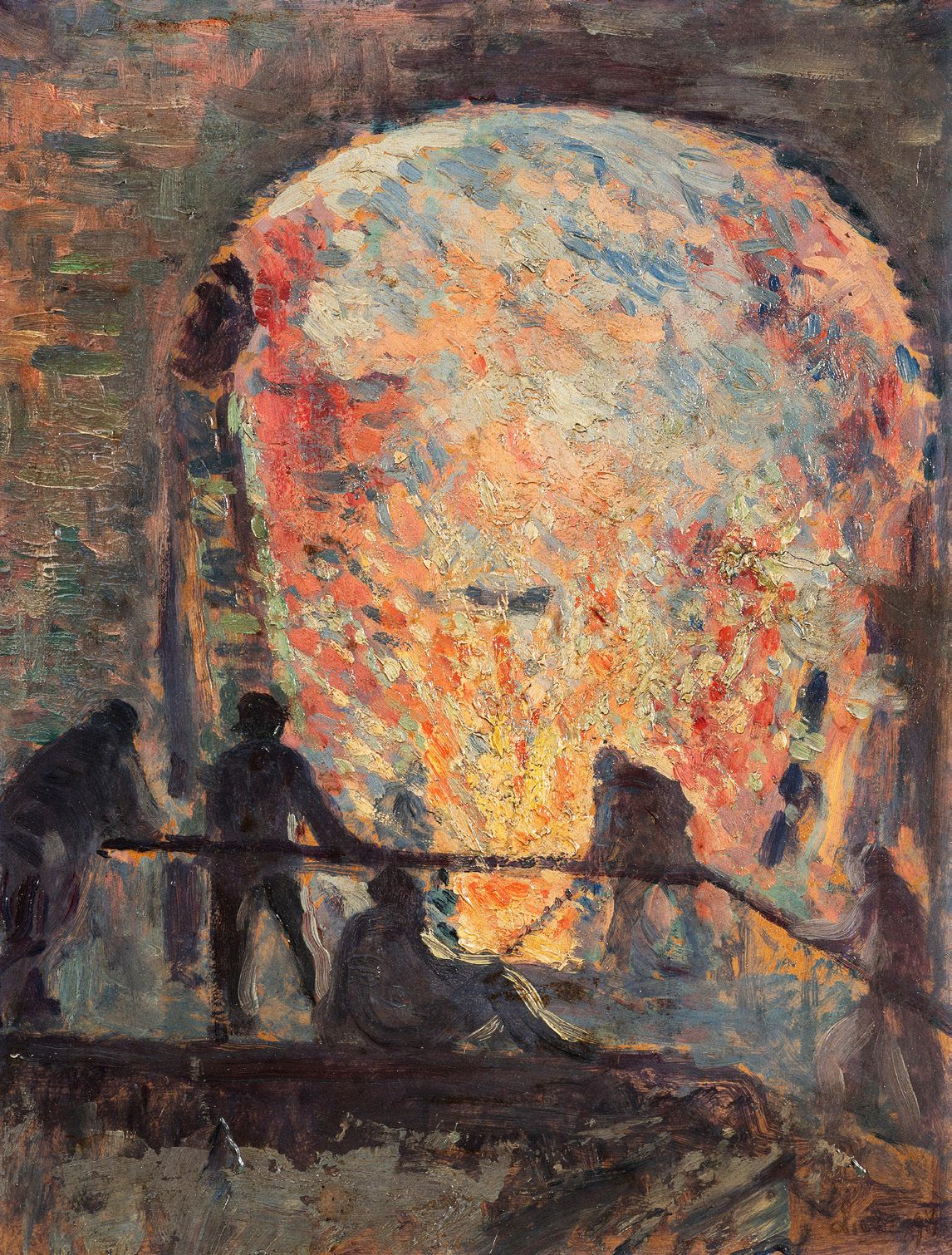
Maximilien LUCE (1858-1941) The steel mill, 1898. Oil on paper mounted on cardboard. Signed and dated lower right 37 x 27 cm. Related work: Our painting is the preparatory work for the Foundry, Former Oscar Ghez Collection, Geneva. Maximilien Luce was one of the earliest companions of the Neo-Impressionists. From 1886, he practiced the division of the brushstroke and painted in high colors. Luce sought out singular lights: the blaze of twilight, the night lights of cities... In 1887, he exhibited his divisionist paintings at the Salon des Indépendants. The discovery of Saint-Tropez thanks to Signac (1892) and the Mediterranean light lightened his palette. In 1895, the Verhaerens invited the Luces to Belgium. With Théo Van Rysselberghe, another Belgian Divisionist painter, he went to Charleroi and visited a steel mill. He was dazzled. The following year, he returned to Charleroi to paint and visited the mines, factories and blast furnaces. Luce painted several works representing the furnaces of a steel mill, with the workers in the foreground against the light. Here, the central blaze painted in touches of yellow and red is a counterpoint to the greens and blues of the shadows. This work is obviously preparatory to the Acierie (Bazetoux tome II, 1052 and Bazetoux tome III, 617). Beyond the splendid spectacle, we know that Luce was sensitive to the working class condition. He had strong anarchist sympathies and was involved in the revolutionary struggle. He also painted in Charleroi the workers of a foundry at work, formally conferring on them the grandeur of ancient warriors.
Estimate
€4,000 - €5,000
Result
€14,000
Buyer's premium
25%
Maximilien LUCE (1858-1941)
The steel mill, 1898.
Oil on paper mounted on cardboard.
Signed and dated lower right
37 x 27 cm.
Related work: Our painting is the preparatory work for the Foundry, Former Oscar Ghez Collection, Geneva.
Maximilien Luce was one of the earliest companions of the Neo-Impressionists. From 1886, he practiced the division of the brushstroke and painted in high colors. Luce sought out singular lights: the blaze of twilight, the night lights of cities... In 1887, he exhibited his divisionist paintings at the Salon des Indépendants. The discovery of Saint-Tropez thanks to Signac (1892) and the Mediterranean light lightened his palette.
In 1895, the Verhaerens invited the Luces to Belgium. With Théo Van Rysselberghe, another Belgian Divisionist painter, he went to Charleroi and visited a steel mill. He was dazzled. The following year, he returned to Charleroi to paint and visited the mines, factories and blast furnaces.
Luce painted several works representing the furnaces of a steel mill, with the workers in the foreground against the light. Here, the central blaze painted in touches of yellow and red is a counterpoint to the greens and blues of the shadows. This work is obviously preparatory to the Acierie (Bazetoux tome II, 1052 and Bazetoux tome III, 617).
Beyond the splendid spectacle, we know that Luce was sensitive to the working class condition. He had strong anarchist sympathies and was involved in the revolutionary struggle. He also painted in Charleroi the workers of a foundry at work, formally conferring on them the grandeur of ancient warriors.
Sale
Friday 14 April 2023・14:00 (Europe/Paris)
Salle 1 - Hôtel Drouot
9, rue Drouot
75009 Paris