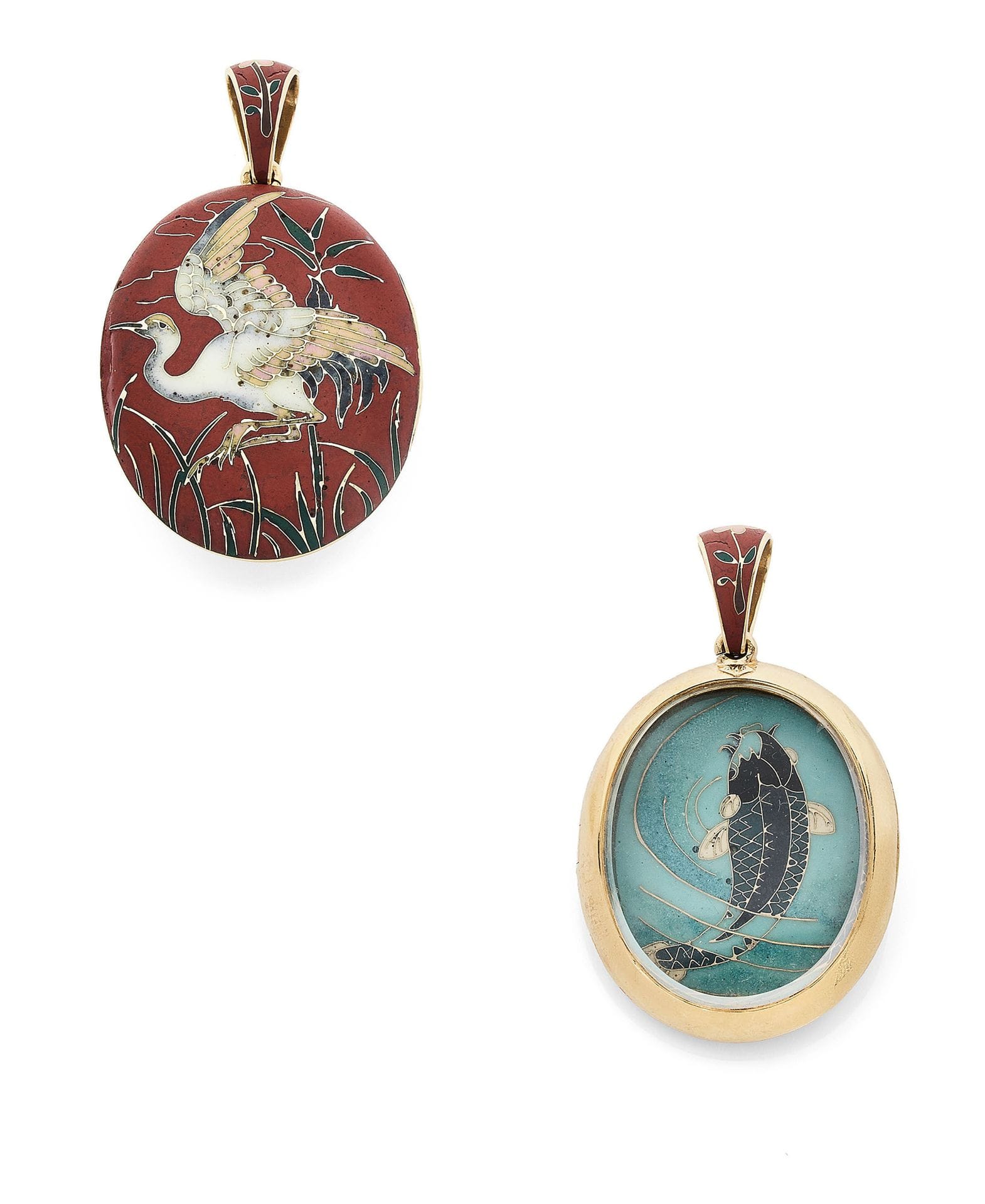
Alexis FALIZE (1811-1898) Yellow gold (750) pendant medallion with a heron on the cover, swimming among bamboos on a red background, and inside, a carp swimming on a turquoise blue background. The clasp decorated with flowers on a red background. The glass in rock crystal, the bezel in yellow gold (750) plain. Hallmark of master under the hoop. Around 1870. Gross weight : 25,3 g. - Size : 5,3 x 3,1 cm. Chips and missing enamels under the heron's tray, small chips on the glass, bubbles from firing. Naturalist japanese decoration inspired by Japanese prints, and most probably made by Antoine Tard with whom Alexis Falize worked for ten years for the cloisonné, from his watercolors. Emile Zola wrote "the influence of Japonism is what we needed to free us from the tradition of black and show us the shimmering beauty of nature". (Cf. Siegfried Wichman, Japonisme: the japanese influence on Western Arts since 1858, Thames and Hudson, London, 1999). Founded in Paris by Alexis Falize (1811-1898) in 1838, the Falize dynasty lasted three generations and established itself as a leading house in the renewal of French jewelry art. Alexis Falize collaborated with the enameler Antoine Tard during his career. Tard was a renowned enameler in the use of the cloisonné technique. He used a gold wire to form the cells of the design, into which the powdered enamel was placed. Apparently, Antoine Tard was particularly adept at controlling the effect of the firing and the depth of the final polish. This jewelry proved to be extremely popular. Reproducing Japanese motifs adapted by Falize from engravings by Hokusai and other Japanese artists, they reflect the interest in Oriental art aroused by the resumption of trade with Japan in the late 1850s. Philippe Burty's book, "Les émaux cloisonnés anciens et modernes", published by the jeweler Martz, is illustrated with chromolithographs by M. Régamey père from his collections. It shows a range of objects that could be made by Falize et Tard, including the medallion that we are proposing today. The heron can be found on another plate, this time on a blue background.
Estimate
€6,000 - €8,000
Result
€12,500
Buyer's premium
25%
Alexis FALIZE (1811-1898)
Yellow gold (750) pendant medallion with a heron on the cover, swimming among bamboos on a red background, and inside, a carp swimming on a turquoise blue background.
The clasp decorated with flowers on a red background.
The glass in rock crystal, the bezel in yellow gold (750) plain.
Hallmark of master under the hoop.
Around 1870.
Gross weight : 25,3 g. - Size : 5,3 x 3,1 cm.
Chips and missing enamels under the heron's tray, small chips on the glass, bubbles from firing.
Naturalist japanese decoration inspired by Japanese prints, and most probably made by Antoine Tard with whom Alexis Falize worked for ten years for the cloisonné, from his watercolors.
Emile Zola wrote "the influence of Japonism is what we needed to free us from the tradition of black and show us the shimmering beauty of nature". (Cf. Siegfried Wichman, Japonisme: the japanese influence on Western Arts since 1858, Thames and Hudson, London, 1999).
Founded in Paris by Alexis Falize (1811-1898) in 1838, the Falize dynasty lasted three generations and established itself as a leading house in the renewal of French jewelry art.
Alexis Falize collaborated with the enameler Antoine Tard during his career. Tard was a renowned enameler in the use of the cloisonné technique. He used a gold wire to form the cells of the design, into which the powdered enamel was placed. Apparently, Antoine Tard was particularly adept at controlling the effect of the firing and the depth of the final polish.
This jewelry proved to be extremely popular. Reproducing Japanese motifs adapted by Falize from engravings by Hokusai and other Japanese artists, they reflect the interest in Oriental art aroused by the resumption of trade with Japan in the late 1850s.
Philippe Burty's book, "Les émaux cloisonnés anciens et modernes", published by the jeweler Martz, is illustrated with chromolithographs by M. Régamey père from his collections. It shows a range of objects that could be made by Falize et Tard, including the medallion that we are proposing today. The heron can be found on another plate, this time on a blue background.
Sale
Friday 7 April 2023・14:00 (Europe/Paris)
Salle 3 - Hôtel Drouot
9, rue Drouot
75009 Paris