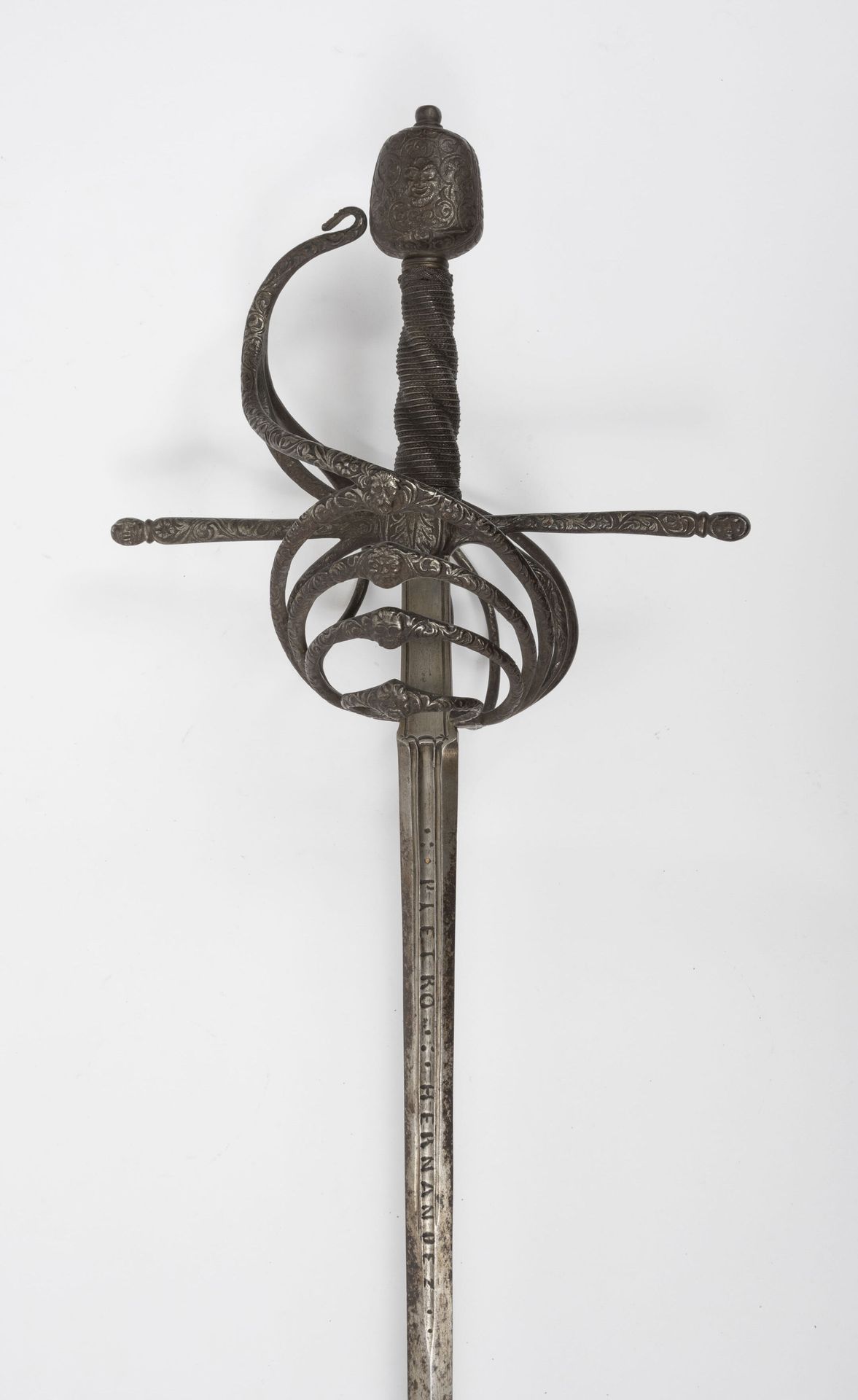
Iron rapier. Guard in cage with many branches meeting in chiselled hook, with cruise with central shield, with two long quillons engraved with foliage ending in olives; the whole punctuated with masks of characters. Important pommel with masks on a background of scrolls. Twisted spindle in filigree. Long straight blade with two cutting edges, with central edge, finished by three gutters towards the heel, marked "PIETRO HERNANDEZ". Work of the second half of the 19th century in the style of Italian swords of the 17th century. Possible reassembly from an older blade. Blade length : 111.5 cm - Total length : 129 cm. Without scabbard. Oxidations and some stains. A dynasty of Spanish forgers, active between the second half of the 16th century and the first half of the 17th century, bears this name. Several Pedro's are known, depending on the source, to have worked either at the end of the 16th century or between 1610 and 1630 in Toledo. The Italianization of this first name into Pietro would be due to the fact that the Spanish blades, of good quality, were imported into Italy to be assembled there.
Estimate
€500 - €600
Result
€3,200
Buyer's premium
25%
Iron rapier.
Guard in cage with many branches meeting in chiselled hook, with cruise with central shield, with two long quillons engraved with foliage ending in olives; the whole punctuated with masks of characters. Important pommel with masks on a background of scrolls. Twisted spindle in filigree.
Long straight blade with two cutting edges, with central edge, finished by three gutters towards the heel, marked "PIETRO HERNANDEZ".
Work of the second half of the 19th century in the style of Italian swords of the 17th century.
Possible reassembly from an older blade.
Blade length : 111.5 cm - Total length : 129 cm.
Without scabbard.
Oxidations and some stains.
A dynasty of Spanish forgers, active between the second half of the 16th century and the first half of the 17th century, bears this name.
Several Pedro's are known, depending on the source, to have worked either at the end of the 16th century or between 1610 and 1630 in Toledo.
The Italianization of this first name into Pietro would be due to the fact that the Spanish blades, of good quality, were imported into Italy to be assembled there.
Sale
Wednesday 8 February 2023・14:00 (Europe/Paris)
Salle 11 - Hôtel Drouot
9, rue Drouot
75009 Paris