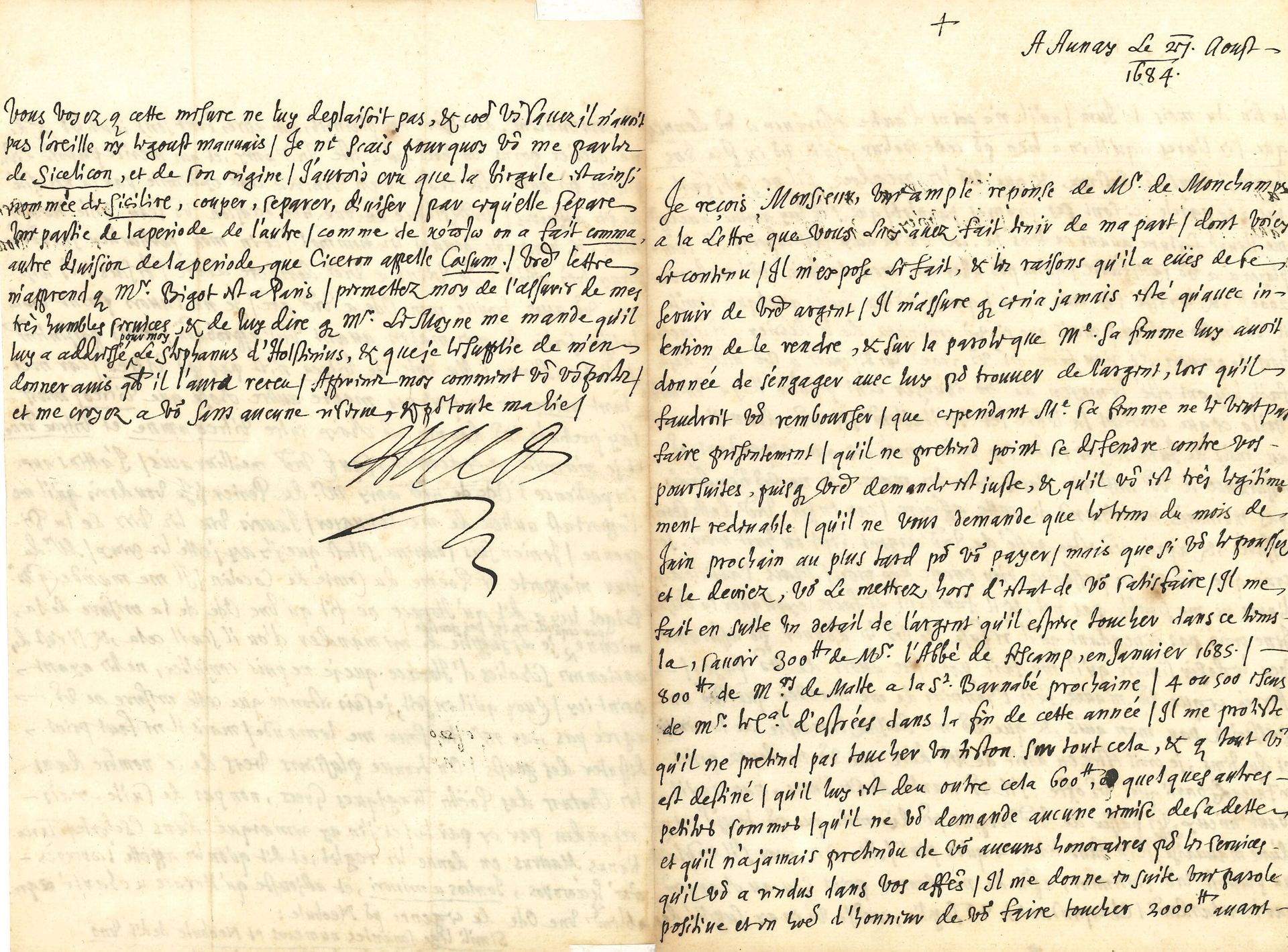
HUET Pierre-Daniel (1630-1721) prelate, scholar and writer, friend and collaborator of Mme de Lafayette; subpreceptor of the Dauphin and bishop of Avranches. L.A.S. "Huet", Aunay August 27, 1684; 3 1/2 pages in-8 (beautiful engraved portrait after Largillière enclosed). Beautiful literary letter. M. de Monchamps undertakes to pay back 2000 livres at the end of next June, as he will in the meantime receive sums from the abbot of Fécamp, from Messieurs de Malte and from the cardinal d'Estrées: "he does not pretend to touch a teston on all that, & that all is intended for you", under penalty of giving up his books Huet encourages to accept this offer, subject to some explanations on "the article of books", then passes to the literary affairs: a distinction between two Latin lessons, his impatience to receive the ode of M. du Périer, the verses of the Pigeonne. "Mr. Du Four brings me the poem of the Count of Cocolin. He tells me that Mr. Bigot told him that Horace only wrote an ode the size of mine because it was not gousted; I beg him to tell me where he knows this, and if it is from Horace's old scholies that I cannot consult, not having them here. And to refer to the Greek tragic poets, to Aeschylus and Terentianus Maurus, who "adds that Horace changed agreeably an ode of this kind to Neobule: Simili lege sonantes numeros et Neobule dedit uno/ Modulatus lepide carmine Flaccus. You see that this measure did not displease him, & as you know he did not have a bad ear or taste. I do not know why you speak to me of Sicelicon, and of its origin. I would have thought that the comma is so named from sicilire, to cut, to separate, to divide, because it separates one part of the period from the other" Etc. Attached is an LA.S. as bishop of Avranches, Caen November 6, 1694 (3 p. in-4). On a case of a debauched priest, accused of sorcery.
Estimate
€400 - €500
Result
€230
Buyer's premium
30%
HUET Pierre-Daniel (1630-1721) prelate, scholar and writer, friend and collaborator of Mme de Lafayette; subpreceptor of the Dauphin and bishop of Avranches.
L.A.S. "Huet", Aunay August 27, 1684; 3 1/2 pages in-8 (beautiful engraved portrait after Largillière enclosed).
Beautiful literary letter.
M. de Monchamps undertakes to pay back 2000 livres at the end of next June, as he will in the meantime receive sums from the abbot of Fécamp, from Messieurs de Malte and from the cardinal d'Estrées: "he does not pretend to touch a teston on all that, & that all is intended for you", under penalty of giving up his books Huet encourages to accept this offer, subject to some explanations on "the article of books", then passes to the literary affairs: a distinction between two Latin lessons, his impatience to receive the ode of M. du Périer, the verses of the Pigeonne. "Mr. Du Four brings me the poem of the Count of Cocolin. He tells me that Mr. Bigot told him that Horace only wrote an ode the size of mine because it was not gousted; I beg him to tell me where he knows this, and if it is from Horace's old scholies that I cannot consult, not having them here. And to refer to the Greek tragic poets, to Aeschylus and Terentianus Maurus, who "adds that Horace changed agreeably an ode of this kind to Neobule: Simili lege sonantes numeros et Neobule dedit uno/ Modulatus lepide carmine Flaccus. You see that this measure did not displease him, & as you know he did not have a bad ear or taste. I do not know why you speak to me of Sicelicon, and of its origin. I would have thought that the comma is so named from sicilire, to cut, to separate, to divide, because it separates one part of the period from the other" Etc.
Attached is an LA.S. as bishop of Avranches, Caen November 6, 1694 (3 p. in-4). On a case of a debauched priest, accused of sorcery.
Sale
Thursday 24 November 2022・20:00 (Europe/Paris)
Sale location coming soon
7 rue Drouot
75009 Paris