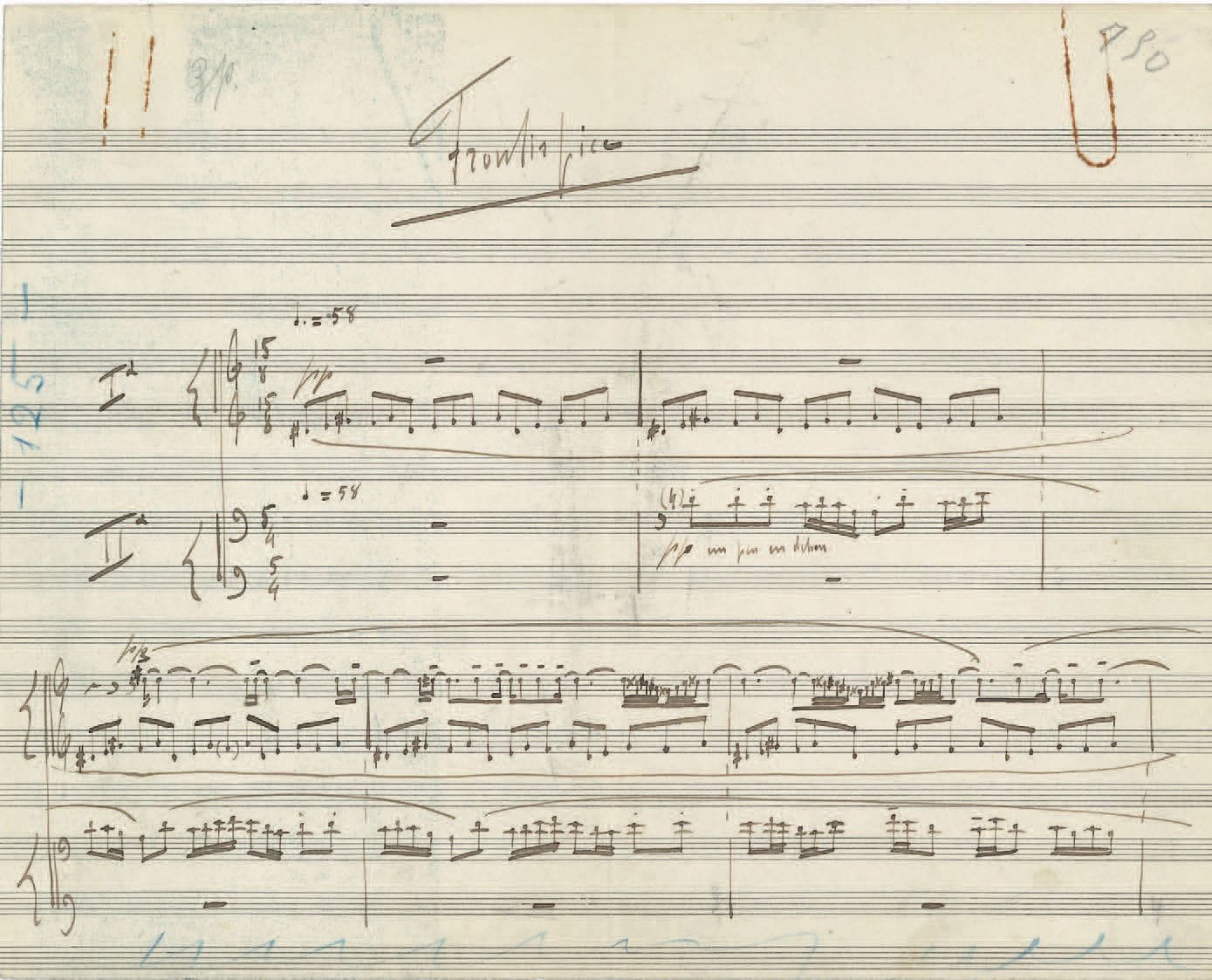
RAVEL Maurice (1875-1937). autograph musical manuscript signed "Maurice Ravel", Frontispice, June 1918; 3 oblong pages in-4 (18.5 x 23.2 cm, slight traces of rust on first leaf). Beautiful manuscript of the brief Frontispice. Frontispice is the shortest work by Ravel: it has 15 bars. Written for two pianos and five hands, the manuscript was used for clichage and facsimile reproduction in 1919 in Les Feuillets d'art, No. 2; then Frontispice orna S.P. 503: the poem of the Vardar by Ricciotto CANUDO (1879-1923), illustrated with a portrait of the author by Picasso and published in a limited edition at the Renaissance du Livre, the year of the poet's death. [A playwright and contributor to the Mercure musical, this Italian, who had settled in Paris in 1901, founded the Club des Amis du Septième Art, whose members included Ravel, Honegger and Roland-Manuel. He joined the Foreign Legion, was decorated by France and Italy, and is considered to have died for France]. Frontispice may have been conceived for the pianola (see R. Lawson, The Pianola Journal, No. 9, 1989.) Another autograph manuscript is known to be in a private collection in New York: written on a single page, it is dated Saint-Cloud, June 1918. Marcel Marnat describes excellently Frontispice: "Less than two minutes resolutely polytonal with three independent melodic lines superimposed on one another, soon mocked by the intervention of the inclining chords introduced by the fifth hand. The bass alone remains stable, eerily repeating the same note. The language here is as new as possible, astonishingly free of all the rest of Ravel's creation" (Maurice Ravel, Fayard, 1986, p. 438).
Estimate
€10,000 - €15,000
Result
€8,500
Buyer's premium
30%
RAVEL Maurice (1875-1937).
autograph musical manuscript signed "Maurice Ravel", Frontispice, June 1918; 3 oblong pages in-4 (18.5 x 23.2 cm, slight traces of rust on first leaf).
Beautiful manuscript of the brief Frontispice.
Frontispice is the shortest work by
Ravel: it has 15 bars.
Written for two pianos and five hands, the manuscript was used for clichage and facsimile reproduction in 1919 in
Les Feuillets d'art, No. 2; then Frontispice orna
S.P. 503: the poem of the Vardar by Ricciotto
CANUDO (1879-1923), illustrated with a portrait of the author by Picasso and published in a limited edition at the Renaissance du Livre, the year of the poet's death. [A playwright and contributor to the Mercure musical, this Italian, who had settled in Paris in 1901, founded the Club des Amis du Septième Art, whose members included Ravel, Honegger and
Roland-Manuel. He joined the Foreign Legion, was decorated by France and Italy, and is considered to have died for France].
Frontispice may have been conceived for the pianola (see R. Lawson, The Pianola Journal, No. 9, 1989.) Another autograph manuscript is known to be in a private collection in New York: written on a single page, it is dated Saint-Cloud, June 1918.
Marcel Marnat describes excellently
Frontispice: "Less than two minutes resolutely polytonal with three independent melodic lines superimposed on one another, soon mocked by the intervention of the inclining chords introduced by the fifth hand. The bass alone remains stable, eerily repeating the same note. The language here is as new as possible, astonishingly free of all the rest of Ravel's creation" (Maurice Ravel, Fayard, 1986, p. 438).
Sale
Tuesday 21 December 2021・14:00 (Europe/Paris)
Salle 4 - Hôtel Drouot
9, rue Drouot
75009 Paris